



October 5, 2026
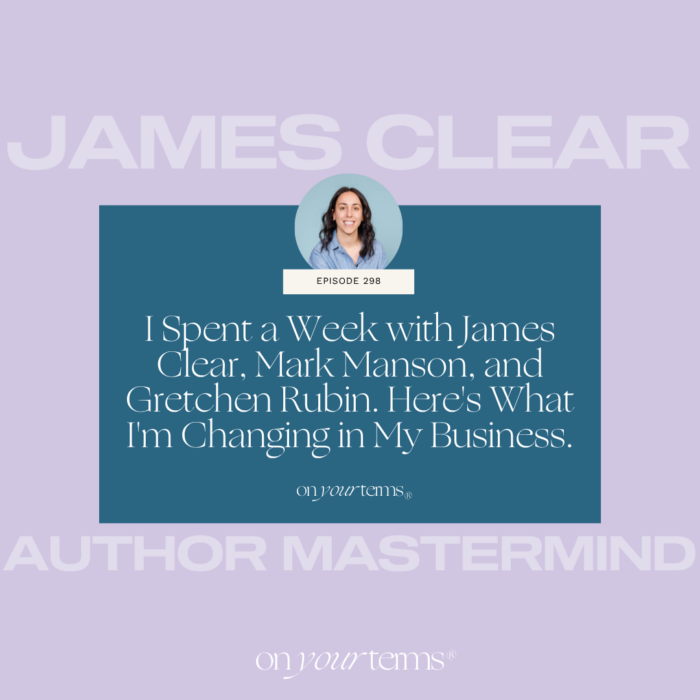
I Spent a Week with James Clear, Mark Manson, and Gretchen Rubin. Here’s What I’m Changing in My Business.
Listen on Apple | Spotify | YouTube
Listen Now:
I’ve been in a lot of rooms over the last 10 years. Cafes in Philly where three people showed up. Webinars where 60 people signed up. Conferences where everybody walked in peacocking. But I’ve never been in a room quite like this one.
A few weeks ago, my director of ops, Lindsey, texted me: “Oh my God, have you looked at your email?” (I don’t keep email on my phone anymore, so no, I had not.) It was an invite from Nathan Barry, founder of Kit, and James Clear, yes, Atomic Habits James Clear, asking if I’d like to join their author mastermind in New York City. Would I LIKE to come? I’d cancel everything. I’m already there.
So I spent three days at Kit Studios in Midtown Manhattan with about 10 authors, including Mark Manson and Gretchen Rubin, people who have sold tens of millions of books and built businesses that make tens of millions of dollars a year. And then there was me, thinking, “How did I get here?”
In this episode, I’m taking you into that room with me. I’m sharing the best tactical tips I picked up from people playing a much bigger game (quizzes, Instagram Stories, webinars, reviews, and the one thing about Instagram almost everybody agreed on), plus the part I didn’t expect: what it actually feels like to be the smallest one in the room, and why that turned out to be such a gift. I even ran out into the hallway and grabbed two friends, Dan Go and Steve Kamb, to share their takeaways too.
If you’ve ever looked at someone way ahead of you and thought, “They must know something I don’t,” this one’s for you.
Save your seat for the FREE last live legal workshop of 2026, How to Start an Online Business Legally Before 2026 Ends (Replay included!)
In this episode, you’ll hear…
- How a decade of tiny, unglamorous decisions landed me at a mastermind with James Clear, Mark Manson, and Gretchen Rubin
- The two-slide Instagram Stories trick a multi-million-follower creator uses to send her engagement through the roof
- What makes a quiz lead magnet actually work, and why treating your results page like a “hostage situation” is costing you subscribers
- A genius (and totally free) way to turn nice DMs and emails into public reviews and testimonials
- Why some of the most successful people in the room treat Instagram as a nurture tool, not a discovery platform
- When newsletter sponsorships finally make sense, plus a 10-minute webinar hack I’m stealing immediately
- What it’s really like to be the smallest one in the room, and why you won’t feel like you belong before you’re invited in
- Hallway chats with health coach Dan Go and Nerd Fitness founder Steve Kamb about fighting for your own art and doing things your way
Listen to On Your Terms® on your favorite podcast platform
Listen to episode 298 follow along so you never miss an episode, and leave a review to help introduce the show to more online business owners just like you!
The Low and Slow Road to a Seat at This Table
I want to be upfront: I didn’t pay to attend this mastermind, and nobody else did either. It was invite-only. I also didn’t hit the New York Times bestseller list or have some overnight viral moment that got me there. When I zoom out, I can see thousands of micro decisions over the last 10 years that led to that couch at Kit Studios. Speaking in a cafe. Tiny webinars. Rooms where I was always the smallest person, until those rooms just kept getting bigger. If you’re in the thick of that right now, you might be closer than you think.
Ask for Advice, Then Make Your Ask
One of the most tactical tips I heard came from someone with millions of Instagram followers who runs her own account. She starts her Stories by asking her followers for advice on something low-stakes but weirdly divisive, like “Do you put your sneakers in the washer?” or “Are you a checked bag or carry-on person?” People LOVE to weigh in, and all those replies tell Instagram the story is worth showing to more people. Then the genius part: slide two is the thing she actually wants you to see, whether that’s her book, her newsletter, or a new post.
Quizzes That People Actually Want to Opt In For
I got a masterclass from someone who has grown millions of subscribers with quizzes. Her rules? The quiz has to promise that people will learn something interesting about themselves. The results need distinct buckets (nobody wants to be “an A, B, C with a D minor”). Sometimes flipping the question works better, like asking which trait is your worst instead of your best. And at the end, offer the results as a valuable report you’d love to send them, instead of holding their answers hostage until they hand over their email.
Package the Praise for Them
This one I’m taking straight to my team. Anytime someone DMs you, emails you, or carrier pigeons you something nice about your book, podcast, or product, thank them, then pull out the exact sentence or two that would make a great review. Put it in quotes and say, “This would make such a great review. Would you mind copying and pasting it here?” with a link to Amazon, Google, Goodreads, wherever. We’ve always saved testimonials internally, but making it stupid easy for people to share them publicly? Game changer.
What It’s Really Like to Be the Smallest One in the Room
I’ll be honest: it was strangely freeing. My business hangs with a lot of the businesses in that room, and people I was starstruck by were asking me about email marketing and funnels. But as an author? I wasn’t trying to prove anything. That let me just be a sponge again, which I realized I hadn’t done in a long time. At some point you outgrow rooms, and nobody tells you what happens next. These doors don’t just open on their own.
Transcript:
Sam Vander Wielen: I can’t believe what I just got to do. For the last few days, I sat around a table with people who have sold tens and tens of millions of copies of their own books, and people who have businesses that make tens of millions of dollars a year.
So many of them, most of them actually, are New York Times bestselling authors, people you know the names of, people whose books you probably have on your shelves, and people whose courses you’ve bought in the past.
There was even a guy who self-published his book, sold over a million copies himself, and then, and only then, got a traditional book deal
There were even people that you’ve seen on morning TV this week. And then there was me sitting there thinking, “How did I get here? Why am I in this room? Like, I know I’m an author, but not this kind of author.”
I got invited to go to James Clear and Nathan Barry’s author Mastermind. Yes, like Atomic Habits James Clear, and yes, Nathan Barry, like the founder of Kit. And it all started with an email that I had to read about three times before I believed it, and only found out about because I got a text from my director of ops, Lindsey, saying, “Oh my God, have you looked at your email?”
So today I’m taking you into that room with me. I’ll share the best tactical tips I picked up from people playing a much bigger game, including the one thing about Instagram that almost everybody agreed upon. And I’ll also share a lot about the part that I didn’t expect, like what it actually feels like to be the smallest one in a room like that, and what you take away when you just get to be in the presence of people who have done such incredible things with their writing and their businesses.
If you’ve ever looked at someone way ahead of you and thought, “They must know something I don’t,” or, “I could never be them,” or, “I wonder what it would be like,” Or how would that ever even be possible for me?” Then this one is for you
So get comfortable, get cozy, grab a little something, pop in your headphones and take a walk, ’cause you’re about to head to a mastermind in New York City with me, James Clear, and a bunch of people who have sold a crap ton of books.
Oh, and before we get started today talking about this mastermind this week, which I just cannot wait to tell you about, I have to tell you that I actually have my last live legal class of the entire year coming up on Monday, October 19th.
You know, on the one hand, it’s never been easier to start an online business than ever, but it’s also never been crazier. And I’ve been doing this now for over 10 years, so I think it says a lot that I feel that about 2026.
We’ve got everything from AI cloning people to look like people in ads who never actually did it, all the way down to the very unfortunate trend of ADA lawsuits, people suing you for your website not being accessible and I feel like we have a whole new host of privacy issues thanks to all the apps and features that have rolled out this year.
And that’s why in my free live legal workshop, How to Start an Online Business Legally Before 2026 Ends, I’ll be talking all about these current legal issues and teach you how to start a business online the right way. I’m hosting it for the final time this year on October 19th and in it, I’m gonna talk about all these legal changes and what you have to do to start your online business the right way Or protect the one you already have.
I just actually opened up registration today and seats go so quickly. So click the link in the description to sign up now or head to samvanderwielen.com and click that hello bar at the top of the screen. You’re gonna wanna save your free seat to my last live legal workshop of the entire year before it fills.
If you can’t make it live, sign up and I’ll send you the replay. It’s the only way to get the replay, and I’ll even send you an audio version just like this so you can listen to it on the go.
Click the link in the description to sign up now. I hope to see you at my last live legal class of the year.
Okay, so let’s set the stage about why I was even at this mastermind in the first place. Well, I mean, at least logistically, I got an email from Nathan and James inviting me to come to this mastermind. I think I should say upfront, by the way, that I did not pay to go to this mastermind. I was not asked to pay to go to this mastermind.
Nobody did. It was an invite mastermind. I just think that’s important because sometimes people talk about these things or they get, like, published on, you know, Entrepreneur Magazine or something like this, and they… it’s actually that they paid for it, but then they try to act like they didn’t. So I thought that was important to say upfront.
But yeah, I got this email, and like I said at the top of the episode, it was kind of funny. I was in Colorado Springs for my mastermind, and I got a text from Lindsey being like, “Oh my gosh, have you looked at your email?” And I actually don’t keep email on my phone anymore, so I did not see the email. And then she sent me a screenshot of it, and I was freaking out.
I was like, “Are you sure that this is for me? Did they mean to send this to me?” But it was so funny because Nathan and James were asking, like, “Hey, this is what we’re hosting in New York City at the end of September, would you like to come?” And I was just like, um, “There’s a question? Like, would I like to come?
Are you kidding? I would cancel everything. Like, I’ll be there. I’m already there.
In terms of like, I think the longer story of like why I was here, why I was in this room, I’ve spent a lot of time reflecting on this this week and in the past couple of months knowing that I was coming here.
It’s the same way actually I felt when I got to speak at Kit’s Craft and Commerce conference and give a keynote, um, and teach a workshop. It was like… It, it was just one of those moments in my now over 10 years of running an online business where you, you see… Like, if I could hover and zoom out, I see all these little like micro decisions and micro actions that I’ve taken that led to this moment of being here. It wasn’t any one thing. I didn’t make the New York Times bestsellers list.
I’ve sold, uh, thousands and thousands and thousands of copies of my book, which is incredible to do as a first-time author with like, you know, we have a tiny but mighty little team and, you know, very little outside support, and we did that. Like, we did that. That’s amazing. And so I can just see now how, like, these thousands of decisions and little actions and all these times over the last 10 years when I’ve felt like I was the smallest person in the room, but those rooms just kept getting bigger. Like, I see how every one of those actions led to me being here this week, to me speaking on stage, to me getting a book deal, like all of the things.
So all that to say, I think just to set the tone for this episode and to set aside any stories that we all might have is, like, my story is one of a lot of long-term hard work.
And, like, the, the come up has been very, very low and slow. It hasn’t been, like, a, I got invited to these rooms, or I got invited to speak, and then everything worked out. It’s like you should see all the little things. Speaking in a cafe, um, you know, starting in Philly with, like, three or four people showing up.
Um, doing webinars where only 60 people signed up. And, you know, things just kind of stack up and build over time, and you just don’t know when you’re in it. So, like, maybe you’re listening to this episode and you’re in it right now. Like, you’re doing it, and one day you’re gonna be in a seat like this, right?
So it’s kind of… I don’t know. It’s kind of wild. It’s been a lot, uh, for me to process, honestly.
In terms of the type of people who were here, um, or the people who were here in general, so everybody who was invited is either, uh, an author or is about to be an author.
I don’t believe there’s anybody, uh, who was at this mastermind who hasn’t already published a book or has one coming out very, very soon. Most people actually had written many books, um, and only a couple of us had either only done one or are about to have their first come out Obviously James Clear was here because he was running it alongside Nathan.
Mark Manson was here, which was, like, just such a, a, like, cool moment for me because, uh, Mark Manson, who’s the author of The Subtle Art of Not Giving a Fuck, uh, and, and many other things, and is a prolific, like, YouTuber and social media personality and everything else, is just like… He was just so cool to meet in person.
Gretchen Rubin was here, uh, obviously the author of The Happiness Project, Four Tendencies, so many different books, and has an incredible podcast. And I, I, I got to actually tell Gretchen that she was such a big part of my story of leaving the law and starting my own business when I read The Happiness Project, and I distinctively remember being on a plane and reading The Happiness Project on the plane and just being like, “I’ve gotta get out of here.
I have to change my life. Like, I can’t do this anymore.” So getting to be in a mastermind with Gretchen Rubin where we were, like, talking sequences and email marketing and, uh, getting to tell her about this, like, and then the impact she’s had on my life was, like, very crazy.
I could go on. There were like 10 of us here at this mastermind. Um, but the other thing is that I should set the, set the tone is that we actually agreed to the Chatham House rules when we started, um, this mastermind this week, and we agreed not to share any attribution to anybody.
So I’ve mentioned a couple of people who were here, but in general, throughout this episode, I’m not gonna be telling you like, “James Clear told us to do X, Y, and Z,” because we actually agreed not to do that.
But yes, there were people here who have sold tens and tens of millions of copies of books. I think James Clear is well over 30 million copies of Atomic Habits at this point. And even more interesting to me is, like, there were several people who have sold a ton of books, but also have really cool businesses.
There are people selling courses, memberships, coaching, physical products, digital products. Like, people have built out worlds outside of their books. People have built a lot of communities. Um, the number of people who were here who talked about how many people have gotten tattoos of something related to their product or their logo or a saying that they’re associated with, that was so mind-blowing.
Like, obviously these are people who have had real and, and big impact on the world.
There was someone here who was on GMA one of the mornings, uh, that we, we were having our mastermind. She’s gonna be on Kelly and Mark next week. Um, so people are, are really doing incredible things.
So here’s overall how the mastermind was structured. Day one, we just arrived here in New York City, um, and at Kit Studios, which if you don’t know already, Kit has three studios that are available with these incredible rooms where you can go and you can podcast, you can record videos, do YouTube videos, um, you can collaborate. They’re, they have multi-angle cameras, professional lighting, professional audio. It’s like a plug-and-play system for Kit customers, um, to come and record their content.
It’s unbelievable. And if you’re on a certain plan like what I am with Kit, this is all included for free. So I’m recording this podcast episode today in a very professional-looking studio, and it just is included for free. So they hosted, um, this mastermind at their new studios, um, right in Midtown Manhattan.
And so on that first day, we arrived here, had a happy hour here at Kit Studios, and had a dinner that was catered.
Um, it was so good. I had… In case you’re wondering, I had some black rice. I had roasted chicken. I had a bunch of vegetables. Um, this beautiful baby gem salad that had the most incredible, like, shallot garlic vinaigrette. It was so good., And I believe that’s it, because the dessert was these, like, little mini cakes, and I couldn’t eat it ’cause I’m not eating gluten.
So, um, yeah, dinner was great, but we had it here at Kit Studios. And that was so great because everybody… I think a lot of us were nervous. Well, especially those of us who were here that were more in, like, my position. Uh, like, not the James Clears of the world. And so we were… You know, I was nervous and just had a lot of, like, impostor syndrome and was wondering kinda how it was gonna go and how it would feel, and it just instantly melted away when I got to meet everybody.
We went around the table and we introduced ourselves, um, but we also shared, like, what we’re working on right now and what we’re very excited about, like, what’s coming. So I thought that that was just, like, a great icebreaker, and it was, it was… You know, you think you know somebody from what you see online or kinda what you can see in their bio, but to hear people describe their work and what they’re really actually passionate about and what’s coming up for them next, that was really cool.
Day two was our full day.
It was a big day, so it started out early here at Kit Studios with breakfast, at the studio. And then we went around, um, they have this gigantic, like, cool couch/living room situation, and we all sat on it together and shared one thing that’s working right now in general. So, like, some people, it was, like, sharing one thing that’s working really well with marketing their book.
Some people, it was sharing about writing or creativity and, um, how that’s going for them. Other people, it was, like, tactical strategy, like social media, and don’t worry, I’m about to share those things with you. But people went much deeper and, like, longer in a good way in terms of sharing, like, just very open, open sharing of, of sharing what’s going on in their businesses, what’s happening with their book deals, um, what’s happening in their writing process.
And so I was just trying to soak it up like a little sponge.
The Kit team did a matcha run to Cha Cha Matcha, so shout-out to Kit team. Chelsea and Daniel, and maybe even Hailey, I think, went over and got us all matchas. I got an iced matcha. Uh, this is the… These are the details that you need, obviously.
Um, but I got an iced matcha with almond milk and strawberry, so good. It was perfect. Um, so that was very sweet of them, and they also got us lunch, um, so everybody had a little bit of a break. We had bowls together and, um, Nathan, the founder of Kit, gave us a presentation on a new Kit feature that’s going to be available to, I think, everybody by the time you’re hearing this episode.
I’ve had access for many months now ’cause we’ve been, uh, testing it out and giving feedback for them, but it’s a new Kit feature called Signals, uh, where you can actually go onto this platform and see all the people who are on your email list and, like, get to know them more.
Like, you can search by, like, author or, like, podcaster or coach or fitness or whatever, and it’ll pull people up on your list based on a bunch of demographic information that Kit has available on the backend. Obviously, beyond my pay grade. I don’t understand. It also links to those peoples’ social profiles and, and their email and all that kind of stuff, so you can, like, see, like, whoa, there’s somebody on your email list who has 100,000 subscribers, and then you can reach out to that person.
Um, so that’s really cool. So he did a little demo for us of that, and then after lunch, we did hot seats. So, um, they asked who wanted to do hot seats. Obviously, I was like, “I’m here. I’ll take advantage of this. Um, I have a lot to ask about.” I asked about pivoting and audience building when you sell one thing but you also wanna talk about something else.
So, like, obviously, I sell legal templates. I help people start online businesses legally, but more and more these days, I wanna write about building a life you love offline. Um, and so that’s what I’ve been doing on my Substack a lot.
I talk about it on my main email list, but, like- It’s something that, I don’t know, I guess in my mind I’ve been overcomplicating and thinking it’s much more separate.
Um, so I brought that to the group. Another person asked about positioning, so I’m, I’m learning as a hopefully second-time author in the future, um, that so much of a book’s success actually has to do with the positioning that you do upfront, which is like, what is this book about? Who is it for? Where does it fit in the marketplace?
What’s fresh about it? What’s like… what’s different? What’s unique? How are we gonna position this, right, in terms of a marketing strategy? Whereas, like, with my first book, I just kinda was like, “This is what I wanna write about. Here’s the book. Okay, now let’s, like, go figure out how to market it.” I’m realizing now, and I have basically for, like, the last year, that you’re like, oh, it’s actually so much more upfront work.
So a lot of people asked about more of the positioning, what’s working, especially for, like, James and what he sees both as an individual author with Atomic Habits, but also as one of the founders of Author’s Equity, his publishing company, of, like, what’s working in ads and what’s moving books and, like, what does he feel about AI and what’s coming and all that kind of stuff.
We then wrapped up, um, the day with a Q&A with James. People were just obviously picking his brain as much as they could. Um, he’s extremely generous, and just somebody who I feel like for the amount of success that he’s had is just someone you can ask a lot of questions and, and is very gracious and generous with his time and, and his knowledge obviously, and, like, all of his experience.
So, um, people were rightfully picking his brain. And we finished up the night by heading to dinner at Lucky’s in Soho. Again, because I know these are the details that matter, um, I had Caesar salad to start. And then I had the chicken, which came with a bunch of roasted vegetables on the side. And they put out all these sides on the table, so I also had broccolini.
And me and my friend Steve Kamb, who I might bring on for a little guest spot,… Uh, we, we ate too many fries ’cause the fries were really, really good and, like, perfectly salted. Like, didn’t have, like, too much salt, but also weren’t under-salted. It was just… It was perfect. So if you’re in New York, go to Lucky’s.
Last but not least, we had our third day, which I think was such a cool thing. Like, I’ve never seen a mastermind do this, where they had, uh, a content day. So the third day of this was, um… Since we’re at Kit Studios, they’re like, “Hey, you guys, take advantage of this space. Collaborate, get together, talk to each other on camera, record, do what you need to do.”
I mean, I was here, so I’m like, while it’s fresh, I wanna record this episode. Mark Manson’s in the room next to me recording ad content. Nathan is interviewing Joseph, um, the, the author of Don’t Believe Everything You Think, uh, two rooms down. So it’s really cool.
There’s, like, all this cool… I wish I, like, had this in my backyard because there’s just a lot of cool creative energy here right now.
Okay, now the rest of this episode is gonna be broken into two parts. First, I’m gonna share with you the best tips that I learned from the group, obviously not attributing them to any one person in particular, but the best tips I learned, and then I’m gonna share my own takeaways, the truth about what it’s like to be in these rooms, the ahas and realizations I have from having conversations with people like this and being in these rooms and then at the end, we’ll wrap it all up with a beautiful little bow. So let’s hop into the best tips I learned from everybody else.
Okay, the first one is, like, the most tactical, and I just thought that this was so smart. Someone shared that on Instagram, and I’m talking about somebody who has many, many millions of followers, is very successful, very prolific at running their own social media account. They’re not having anybody do it for them.
They start their Instagram stories asking their followers for advice on something because it gets them involved in the process. She was sharing about how people love to be, like, the one that’s helping. Everybody loves to be, like, the bubby. That’s what I kept thinking about. It was like, give them the chance to be the bubby, right?
So everybody wants to give you their, their thoughts and opinions on something. And at first I thought she was saying this about, like, her business or, like, the content of what she does, and she’s like, “No, I just make it, like, stupid life stuff,” right? Like, fun things that everybody just, like… I don’t know.
There’s, like, a debate over it, but you wanna give your input. So one of the examples that she gave was, “Does anybody here ever put their sneakers in the washer, or is it just gonna ruin them?” Right? So ’cause it’s like people have strong opinions of, like, “Don’t put your shoes in the wash,” or, like, “Yeah, it’s fine.
It’s gonna be fine.” The other one she gave was, like, do you always check luggage, or do you always carry on? Like, are you, like, a hardcore one way or the other? Because people who feel one way or the other have, like, very strong opinions about it.
The point of this wasn’t really even what everybody says, but she was saying just that it gets everybody so involved, and on a more practical, tactical level here, it really, really boosts the engagement when you get that much, you know, if you get that many replies to your stories, you get people clicking on it, typing in and replying, or, like, hitting the little box and filling in something.
It basically sends Instagram a signal like, “Hey, this is a good story. It’s taking off. Show it to other people,” and it skyrockets. But then what is brilliant is what she does next. So essentially, that first slide will ask somebody maybe the question that’s, like, a little spicy, stirs the debate, and then the second slide is actually the thing that she wants people to see and that she wants people to click on.
So if that’s maybe a link to her book or someone to sign up for her newsletter or to find out about her new Substack post or to go watch her new reel and comment on something, whatever it is that she wants them to do is whatever’s in that second slide.
The next thing I learned so much about was quizzes. So there was a lot of talk on quizzes as a lead magnet, as a freebie, a way of attracting an audience, but also getting people to then get onto your email list.
A person who was here who is just prolific with quizzes and has gotten millions of subscribers because of quizzes, um, was sharing about how quizzes, in order for them to be successful, the person that is taking the quiz has to learn something interesting about themselves.
The quiz has to propose that they, by taking this, are going to learn something interesting about themselves. And she also shared that you must have very distinct answers, like categories or buckets. So she was, like, saying how the worst quizzes or quizzes that don’t do very well are, like, when you get done the quiz and you’re like, “You’re an A, B, C with a D minor,” or something like this, right?
Like you’re some combo of all three. The best is when you’ve actually spent the time to categorize or bucket people so that when they take the quiz, they appropriately end up in a single bucket where they’re like, “You are this thing,” right? Like, “You are, you are definitely this one.”
She was also saying how taking the opposite approach sometimes helps.
So, um, I can’t give the exact example ’cause it will give away who or, like, who it is and with their quiz. But basically she wanted to, test out on people, like, what was the best, uh, one of these things about them, right? Like this best, best quality, right? Let’s say there’s like five qualities, and it was like, which one is your best trait?
And she decided that instead of making the quiz, like, which one of these five is your best trait, she flipped it and said, which one of these five is actually your worst one? So that people were more interested in figuring out kind of where were they lacking, where was there room for improvement versus just, like, getting affirmation that they were already doing a great job.
Last but not least, she shared that when you have a quiz and the person gets to the end, you want to make the delivery of the quiz results a valuable opt-in. Like, “Hey, thanks so much for taking the time to take this quiz. I want to go ahead and send the report together. Like, I’ve put together this valuable report,” or whatever you want to call it, “and I’d like to send it to you.
Like, give me your email,” right? Versus sometimes people treat the end of quizzes like a hostage situation, as she described, and you take the quiz, and now you’re, like, desperate for your answer. But then they’re like, “I need your email in order to tell you what you are,” and people don’t like that, and she finds that there’s a higher bounce rate.
Okay, the third thing, I thought this was so genius and something I’m going to implement immediately with my team, but any time somebody texts… well, not, they’re hopefully not texting you, but DMs you, emails you, like, any form of communication, carrier pigeons you anything nice about you, your product, if you have a book, you know, a podcast, whatever it is, you basically thank them, right, in your reply.
Package their exact words. Like, take, if there’s, like, a whole long email but there’s, like, one or two sentences that essentially would make a review, package it for them. So, like, write it and put it in brackets and say, “Thank you so much for writing that to me. That is so nice. Um, when you said,” and then, like, put it in the quotes, um, “that would actually be such a great testimonial for my podcast,” or a review on Amazon for my book, or, um, a review on, for my business on Google.
“Can you click here to le- to just copy and paste that and put it on Google, Amazon, like, Goodreads?” Whatever it is the thing is that you’re asking them to review. Like, essentially, just making it so stupid easy for people to help you out. Like, that person already took the time to reach out to you and to say this nice thing to you.
I’ve never thought… Like, we capture those testimonials. We take screenshots. We have, like, a whole little system of saving those things and all of that, and that’s great, but then it’s like we keep it internally. Sometimes we do write back and say, “Hey, that’s so, so sweet. Thank you so much for…” Like, this happens a lot with my book.
They’ll be like, “Oh, I loved your book. I read your book.” “Oh, thanks so much. Would you mind leaving us a review on Amazon?” And sometimes we even will send them a link, right? But this idea of, like, packaging it for them so you make it so easy that that person could just highlight and copy and then paste that into Amazon or wherever you’re asking them to leave a review, so genius
Okay, another thing that I learned, uh, it was maybe not as tactical, but I thought this was super impactful. Someone very famous here said, “The only reason to make a lot of money is to not have to do stuff that you don’t want to do anymore.” Um, I thought that this was really interesting because even though you might be listening and thinking, “Well, I don’t have that problem, I don’t make too much money,” I do think it’s really important as you’re building your business to have this mindset out front..like, people, people don’t think enough about what is enough, right? And so if you don’t kind of put some parameters here on, like, what are you building? What is this all for? How will you ever know to relax, to pull back, to enjoy it, to savor it, to feel proud of yourself if you don’t ever have any parameters?
And so this person was sharing about how they’ve made more money than they ever could have imagined, they made more money off their books than they ever could have imagined, and at some point they weren’t having fun anymore, and they weren’t actually enjoying their business either m- or the writing, right?
And this person then realized, like, “This is what I said I wanted. I got it, and now I’m not happy. If I’m doing all this, what is the point?” So the only reason to make a lot of money is to do stuff you don’t have to do anymore? Then stop doing the stuff you don’t want to do anymore, right? So if you listen to the podcast, you know I’m a huge fan of future-proofing mindset, of starting to act now like you want to be in the future.
And so if that’s the case, I, I, I don’t know, I’m going to come home applying this in my own life and my own business of being like, what is the point of even the success I’ve had so far in my business of, like… If I’m, if I’m continuing to do stuff I don’t like, that I’m telling myself a story that I, like, have to do it or it’s required, what’s the point?
Okay, a lot of people talked about how they see Instagram very differently here than I think a lot of people who are probably listening to this, and even myself, and definitely, like, early, you know, early business Sam, like 2016 Sam who started an online business. People here talked a lot about the way that they think about Instagram or insert other, like, kinda, you know, quick, quick social media platform like TikTok or something, they think of it as more of, like, a nurture platform, and a communication tool to just, like, share about their work than they do a discovery platform.
Now, there were a handful of people here who have literally made their millions or sold their millions of books because they’ve built huge audiences on Instagram, and then that’s how they reach people. But then there were other people here who have also done e- equally as well, if not better, and said, “You know, we actually realized that we were spending so much time, money, and energy on Instagram, and it actually doesn’t have the return, on energy and literal spend that we thought it did.
And so therefore, it’s not where we’re going to pour our, our attention anymore, and it’s more just, like, a place that we are active, but not where we’re putting our, like, first focus.” Um, someone shared that, that, that they had come to that realization. They had realized that YouTube, for example, was their place where if they did, like, one really good YouTube video, this did so much better for them than all this time and energy that they were putting into Instagram.
But Instagram was taking up all the time and energy because of the, because of, like, the rapid nature of content and how much just, like, the sheer output. It was, it was just… Yeah, it’s just not worth it.
Someone else shared about when it makes sense to share ads or sponsorships, like to take sponsorships for your newsletter from other people versus just using that time and space to promote your own stuff. And I thought this was so interesting, because I think about this all the time.
I get a lot of offers to, uh, like through Kit’s platform for companies to sponsor my newsletter. But the way that I always look at it is, like, I wanna talk about my own product, because I can make a heck of a lot more through my own sales than I can through an ad at this point. But this person shared that when it makes sense to start taking those outside sponsorships is, for them at least, was, like, once their audience had gotten so broad, like they had started out talking about one topic, but then they started branching out and talking about lots of different topics, they realized that they couldn’t market to everybody all at once with any single product, and that’s when they started taking ads and sponsorships, which I thought was so interesting.
Last but not least, the last tactical tip that I thought w- it was worth sharing with you is about webinars.
So this person who does webinars similar to me, they do live webinars just like I do. But, uh, something I thought that was so smart that they do is that at the end of the live webinar, you know, they get off of the webinar and let everybody go. They stay in the same outfit, obviously they’re already in, and then they sit down and they film a new intro and a new outro so that they can turn the webinar immediately into an evergreen webinar. Because in a live webinar you might start out by saying like, “Hey everybody, can you hear me?
Are you on live? Do you know what day it is?” Like, something that’s making it obvious that it’s live. And then also at the end you might share something about a time-sensitive bonus or use dates or times or whatever. So you can re-film all that and then reuse it right away. It’s like while you’re already there, why not spend the extra 10 minutes and just get it done?
So I thought that that was so smart.
Okay, now let’s get into my own takeaways and what it was honestly like to be in a room like this you know, honestly, I might have to do a part two depending on if you like this episode and you want to hear more about it, and you want to hear more a- about what I think about this whole thing.
But like, because I think I could use much more time to digest this part about it, uh, in particular. But I can’t tell you how transformative and important it feels to be the smallest one in the room. Now, you know, I understand my business has done very well, and my business does hang in there with a lot of the businesses that were here, and I felt like I had a lot to offer in terms of, uh, especially marketing and talking about email stuff, and, you know, people who in the room who like, I’m starstruck were asking me questions about email, which I can’t believe.
I feel, like, comfortable and confident in that respect. Obviously, as an author, I don’t. I, I had one book. It was a very niche book about how to start an online business, um, for online business owners, you know? And my book, I, by all accounts, did great in terms of… I, I think the statistic is that, like, most books don’t actually ever surpass 1,000 copies, and mine many, many, many more than that.
So, like, that’s great. But it wasn’t a runaway bestseller. It’s not a New York Times bestseller. It’s not, it’s not like the people I was just in the room with. Like, It was almost freeing in a way to be in that room. Like, I, you know, I’ve been in other rooms where you’re in pe- with people who maybe you can hang with a bit more, and there’s always…
Like, no matter how evolved you think you are or, like, how f- how many s- sessions of therapy you’ve gone to, I’m telling you, I’ve been to so many conferences, so many masterminds, so many meetups, everybody comes in and peacocks. Like, everybody starts out with this, like, guard up, and talking about who they know, and how many of this, and how important they are, and everybody means well, everybody wants to be accepted and, and liked, and all that kind of stuff.
But it’s, it’s just, it’s, it’s different, I think, almost, like, when you’re, like, so much on a peer level. So it was kind of interesting to be here and be like, “No, like, I know. Like, I know. I’m not in this. I, I get it.” You know? And so, like, I wasn’t trying… I don’t know. It was kind of freeing in a way. I don’t know if this is making sense, but I felt like it was a little bit freeing to just be like, I’m not trying to make myself seem any different than I am.
And I think because of that, I got to just, like, be a sponge. Like, I just kept thinking about how grateful I was for the opportunity to be here, how I really just had a lot to learn, and what I could give was holding space for people, maybe offering a fresh perspective. Obviously, some email marketing, apparently.
I, I could talk about, um, some funnel stuff. People love talking to me about funnels and webinars, let me tell you. Um, but I… Yeah, like, I, I could hang and, and do my best, but also it was- wasn’t the point, and I didn’t need to prove myself in terms of being like, “Look at how valuable I am. Like, I can teach you this thing.
Um, okay, now is it okay if I learn from you?” I mean, I’m also really fortunate that the people that they always bring together are so giving, and generous, and kind. And so, like, I don’t get that… I never got that feeling from anybody else who was here. But I think as somebody who would be comfortable, like, continuing to always have, like, the biggest business in the room or, like, always be in the position of teaching in the room and so that I don’t ever have to feel uncomfortable or insecure or comparing myself to other people. Like, I’m, I’m good at putting myself in those situations, partially through probably just not seeking it out, and partially through honestly not knowing exactly, like, how to get into rooms like these or how to get invited to big things like these or, like, a big mastermind or something like that. I am not in rooms where I am the smallest, and this is so good.
And, you know, when I started my business, for many, many, many years, I was always the smallest, you know, business person, business thing in the room, and that was so impactful.
Like, I was a sponge. I was always learning. I was always, like, saying yes, going to every opportunity. And then at some point you get to this weird place where you’re like, “Oh, that’s not what’s happening anymore.” You, you kind of outgrow some things, and you don’t know where else to go.
This might sound like a very annoying problem. Like, I could imagine listening to this on the other side, you’re just like, I don’t know, maybe you think it sounds conceited or you think that it’s, I don’t know, just, like, a nice problem to have. It’s also the problem that you probably hope you have one day, right? Like, if you’re, if you’re here and you’re listening to this, you obviously care enough about your business and you want to grow a business, so you’d like…
At some point, don’t you wanna be, you know, like, your business outgrows it. , Do you always wanna be a big fish in a small pond? Like, I mean, I guess you can choose to do that, but, like, I think if most people are honest with themselves, that’s not what they really want. And nobody really thinks about, okay, then what happens, right?
And these doors don’t just automatically open for you. Uh, I have not been invited in or welcomed in by some people in this industry who I know, like, host things and just don’t, you know, it just, I, I haven’t, for whatever reason, I haven’t found myself in many of those rooms. And so, yeah, it’s a whole… It’s, it’s just like a, it’s a very interesting concept to, like, be back in a place where you’re like, “Okay, now I’m actually starting to get back into rooms where I feel uncomfortable in a good way,” and realizing the importance of, of being in rooms like that.
You know, I always have these aha moments when I come to events like this or like when I spoke at Craft and Commerce and got to be on stage with people I admired so much, that like it’s amazing the stories that we tell ourselves about people who are successful and what it must be like for them or what they must be like, um, or how we’re so different or they’re so different and that’s the only reason that they can be successful or we can’t or they can or blah, blah, blah, right?
Like, we craft this whole narrative And I can tell you so far in my experience, like I mean, yes, of course you meet people who are- Like they always say like, “Don’t meet your heroes,” or something like that. But you know, of course I’ve had experiences here and there where I’m just kinda like, “Oh, that was disappointing,” or like, “Oh, that person’s not who I thought they were.”
But I can tell you at this, I, I didn’t have any of that. Uh, at other events I’ve gone to, like there have been people actually that I came into things having a story about them or like why they’re successful, and that’s not possible for me, and then I meet them and I’m like, “Ugh, they’re actually just like really nice.”
You know what else I think is like so, is so interesting and is so important for us all to remember? Like a lot of times, especially I, I think as social media has gotten so loud and we see so many examples, whether they’re true or not, different story, different podcast, but we see so many examples of like fast, quick success or like, or we’re promised fast, quick success.
It’s really, really interesting to be in rooms like this where you talk to people and they’re like, “So, uh, 20 years ago, I started a blog, and I started blogging about,” some obscure topic that they don’t talk about at all anymore, “and you know, back then I sent an email to this guy and I asked him,” like blah, blah, blah.
And you’re just like, “Oh, you’ve been doing this for like a really long time. You’ve put in the work. You did it. You’ve had many iterations. Oh, and by the way, also, you’ve had a lot of unsuccess. Like you’ve had things that have not gone well.” It’s just really easy in our position to look at some of the people who are here, for example, and be like it’s like you just like think they’ve always been famous or that they’ve always been successful. They’ve been rich. They’ve always sold millions of books. And then you talk to them and you’re like, “Oh, wait, you had a podcast about an obscure topic? You had a blog about this?” Also like, you know what I was thinking about yesterday?
Like when people, a couple of people had mentioned that they started like a blog in 2006 or started this blog in 2009 or started writing essays in 2007, and I was like, “Good for you, man,” because that means you started early. Like you started so early that you were ahead of the game. And you do deserve to have success for having known, for having iterated so early that you were willing to try. You were doing a medium that like wasn’t super popular. You put yourself out there, like, and you hustled. You did the work. And, and I do think there’s something to these early adopters that it’s like, good for you that you knew.
Like what’s the difference between that and like investing in a company before it’s ever gonna be big ’cause you feel like it’s going to be, ’cause you’ve done your due diligence or you believe in them, and then it takes off? Like that’s cool. It’s like essentially what they’ve done.
I guess the point of me sharing all this is, like, I think when you start putting all this together, it undoes a little bit of the stories about maybe you m- that you might have.
I know I certainly have, like, what’s possible for other people, but not for you. But it also makes you realize that you’re actually just doing it right now. Like, you’re, you’re on the very journey. I, too, had a shitty blog called Barrister’s Beat that was about food, and posted crappy food photos about, uh, steel-cut oatmeal that looked like blobs of poo-poo, right?
Like, I, I’ve been there, I’ve done it, right? But I did it in, like, 2016, 2017, right? And so I was, like, 10 years behind these other people. I’m on the journey, right? I’m doing it. I’ve done the flops. I’ve started a first business that didn’t work out. I’ve tried certain things with my podcast that didn’t work, right?
I wrote a first book that sold great, but, like, didn’t make the huge success. Guess what? They’ve had other books that weren’t huge successes, and then wrote other books that were major, major successes. So it’s like, you know, it’s, it’s just interesting. I guess, like, humbling in a good way that you’re like, “Yeah, I’m on my journey.”
And also they put in a shit ton of hard work. So, like, don’t sit here and think that this is all gonna happen to you or for you. Like, in my experience so far, like, you walk away from these interactions having a lot of respect for, for what they’ve done.
You also always have something to give in these situations. So as you, I hope, expand yourself and let yourself be in rooms where you feel like you’re, you don’t belong, you feel like you’re the smallest, you know, person in the room, whatever that means. You, you know what I’m saying, I hope. But you always have something to offer.
Like, even a celebrity or a person in our industry who you admire, somebody who’s sold millions of books, like they will find something that you have to share insightful, whether it’s your story, your perspective, your insight, you have some expertise. Like you’d probably be surprised at what they wanna learn from you
One of the biggest things that was, you know, so impactful for me this week was just how much of an expansive experience this feels like for me. I- we had to go around the table at dinner last night and share, like, what was our number-one takeaway, like, benefit from being here, and I said, like, “I can’t even dream this big.”
Like, maybe you can relate to this, that, like, I’m not, I’m not the person… And there are people here who, by the way, like, I met this week who, you know, they said, like, 15 years ago they showed up at conferences and they were like, “Hey, my name’s so-and-so, and one day I’m gonna sell 10 million copies of books, and I’m gonna be a New York Times bestseller.”
And then they did go out and do that, and, like, that’s amazing, and I love that for people who have that confidence and perhaps did not have so much trauma in their childhood. But I, I, I am not that person, and so, and I will never be that person. I can’t even dream this big. I didn’t even know that the things that they’ve all accomplished are even possible, and so they, they are not even on my radar.
And so while I might not still walk into rooms and say like, “Hey, I’m Sam, and you might not know me yet, but don’t worry, you will, ’cause one day I’ll be a New York Times bestseller,” like, that might not be me. But I also see how small I play and how small I play in my mind, and how that leads to then taking actions that can continue to keep you small and keep you in rooms where you are the biggest person in that room or you’ve outgrown the room, right?
And I see how healthy it is to see examples of what’s possible. The only reason I left the law was because I saw other lawyers who had gone before me who left. I needed to see examples of people who had left and, like, not died, essentially, because that’s how, that’s how dramatic and dire it seemed in my mind, was like, what kind of crazy person would go and become a lawyer and then just, like, quit and then not care about calling themselves a lawyer?
Like, that’s so crazy. And then I saw it, and I was like, “Oh my gosh, she actually looks, like, really happy and, like, thriving, and she’s doing this other stuff, and she didn’t die,” right? I needed to see examples of myself. This is even more important for women, for people of color. Everybody needs to see themselves in the future.
Last but not least, I guess I thought I would share just my takeaways on, like, busting an assumption. I think it’s so interesting that people will always say to me, like, “Oh, you’re so lucky that, like, when you go to these events…” Actually, someone here said it to me, like, “You’re so lucky to- that when you’re here, like, you’re so extroverted.”
Like, she was commenting on how I had gone around and introduced myself to all these, like, extremely intimidating people, and to, to the point that she actually thought that I knew these people already. And I was like, “No, no, no. I’ve never met them before in my life.” I’m also … I would not consider myself extroverted.
I am comfortable in social situations. I then need a lot of peace and quiet to recharge and to, like, come back down to Earth and so these things are still hard for me to go to like, before I come to these events and when I’m here. And then even coming, like, here several days before, there’s just so much mental drama in my head about, like, feeling like I didn’t belong here, and like, “Why am I here?” And, “They probably wish I wasn’t coming,” and, you know, “I’m never gonna be these people.
I could never do that.” Like, just so much mental drama, and I don’t think it gets easier. Like, I mean, maybe in the sense that I’m used to it, but, like, I don’t think it gets easier and what I wanna make clear is that you are not gonna get to a place where you’re just, like, so confident, you don’t care what anybody thinks about you, you’re never comparing yourself to someone else, you don’t think that you don’t belong, and then you get invited into this room.
It is so important that if you leave here with nothing else today, that what you understand is that you have to be in rooms where you feel all that, survive it, and then keep going anyway.
And then you get invited to another room, and a bigger room, and a bigger thing, and a bigger opportunity. It’s not going to get better and then you are invited into these spaces. I wanna normalize it for you that you’re going to be invited into these spaces and feel like you don’t belong. There are people here who have sold crazy amounts of books, who have crazy social media followings, who have crazy this, that, and the other thing, insert all the metrics here, right?
Who felt like they didn’t belong. The money, the followers, the subscribers, it doesn’t cure all the stuff that’s deep inside of us. I have seen that at every stage with myself, and at least by now I know, like, oh, that metric that I think once I hit this, then everything’s gonna be fine. I mean, this is literally why I titled my book, When I Start My Business I’ll Be Happy, is because it, it doesn’t. Like, we, we put so much stock and so much weight in these things that have to happen in order for us to then be whatever, like, finally feel comfortable, feel accepted, feel worthy of being in this room.
I’m telling you, like, here’s a, a, a sneak preview. Those things will come, and you still won’t feel like you belong, right? Unless you just had, like, the most secure childhood and in that case, like, congratulations. You’re like n of three in the whole world. But pretty much everybody else I know doesn’t feel that way.
Okay, before we go, I’m gonna go out in the waiting area, and I’m gonna see if there’s any people here who wanna hop on real quick and share some of their takeaways from this week, too.
Okay, good news. I ran out into the hallway and I found Dan Go. I am so excited for you to meet Dan. He’s @coachdango on Instagram. He has over 1.5 million Instagram followers, and Dan is a high-performance health coach for entrepreneurs. You have a lot to learn from Dan, both in terms of health and wellness, but also in terms of how to run a business and to do so sustainably.
So let’s talk to Dan.
Sam Vander Wielen: Hey, Dan. How’s it going?
Dan Go: Good. How are you?
Sam Vander Wielen: I’m so good. I mean, we were talking last night at dinner about how this was all so much to take in, in a good way. How are you feeling after being here this week?
Dan Go: I’m feeling pretty refreshed.
Sam Vander Wielen: Yeah.
Dan Go: Um, I think sometimes when we come away from these things, we have, uh, 20 to 100 different action items that we want to, you know, do when we get home, and for me, it was more so being around, uh, seeing how people do things so I’m just, uh, kind of soaking it in. I’m gonna do my reflection- Mm-hmm … and then probably come away with, like, three things that I want to do after this.
Sam Vander Wielen: Yeah. Yeah. Speaking of, was there any one thing, like, I… on the more tactical tip side of something you’re like, “Oh, I can’t wait to try that”?
Dan Go: Uh, I think it’s more so understanding that, uh… so right now I’m in the process of, uh, doing a book proposal- Yeah … and we’re gonna be shopping this to publishers, and it’s more so making sure that I am fighting for my own art and- Yeah … fighting for my direction when it comes to that. Uh, and also, not to get into too many details, but, uh, we did a exercise yesterday where we were talking about the title and the direction of, uh- Mm-hmm said book. Uh, so the advice that I got from James and from Mark and from everyone else when it came to how you should think about titles and how you should kind of, like, brainstorm them and, and what actually works and what actually doesn’t- Mm-hmm … uh, that, that went a long way. And I also, like, when it came to that, is I actually had an idea of what I wanted the book to, uh, be titled, and my agent’s like, “Nope, I don’t like that.”
Now I’m gonna go back to the agent who’s like, “No, that was actually the right call. Uh, we’re gonna work on this right here.” So it’s more so just, like, just, just making sure that we are focusing in and reclaiming our art and making it- Mm-hmm … ours, uh, because I think the more that you make things for other people as opposed to yourself, it, you don’t get the most fulfillment out of that, so yeah.
Sam Vander Wielen: Yeah. Yeah. Yeah, that was one of the most inspiring p- things, I think, to be around people who have played this game at such a high level, to realize that you maybe have a little bit more autonomy than you think you do.
Dan Go: Absolutely. Yeah. Absolutely.
Sam Vander Wielen: Yeah. Yeah. And so how did it feel for you knowing you’re on the precipice of this journey? Like, how did it feel for you to be in the room with people who are at, I guess, at all stages, who are much, much further along than us- Mm-hmm … and then who are just starting out as well?
Dan Go: Uh, it actually made me feel comfortable- Mm … uh, to be in this room. Uh, and the reason I say that is because- meeting a lot of the authors that we’ve been reading books about or we’ve been reading their books, and to be able to meet them in person and to understand that they’re real people just like us.
Yeah. Uh, they’re dealing with the same things, and there’s things that I can help them with, and there’s things that they can help me with. So, you know, when I came in here, I, I wanted to come in and just treat everybody as like a normal human being. Mm-hmm. And it’s, it’s great that everyone was pretty cool human beings in the first place.
So I, I would feel that, uh, I came out of here more kind of motivated and inspired and, uh- As you said with the autonomy piece- Mm-hmm … just like, just, just standing for what I believe to be right when it comes to the art that I want to put out there.
Sam Vander Wielen: Yeah, and it’s worth it in the long run. Yeah. I feel like Joseph was such a good example of that- Yeah of showing us, like, he fought for what was right, and that’s maybe why no one would take him. Mm. And then, like, look at how his journey went.
Dan Go: Yeah, it’s almost like the, the best art is not one that is cultivated by outside forces. It’s cultivated by what’s inside of you and your intuition and what you feel is right, and I liken this to an example that I’m using. So I’m building an app right now. Yeah. And, uh, I’m doing this in conjunction with developers, and developers are making changes, uh, to the coaching voice. It’s like a nutrition coaching app. So when I’m interacting with this app, I know inherently how I want the app to respond to me. I know what I want it to say.
I know I don’t want it to say this. I don’t want it to, to say that. And it is just an intuition of mine because I’ve been coaching for the past 20 years. So I have to lean into that- Yeah … and call out what I think is right and call out what I think is wrong, and the same thing goes with this book. Uh, I, for me, I have a tendency to really place a lot of the control on other people because they have more experience than I do.
Yeah. Uh, but, but no, the, if this is gonna be my book, if this is gonna be my words, if this is gonna be my philosophy, then I have to really imprint myself into that. Yeah. You know?
Sam Vander Wielen: And I mean, maybe this was always true, but even more so now in publishing that we’re the ones that are responsible on the back end for marketing these books.
Your name’s gonna be behind it. Whatever comes out of the book is going to be yours. Yeah. So, like, you have to like it.
Dan Go: You, you have to, like, it, you have to own it. Yeah. And you can’t own something that you feel someone else has created for you. Uh, if you are gonna sell something, I think you sell something because you have made it for yourself.
Yeah. And the more that you make it for yourself, the more that you can sell it out to the world because you’re really proud of what you made. Uh, if you’re trying to sell someone else’s art, then you’re not gonna really have that, uh, that gumption- Yeah … so to speak. Uh, so it is very important and also to the point, I think, um, with, uh, Joseph.
A lot of what he said was really the antithesis to what a lot of authors do- Mm-hmm … when they write their books. Uh, he didn’t have a publisher. Uh, he didn’t have a traditional distribution, but he created the book as if it was his own business, and it was his own baby. So, uh, for him to be able to do that on his own, it gave me a lot of motivation and inspiration, uh, to be able to say that, “Hey, what’s up?”
Like, I can actually take this and make it my own. Yeah. Yeah.
Sam Vander Wielen: Yeah. I’m really excited for you.
Dan Go: Yeah, I’m excited too. Yeah. One thing at a time. Yeah, exactly.
Sam Vander Wielen: Yeah. Okay. Where do you want people to find you so that they can get your book once it comes out?
Dan Go: Yeah, just, uh, search Dan Go on Google. I’m all over the place. So, uh, or you can go to dango.co. It’s most likely gonna be there, yeah.
Sam Vander Wielen: Cool, and on Instagram?
Dan Go: Uh, Instagram, coachdango. Cool. On all platforms.
Sam Vander Wielen: I’ll link to everything down below. Thanks, Dan.
Dan Go: Thank you. Appreciate it.
Sam Vander Wielen: I hope you enjoyed that conversation with Dan. Okay, so I was actually able to run, run back out in the hall and I found my friend Steve Kamb. So I’m gonna bring Steve in. Let’s chat with Steve. Steve is the author of the recently released book, How to Try Again, and the founder of Nerd Fitness.
You can find him @stevekamb on Instagram. Let’s talk to Steve about what it was like to be at this mastermind this week.
Sam Vander Wielen: Hey, Steve.
Steve Kamb: Hey, Sam. How are you?
Sam Vander Wielen: I’m good. You’re, you’re my second Sammy on the street interview.Yes. I love it. Two for two.
Steve Kamb: We just, I just see you like every three weeks now. Yeah, everywhere I go.Even though we don’t live anywhere close to each other.
Sam Vander Wielen: I know. You do keep following me. It’s like every time I turn around I’m like, “Why is Steve here again?” That is true. Yeah, that’s true. I did think it was weird when you were like trailing me on the street the other day. I was like- Yeah … “Why is he here?”
Steve Kamb: Yeah, you looked really nice. Yeah.
Sam Vander Wielen: Thank you. Yeah. I appreciate it. Um, so anyway, we have been here yet again together this week. Actually, we get to see each other in like two weeks at Mashup. That is true. Um, I’m so curious from you, like what was something you heard this week that you’re like jazzed to try?
Steve Kamb: Hmm. I… There’s, there’s a few things. Um, I really appreciated… So Dan, Dan Go, had a, uh… He had this analogy saying like, you know, Think of your attention like a mic- like a- Mm … magnifying glass. Mm-hmm. And you can only use it to magnify one thing. So when you spread your effort everywhere across every platform, um, it doesn’t seem to…
You know, y- you don’t get the compounding effects of like focused effort. Yeah. So it’s got me thinking like, where am I spreading myself too thin, specifically because I think I should- Mm-hmm … be on certain platforms or do certain things. Um, and instead like, hey, pick one and get great… Which is how I built Nerd Fitness in the first place.
Um, it’s just doing that again- Yeah … in a different direction and seeing what that looks like.
Sam Vander Wielen: Do you have any instinct as to like what that might be already?
Steve Kamb: Hmm. I mean, it’ll probably be text-based, so- Yeah … Threads, um- Yeah … Substack Notes, finding a fun way to use text on Instagram. You know, like my wall of failure thing that I’m… um, or sharing your failure aspect of like, oh, like there’s a fun way to do texts even on visual platforms and kinda having fun and being creative with that.
Sam Vander Wielen: Yeah. It is kind of funny how like it’s like we want to be writers, both you and I want to grow more and write more books a- as writers, and then it’s like we have to then do writing based things to grow our audience.
It’s like this kinda makes sense when you think about it. Duh. Yeah. I’m like, no wonder. I tried YouTube for years and like it wasn’t my thing. Yeah. And I’m like, yeah, I wanna write. So like that makes sense. Yeah. Yeah. Okay. Well, that’s really helpful. You know what else is really interesting about you sharing this, is that it’s so funny like- I attended the same exact thing as you, went to all the same things, and like I don’t remember him saying that.
So it’s so fun that this is like also- Yeah … it’s like part of the continuing education is like getting to talk to you guys and be like,
Steve Kamb: “Oh-” It was a private conversation.
Sam Vander Wielen: Oh, it was?
Steve Kamb: I, I don’t think Dan will mind- I was like, “I don’t remember that” … ’cause Dan just big timed me before this, getting into this room.So it’s okay, Dan.
Sam Vander Wielen: That’s so funny. Okay. Well, that’s fine. Private conversation tips are allowed. But it was just funny ’cause I was like, “Wow, that’s great,” ’cause like now I’m gonna keep learning more and I don’t remember- Yeah … him saying that. No, that’s good. It feels very Dan Go thing to say. Um, so that’s helpful.
Classic Dan Go. Yeah. I mean, so okay, so I shared a lot in the episode about how, you know, you and, and you and I talked about this privately of like it’s kind of funny to come in here, that it, it almost was like a relief to be the smallest person, quote, unquote, you know, whatever that means, which I talked about in the episode.
But like, because I’m not trying to be anything that I’m not, and so I could kind of be a sponge this week. At the same time, it, at least for me, is like very intimidating, like, and overwhelming just to be like, wow, these people have accomplished so much. And I shared about how like I can’t even like dream as big as what so many of these people have even done, right?
Like I didn’t even know it was possible for a human being to do these things. Um, and I gave a shout-out to like the three people in the world who had good enough childhoods that they can imagine that for themselves. And ’cause that was not me and I don’t think it was you either. So I was just like, “Oh, that, that must be very interesting.”
I, that is not my life experience. But anyway, I was curious like if you could share what it was like for you walking into this room, and then if there was anything that you maybe had like an aha about this week.
Steve Kamb: Yeah, I mean, I think there’s certainly some insecurities- Yeah … walking into a room of pe- or impostor syndrome, and I, I think I learned a few things.
One is like, uh, it, they’re all, everybody’s just like good people doing interesting things. Mm-hmm. And that is true regardless of their success. And it’s easy for us to look at success on one specific metric and compare that metric against us- Yeah … and say like, “Oh, I’m not good enough because I’m not on this platform in this level or sold X, Y,” whatever it is. But then you’re just like, “Oh, wait a second. These are my people, and this is fun.” Mm-hmm. And this is, like, a just a really interesting group. Here’s the thing that I took away. Everybody was, you know, quote-unquote, “crushing it.” Mm-hmm. But in their own way that is, like, was completely unique to them. Mm. And I think the thing that I’m taking away from this is, like, they had the courage to lean into that and not the, “I should be doing this.”
Mm. Or, “Everybody’s over here, and I should do it that way because they succeeded in that path.” Instead, they’re like, “No, this is my skill set and my weird eccentricities.” Mm-hmm. “And based on those things, I’m gonna go in this direction.” Yeah. And because of that focus and courage, they’re, you know, from the outside, uh, like everybody, they’re crushing it in that way, um, because they had the, the, the conviction to, to do it their way, have fun with it.
Um, you know, we were talking about Kat and her- Mm-hmm … you know, she’s like, “Yeah, I danced and Excel.” Yeah. “And I combined ex- literally spreadsheets and dancing, and s- um, and that’s my path.” Yeah. And, and Joseph about, you know, “Oh, I wrote this type of book, and I didn’t want a book deal. So then I marketed it this way, which didn’t make any sense, and I don’t use this type of social media,” crushing it.
Yeah. It’s like, oh, this is so interesting. Like you said, there’s just no way to know. Mm-mm. So, like, this opened my eyes a lot. Mm-hmm. And also I think maybe gave me some permission to say, like, dude, like, when you do the thing that you love doing in a way that’s fun for you, like, lean into that and see what comes from it.
Sam Vander Wielen: Yeah. Actually be, like, more true to you and what you want to do, the way you wanna do it.
Steve Kamb: Totally. Yeah. ‘Cause it’s so easy to just think, “I should do it this way, and everybody else is,” and instead, like, finding your own path. And this was a room of some of the most successful authors and business folks on the planet- In the world and they’re doing it in completely different ways, every one of them.
Sam Vander Wielen: I would actually argue that, like, the people who are the most successful here were the ones that had this, like, almost upfront audacity, I don’t even know what else to call it, to just be like, “You know what? I’m gonna, like- Yeah … go out and do this, and like, I know it’s right, and I know either way that’s how I want it to turn out.”
I also didn’t, I don’t know if you feel differently, but, like, it wasn’t like people were saying, like… Like, Joseph wasn’t like, “Oh, I’m gonna do this differently because I know if I do it that way, that’s how I’ll sell a million copies.” He was just kinda like, “This is, I want the book to be small. I want the book to have, like, a tactile cover.
I want the book to, like, do this, be under 100 pages, and blah blah blah, but like-
Steve Kamb: My gut te- says this, yeah.
Sam Vander Wielen: Yeah, just like that that’s what he wanted to do, but he wasn’t like, “That’s my pathway to a million copies.” Like, it’s an interesting… Yeah, that’s so interesting.
Steve Kamb: Yeah. It’s great. Yeah.
Sam Vander Wielen: Very cool. Well, thank you for being here. Where do you want people to find you?
Steve Kamb: Stevekamb.com, or you can check out my book at howtotryagain.com. And @stevekamb at, on Instagram. Instagram, Threads. Yeah. Yeah, @stevekamb on most platforms.
Sam Vander Wielen: Great. Thank you so much.
Steve Kamb: Thanks, Sam.
Sam Vander Wielen: Okay, well, the only other people out in the hall are, like, James Clear and Mark Manson and Nathan Barry and a lot of other people who I’m just gonna leave alone and not ask to come and do this on the spot. But I hope that you liked this episode. It was really fun for me to reflect.
Honestly, I feel like I could do another one in a couple of weeks when I’ve had even more time to process, and also, like, I keep having now follow-up conversations with all of the people who went, um, to the mastermind, and I’ve had conversations with a couple of the people who I was already close with about, like, what they also felt about it.
And so I wanted to know from you, do you want me to talk about this more? Is there anything left, you know, that you’re left wondering about or you wish I talked about in this episode? If so, I’ll make sure I always include a link in the show notes, um, for you to submit a question to me or a comment, feedback.
Um, you can actually go ahead and send me a text. You can send me a voice note or even a video note if you want. Just click the link down in the show notes below and let me know. Is there something else you want me to follow up? Do you want me to do a part two of this? It’s also good for me to hear from you… well, in general, I really want to hear from you and, and know that you’re listening and see how you like it.
But I also, uh, really, it’s helpful for me to know, like, do you like these kinds of episodes? I’ve tried to do them after I’ve done major events, like when I went to Craft and Commerce, I recapped that for you.
When I spoke at Craft and Commerce. I try to do a recap after each one of my mastermind meetings. I’m actually going to another, session of my mastermind next week. I’m only home from, uh, this James Clear mastermind for, like, a week, and then I head out of town again. And so I wanna know from you, like, do you want that mastermind recap?
Um, last time I recapped that episode earlier this year, which I’ll link to in the show notes below, you guys absolutely loved it. But there’s going to be, like, really famous authors and big business owners and big social media people and YouTubers and all of the things there. So I’m- I’d be really happy to talk about that, too.
But I, I need to know from you, like, is this helpful or interesting?
And last but not least, just remember before you go, I’m hosting my last live legal workshop of the entire year on Monday, October 19th. If you can’t make it live, you’ve gotta sign up to get the replay, um, so that that way I can send it to you, ’cause otherwise I’m not gonna know that you want it. Um, but I’m hosting this last live legal workshop of the year so that I can keep you updated on everything that’s going on in the online business industry between AI, protecting your privacy as a creator, those pesky ADA lawsuits that keep happening.
But I’m also going to teach you the five easy steps to legally protect your online business or to start the one that you maybe haven’t started yet. So if you’re looking to do that before 2026 ends, make sure you go sign up for my class. The seats actually just opened today. It is completely free, and it fills really quickly.
So click the link down in the show notes, sign up now, and come to my last live legal workshop of the year.
With that, I’ll keep my eyes on my inbox to see if you send me a text or a voice note or anything fun like that. Um, you can always find me on Instagram @samvanderwielen, and I cannot wait to see you on Monday, October 19th at my last live legal workshop.
See you there.
Oh, and by the way, before you go, if you know a friend who needs to be at my last live legal workshop of the year, you have a friend who wants to start an online business, you have a friend who’s just been maybe spinning their wheels, doesn’t know what they’re supposed to do to start this business the right way, go ahead and text them the link so that they can sign up too. It’s free, and I really appreciate you spreading the word. All right, see you later.
Thanks so much for listening to the On Your Terms® podcast. Make sure to follow on Apple Podcasts, Spotify, or wherever you like to listen to podcasts. You can also check out all of our podcast episodes, show notes, links, and more at samvanderwielen.com/podcast. You can learn more about legally protecting your business and take my free legal workshop, Five Steps To Legally Protect and Grow Your Online Business at Samvanderwielen.com and to stay connected and follow along, follow me on Instagram at samvanderwielen and send me a DM to say hi.
Episode Resources:
- Save your seat for the FREE last live legal workshop of 2026, How to Start an Online Business Legally Before 2026 Ends (Replay included!)
- Subscribe to Sam’s Substack
- Sam’s book, When I Start My Business, I’ll Be Happy: A Practical No-BS Guide to Successful Online Entrepreneurship
- Check out KIT & get your first month free (affiliate link)
- Craft and Commerce recap episode
- Sam’s previous mastermind recap episode from earlier this year
- Dan Go: https://dango.co & Instagram
- Steve Kamb: https://stevekamb.com & Instagram
- If you have a question you’d like Sam to answer on a future podcast episode, you can submit it here.
- Click here to be notified when new episodes of On Your Terms® come out
Connect:
- Get Sam’s weekly newsletter, Sam’s Sidebar, to learn how build your email list, protect your biz & grow an audience online
- Watch Sam’s Free Legal Workshop “5 Steps to Legally Protect & Grow Your Online Business” to learn exactly how to start an online business the right way.
- Follow Sam on Instagram
- Subscribe & follow On Your Terms®️on your favorite podcast platform!
- Subscribe to Sam’s Substack, where she shares behind-the-scenes of building a life offline, after growing a multi-7-figure business online
Free Legal Class:
Want to make sure you start your online business the right way? Save your seat in my free legal workshop “5 Steps to Legally Protect & Grow Your Online Business” here: GET MY FREE TRAINING
Sam’s Favorite Business Tools:
- Kit // what I use to build my email list, send emails to my list, and create opt-in forms & pages
- Kajabi // use Kajabi to sell your course, program, or even build your entire website. Get a 30-day free trial with my link.
- SamCart // what I use for my checkout pages and payment processing, and LOVE. And no, not because it’s my name.
AFFILIATE LINKS: Some of the links we share here may be affiliate links, which means we may make a small financial reward for referring you, without any cost difference to you. You’re not obligated to use these links, but it does help us to share resources. Thank you for supporting our business!
DISCLAIMER: Although Sam is an attorney, she doesn’t practice law and can’t give you legal advice. All episodes of On Your Terms® are educational and informational only. The information discussed here isn’t legal advice and isn’t intended to be. The info you hear here isn’t a substitute for seeking legal advice from your own attorney.
© 2022 Sam Vander Wielen LLC | All Rights Reserved | Any use of this intellectual property owned by Sam Vander Wielen LLC may not be used in connection with the sale or distribution of any content (free or paid, written or verbal), product, and/or service by you without prior written consent from Sam Vander Wielen LLC.
–
–
 0 Comments


So What Do you think?