



March 9, 2026
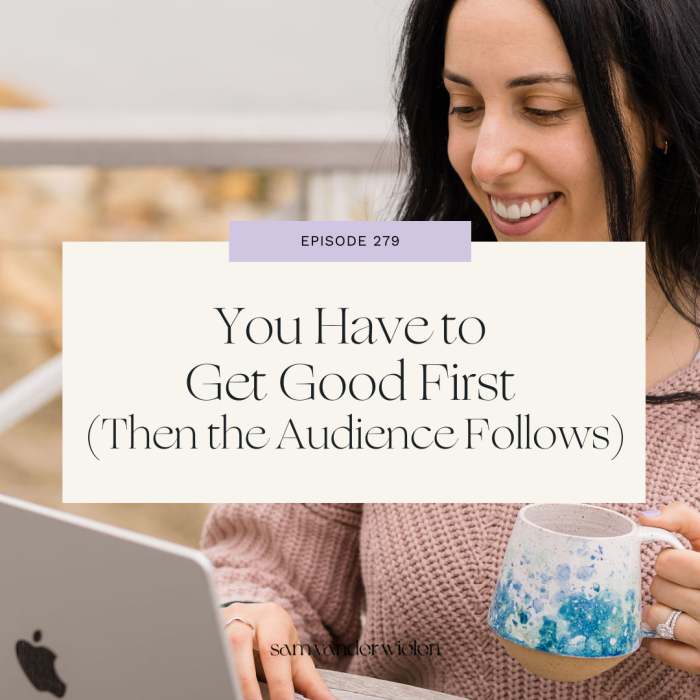
You Have to Get Good First (Then the Audience Follows)
Listen on Apple | Spotify | YouTube
Listen Now:
You’ve probably heard it before:
“Build the audience first.”
“Grow your following, then you can write a book.”
“Hit 10,000 followers, then you’ll be taken seriously.”
But that advice? It’s kind of like saying, “Get engaged first… then figure out if you actually like spending time with them.”
In this episode, I’m sharing the most common mistake I see online entrepreneurs make when trying to build an audience—and what to focus on instead if you want real, sustainable growth.
Because the problem usually isn’t that you don’t have an audience yet.
It’s that you’re skipping the part where you become really good at the thing you want to be known for.
In this episode, you’ll hear…
- Why obsessing over audience size can distract you from building actual skill
- The “wedding vs. marriage” analogy that changed how I think about growth
- What I realized after being in a mastermind with serious writers
- How to practice your craft in public without spiraling over metrics
- How to consume content in a way that fuels your output (instead of becoming a content junk drawer)
- A simple way to audit whether your time matches what you say you want
Listen to On Your Terms® on your favorite podcast platform
Listen to episode 279, follow along so you never miss an episode, and leave a review to help introduce the show to more online business owners just like you!
The Real Reason You Don’t Have an Audience Yet
It’s not because the algorithm hates you.
It’s not because you haven’t found the perfect niche.
And it’s not because you haven’t cracked the latest Instagram trend.
More often than not, it’s because you’re trying to grow an audience around a craft you’re not consistently developing.
If you want to be known as a writer, are you writing regularly?
If you want to grow a podcast, are you studying interviewing and storytelling?
If you want to be a YouTuber, are you learning how to make better videos?
An audience gathers around skill, clarity, and consistency — not just visibility.
The Wedding vs. Marriage Problem
I shared an analogy in this episode about weddings.
So many people pour all their energy into planning the wedding… but not nearly as much into the marriage itself.
In business, the “wedding” is the audience size.
The “marriage” is the craft.
We obsess over followers, list growth, and metrics — but neglect the actual thing we want to be known for.
If you focused half as much on becoming excellent at your craft as you do refreshing your follower count? Holy cannoli. Everything would change.
What I Learned from Real Writers
Being around other authors in my mastermind was a wake-up call.
They take writing seriously.
They protect time for it.
They write even when no one is reading.
They don’t measure their worth by likes.
And a lot of them? Aren’t Instagram famous.
But they have strong email lists. Published books. Loyal readers.
They act like writers.
That made me ask myself a hard question:
If I say I want to be a full-time writer… am I actually behaving like one?
That question applies to you too.
If you say you want to be known for something — does the way you spend your time reflect that?
How to Practice in Public Without Obsessing Over Metrics
Here’s the tricky part.
Practicing your craft publicly feels vulnerable.
It’s slower.
It’s quieter.
It’s not as instantly gratifying as “grow my list by 1,000 people.”
But this is where the magic happens.
You need reps. Messy ones. Imperfect ones.
Instead of asking:
- “How many followers did this bring in?”
Try asking: - “Did I get better at my craft today?”
Shift from audience metrics → skill metrics.
That’s how you build something sustainable.
Stop Turning Learning Into Procrastination
There’s also a sneaky trap here.
Sometimes “getting better” turns into:
- Buying more programs
- Taking more notes
- Saving more posts
- Consuming endlessly
Without actually creating. If you’re not careful, your brain becomes a content junk drawer.
The solution?
Consume with intention.
Create more than you consume.
Use what you learn immediately.
Learning should fuel output — not replace it.
Transcript:
Sam Vander Wielen: You’ve probably heard some version of this. Build the audience first. Then you can become an author. Build the following first, and then you can start a podcast. Get people watching your content first, and then you can make better content. But that kind of advice is kind of like saying get engaged first, and then figure out if you actually like spending time with them.
Because the real problem isn’t that you don’t have an audience yet. It’s that you’re trying to skip the part where you become good at the thing that you want to be known for.
And I get why? Because working on your craft feels slower, quieter, and way less trackable than grow my list or hit 10,000 followers.
And it definitely feels more vulnerable to let yourself suck at something, even just a little bit in public. Plus, if you’re not careful, getting better turns into a sneaky form of procrastination. Just gathering more courses, more notes, more planning, more learning without the messy reps.
So in this episode, we’re talking about the most common mistake I see entrepreneurs make, obsessing over audience building while ignoring the craft that actually creates an audience. I’ll show you how to pick what you’re focusing on, how to practice in public without spiraling over metrics, and how to learn and consume in a way that fuels your output without turning your brain into a content junk drawer.
Welcome back to On Your Terms®. If you’re new here, welcome. On Your Terms®. Is a podcast for online business owners who want to be as present in their lives as profitable in their businesses. The truth is you’re not going to be very profitable in your business if you’re not actually good at the very thing that you want to become known for, and you’re also not gonna be good or profitable in your business if you obsess so much over the metrics that we don’t focus on actually becoming good at what you want to be known for too.
So the other day I was reading this Substack and I saw that this person was writing about how they were, they were trying to dispel the myth that in order to become an author you have to have an audience. They were like, I heard that you can’t get a book deal if you don’t have a big audience. Or like, I heard that no one will take me if I don’t have an audience first.
And the person who writes this Substack, who’s, you know, kind of question or comment had been submitted to, she’s a well-known author, and she was like, you know, it’s so funny that people always talk about the audience thing and how like you have to have an audience in order to become an author. She was like, you know what you need to become an author to be a good writer. And I was just like, that is such a good point. Like I just, I’ve never really heard somebody say it so plainly that way. And she was like, actually, you need to become a good writer to become an author.
By practicing your craft, in this case, writing in public, right? Becoming known for writing, being open to practicing this thing in front of other people before you know if you’re good, before you have the adoration, before you get comments, before you have a lot of followers or people subscribing to your thing. By practicing, you’re going to get better at it, and by being better at it or being somewhat good at it, you will then build an audience because you will, if your writing is good in this case. People will want to read it, so then people will start assembling and, and you will build an audience out of it.
I remember when Ryan and I were getting married, and which was almost 11 years ago now, which I can’t believe, but when we were getting married, and I remember somebody had said, I wish people focused as much on their marriage and the like actual relationship as they do on their wedding. And that really spoke to me because, you know, we, we were paying for the wedding ourselves. We were putting on like a really small, very intimate gathering, which was very cool, like very, my style, it was very chill and was at like a pizza, wine bar restaurant that had better food than like, you know, everybody goes to a wedding and the food sucks. Like, I was like, I want really good food. I don’t really care if the wedding sucks. And so I was more concerned about that. And yeah, we were just more, I think, more concerned and more interested in like us being a good fit for each other, that we had similar values. The wedding to me just felt like an opportunity to celebrate that.
And so this, this analogy to me really spoke to me and it’s something I’ve noticed obviously over the years as I’ve seen people around me get married or in like media get married where the wedding is such a, such a thing, right? Such like an epic thing. And sometimes you won’t see those relationships actually last and it’s like it is true if they spent probably even half the amount of time as they did picking out the perfect flowers and table settings as like, how are we communicating? What do you feel about having kids, like how are we doing with money? We would probably be a lot better off.
And so, you know, kind of having, I guess this mindset of like focusing on the right thing or focusing on the thing that you really want to nourish and develop. It also came up for me, I’ve talked now a couple of times about how I’m in this mastermind this year called Aspen.
It’s a group of really incredible entrepreneurs. It’s a year long thing. And there are a lot of people in the group who are, who are also authors like I am, I guess I’m trying to own that part, but I guess I also am an author, but they’re, they’re authors and it was really interesting observing them and hearing them talk, especially at our first in-person gathering in January.
How much, I mean, this sounds really stupid honestly when you kind of say it out loud, but I was like, wow. They really take writing seriously. And it was like, it was just kind of an interesting observation where, you know, I’m in a place where I’m like, in my mind, or at least I would tell you, like, I want to be a writer.
I want to be a full-time writer. I want to be taken seriously as a writer. I want to be better at writing. I wanna be a better writer, and I want to start gathering more of an audience. For my writing, right? Not just because I sell legal templates or give tips for this, that, or the other thing. And so it was interesting to have the kind of that honest moment with myself where I was like, these other people who I admire and I look up to, I was seeing how seriously they take it and how much time they spend on their actual craft.
How they’re at least in my opinion, not messing around probably as much with some of the little things that I do. Like they’re not as prolific on social media, for example, because they kind of see it as a distraction From their craft itself. And a lot of them don’t have big social media followings. A lot of them have relatively big, uh, email lists that they’ve built up through years of blogging, years of writing, books that they’ve written that have gone really, really well.
Networking, like a lot of in-person stuff. So a lot of different things. But it’s, it’s interesting, like they’re not, Most of them Instagram superstars, which like, I think if you came up in my time period, like my little, bubble of 2016 starting an online business, Instagram was, you know, where it’s at.
And that’s kind of how we’ve judged people up to this point of like, you’re, you have a more legitimate business if this is what you have. So it’s been really, really helpful, uh, and I mean this in the best way possible, but slap in the face, like a wake up call of, of looking at these people thinking, you know, wow, they’re really taking this very seriouslyAnd, and, and from my perspective, they’re focused on the right things, and then it just causes me to think like, if I want to be a full-time writer, if I wanna be what I’m saying, like I wanna get better at writing, I want to be known for this building audience.
Am I dedicating myself to the craft of writing? Like someone who wants to be a full-time writer. Am I taking it seriously like that? Am I owning it? I can’t even tell people I’m an author, let alone a writer, and I have a book. Right?
So it’s like I, I’m not doing that. But then it was also helpful to hear the way that they would describe their habits and their rituals and you know, how frequently they write and that they’re okay writing things that nobody ever reads, for example, or that they write things that they intend for people to read, but don’t really care if it goes that well.
So like, I’m just seeing like kind of their, their attitude, their mindset and their habits, and reflecting on my own thinking, well, I’m not doing those things and I, yet I say I want to be them. Right? So, those two things don’t add up.
It’s really helpful to take a look at like the way you’re spending your time and what you’re prioritizing. Does that scream full-time writer? Like does it scream full-time YouTuber, if that’s what you wanna be? Does it scream like top podcaster? If you’re not spending time developing the craft to learn to be a better podcaster or a better interviewer, or learn more about audio or how to make better videos? If you wanna be on YouTube, how can you say that that’s the thing that you wanna be known for? How can you say that’s the thing that you want to build an audience around?
It’s a really good way to observe how you’re spending your time and what you’re focused on versus what you say that you want and do those two things match up or are they pretty far apart?
So how do we then work on the craft, like whatever yours is. And when I say the craft today, this can either mean whatever it is that you do for work. Like maybe you wanna become the best dietician in the world, or something like this, that, so it could be that.
But your craft can also be the type, of like the way that you want to communicate what you do and how you get your message out into the world. So this might come in the form of writing. Videos, YouTube, you know, uh, podcasting, right? Giving presentations, public speaking. There could be a number of different things that you wanna focus on.
So when I today say craft, think about the thing that you wanna grow in your business. So like, if you really wanna grow an email list, well, growing your email list requires you to write really good emails. So your focus would be, your craft would be learning how to write better emails.
If you wanna grow a really big YouTube channel, you have to be really good at creating videos. You have to also be good at crafting stories for those videos of positioning, those videos, of learning how to properly title, those videos and create, um, thumbnails for those videos so people actually see it.
You would get better at audio, um, people actually wanna listen to them, right? So these are all little ways that you could improve your craft.
But here’s the thing, and here’s something I, I know about you, ’cause you’re probably very similar to me. How do we then balance this with not obsessing over the craft and getting too caught up in learning and gathering more information and taking courses and getting a coach and doing all the things, right?
It’s very easy to get into this trap, like of where you’re saying like, I have to get better at videos before I start on YouTube. I have to get better at interviewing before I ever interview someone. That is not what I’m saying today. That is not what I’m recommending.
We’re talking today about how do we essentially do these two things simultaneously? How do we get out there and start trying while also recognizing that in order to build an audience, you actually, I think in my opinion, have to be very good at the very thing you’re trying to grow an audience around.
It’s only been recently that when people have asked me how, I think I heard this morning that I have 61,000 people on my email list now, which is like, I’m not sure how that happened, but, uh, actually by the time you listen to this, it will be, it’ll hopefully be a lot more than that, but. I, I have finally gotten to the point that when people ask me when I’m out and about or like, uh, conferences, they’ll say like, but how did you grow an email like this? Like especially given what you write about. And you know, honestly I’ve just started saying I think it’s ’cause my emails are really good.
And so like, I just think that’s true. I’m not saying every single one is very good. I have lots of misses. I think most of ’em though, are pretty dang good. I can tell and I can tell now. I know enough to know when I hit send on those emails my Sam’s Sidebar emails. By the way, if you don’t already get them, make sure you click the link in the show notes below to sign up for my weekly newsletter.
But I can tell literally from the moment I click send on Tuesday morning whether it’s gonna be good or not. I have like, I’m always like, now I’m like, that wasn’t my best. Like, and I did my best and I’m okay sending it. ’cause I think that’s important too. And not every one. Is going to be a home run that’s okay with me.
Sometimes it’s just about like the message is important or it was a more boring, dry topic I had to write about and I just couldn’t think of a way to jazz it up. Other times I hit send and I’m like, oh boy, here we go. And then like the replies start like boom, boom, boom, boom, boom, coming in. So I, I have a better, I have a better feel for that.
That’s only because I have written a weekly newsletter every single week without missing a week since 2016. , And like I think a lot of people, the way that they think about this is like, I will write emails when I’m good at writing emails, and I’m like, no, no. We write emails and then we get good at writing emails. That’s how we got here in the first place.
So, all that to say, I have several ways that I think you can practice this, of like actually improving the craft of whatever you’re trying to build while also not obsessing too much. And the first thing is that we need to focus.
To me, there’s two parts to this focus element. So the first part of focus is what is the one thing that you actually do want to grow? What’s the one thing you wanna be known for? I think it’s hard in today’s day and age when I say this, ’cause I’ve done this to be like, I want to be a YouTuber, a podcaster, world’s number one Instagram person. Have a 61,000 email list and also like be a Substack number one bestseller.
You could sure try, but I will tell you that will not last very long. So I think it’s really helpful when you have a business to figure, out what do you actually want to be known for.
I write about this a lot in my book called When I Start My Business, I’ll Be Happy. I’ll leave the link in the show notes down below. You can get it wherever books are sold. I talk about this a lot in the book though, about how I truly believe that there’s this like weird intersection of what you’re good at and what you find fun, and what works for your audience. Like, I wouldn’t say like if you just like love being on Twitch ’cause you love gaming, um, but you’re trying to like start a coaching business, I don’t know that that’s the best place to hang out. So I think there has to be some weird intersection here of like you know that your ideal audience is probably hanging out on this thing, but also you like it, you’re interested in it, and whatever the primary medium is of this actual platform that you’re choosing, you have to be interested in and like somewhat good at, right?
So if you are like, you know what, writing is the most natural thing to me that comes, that like flows out of me and I feel like I could commit to writing a piece, an original piece every single week without fail, regardless of how it performs.
Like then maybe picking a platform like, you know, something like Substack would be helpful for you. If you love videos and you’ve, you’ve been the kid who, you know, created home movies since you were single digits and you were always into film and editing and you’re interested in things like sound and lighting.
Go for it. Go for YouTube. But if you’re the person who’s like, I hate being on video. I don’t want anyone to see my face. I have no interest in like, in communicating my message this way, but everybody told me I should be on YouTube. It’s already gonna be a failure. Like I can already tell you, right ?
Now don’t get this confused , what I’m not saying is that you automatically have to be good at this thing already. Like this can be a skill that you can develop. I don’t even now consider myself to be a good writer. It’s something I like to do though, and I’m interested in it enough to be like, I wanna keep trying and I can tell that I genuinely like it because even when I post something and I’m like I don’t feel like this is that good. I still wanna show up and do it again ’cause I’m just hungry enough that I want to keep going with it.
The thing I want you to commit to me and to yourself is that you will pick this thing and you will focus on it intently for the next six months, whatever it is, because that way you kind of box yourself out of making excuses of like I’ve posted four times and nobody liked it, or I put out a month’s worth of podcast episodes and I only got 10 downloads. Like, it doesn’t matter because if you’re committed to the six month period anyway, then you’re posting and showing up regardless of the results. And as we’ll talk about in a little bit, the results aren’t the focus.
Now the second part to focus is actually staying focused on that thing that you pick. Like this is a muscle, I think that you have to like continuously strengthen, not running off to start every new app or every new trend or like, you know, clubhouse rolls out when you’re three months into your YouTube journey and you’re like, now I’m gonna be a clubhouse superstar. No. So we’re focused on this thing regardless of what’s happening.
The second thing you have to do, in my opinion, is to practice in public. I mean, if you wanna build an audience, like I’m all about people doing art, making movies, uh, writing things like doing whatever you want to do, and people don’t ever have to see it, and you don’t have to produce things for other people’s consumption. Like I think that’s a very important part of the creative process.
If you’re trying to build a platform for your business, I think you have to get comfortable pretty fast with practicing in public. Instead of waiting until you have an audience in order to start sharing content, start sharing good content, making it better, like whatever it is, start now and therefore the audience will build along the way.
Personally, I’m pretty honest and upfront as I have been already in this episode about what I’m working on, right? So I will be like, oh, I want my podcast to grow. Like that’s something that’s really important to me, and I’m spending time and money and energy to figure out how to do that. I also will talk a lot about how i’m learning to own my writing piece and like how I want to get better at it. And I’m writing a personal Substack, called Beyond Business, I’ll leave the link down below, but it’s a, you know, a Substack for me to practice, literally practice in public.
It’s, it’s literally me doing in real time what I’m suggesting here. Not because I’m practicing in public to be. Oh, if I put this essay out, do people like it? But because first of all, it’s holding me accountable to show up every week. I send a new Substack every Wednesday, and so it’s, it’s holding me accountable to show up and regularly get in the practice. It’s also bringing me closer to that goal of like, you know, I was saying earlier, my Aspen friends, they are, they are dedicated full-time writers.
And I’m like, well, if I say I’m a dedicated full-time writer, I have to be writing and I have to be, and I want to build an audience around people who know and like my writing, this type of writing, not legal writing. So where am I doing that? Well, for me, like Substack was a natural place to do that.
I think one of the biggest mindset shifts for me that I’m, I’m like currently working on and evolving through this year is that I saw my, my personal writing, like on my Substack for example, as a nice to have, like, it was like once I get all my homework done, I can then go do this if and only if everything in the business is perfect and I’ve gotten all my to-dos done and all of this stuff.
It wasn’t until the beginning of this year of 2026 that I started to carve out some habits that prioritize my own writing or my own, like reading about writing or reading fiction for example, which I think really helps my writing.
And carving out time to take writing classes and do all these things. It wasn’t until I started to do that that I actually became more consistent because on all the other weeks I was able to make an excuse of like, oh, this big thing’s going on in the business. Oh, we have, uh, a promo right now, or, oh, something’s going on with the team, or like some other project that I’m working on. So it was just very, very easy to fall to the back burner.
This is where we really need you to get your reps in, because the more that you do this thing, the more that you are, you know, getting used to taking footage, then editing that footage, even uploading the footage and figuring out how to organize it and properly label it, and then edit it and then color correct it, and then adjust the sound. Every rep that you do, you will get better and better and better. And the more change that you’ll see in your actual craft itself.
And I think it’s like, I always, I’m always like careful to balance this advice, but I’m like, I think if you do that, you will see the audience come, but it, it’s just so hard ’cause I’m like, but that’s not the reason. But also I think you will. So it’s, it’s a little bit of both.
Now the next thing, speaking of that, is that you have to get, you have to get really comfortable with who you’re doing this for, right? So as you practice, you keep having to come back to like why you’re doing it. If you’re doing this, like writing consistently, for example to become a better writer. It can’t necessarily be that at that same time you’re focused on getting the most amount of likes and comments and subscribers and all of those kinds of things. The point of this exercise for you right now would be, you know what? I’m working on becoming the best writer, videographer, like whatever it is.
Now that doesn’t mean that the content itself is not focused on other people, or you know, that you, you know your audience well, and you’re speaking to your ideal listener or reader, or viewer of some sort. That’s, that’s fine. I think we can balance that when it comes to like the actual content and how that content is packaged.
But in terms of its performance and how it goes, we sort of can’t control that. We kind of can’t control how our stuff lands. So that’s where you have to come back to like the purpose of what you’re doing.
The next thing I think that really helps this is to be in an environment of learning if you can join a group or a community of other people who are also working towards, if not the same goal, then who are also just like goal oriented, right? They have similar values and maybe, maybe they’re trying to build a very different kind of business than you, or maybe they’re trying to become a full-time author when you really wanna grow a YouTube channel.
It doesn’t really matter in my opinion. I think it’s the, just even the idea of being around other people who are so, like growth mindset oriented, who are working towards similar goals, who are creative and inspiring and I think, I think it’s helpful when the, when you can join a group or be in a community that’s a little bit ahead of you, that’s not always possible. I know that’s hard. I do think that that is helpful, or at least that there’s some people in the community who are, uh, what my mindset coach Jen calls expanders.
And so like in, for me, being in the Aspen community, for example, like there are varying size of businesses, even, that’s not the only metric. By the way, I’m, that’s not what I’m talking about. I’m not talking about being in a group of people who make x number of figures per minute, like that. They’re all touting on Instagram. What I’m talking about is like, these people can be expanders for you in many different ways.
They could be expanders for you in asking for what they need. They could be expander for you and owning up, owning space, of not being afraid to make mistakes of going after what they want. For, for having built an audience in public, like there, there can be lots of different things.
So in my Aspen group, for example, one of the things that feels so expansive for me, for like the authors is their ability to own that, right? And to own what they are. And just say like, yeah, I’m a full-time author.
And like, yeah, we’ll just get this next big book deal. Like why wouldn’t I? And there’s little of me standing over here being like, who would ever give me another book deal? It’s very helpful for me to be around that and see, see what’s possible and how that mindset then translates into their experiences and what they ultimately get, and the stories that I’m telling myself while I’m sitting here.
Now I have real life examples of the fact that those stories are not true. These stories that I’m sitting here telling myself is like, well, what about, I’m gonna make up a name like, Jake over there who’s out doing it right, so that it’s just not true anymore, and it makes it really hard to continue to buy into those stories that you have about why you can and can’t do things.
I think this is where it’s really helpful. A lot of times people ask me for an episode, we can, we can do this episode, you can let me know. You know, feel free to reach out and let me know. But people often ask for like an episode on how to pick a mastermind or how to pick a business coach. And one of the things that I think has been. The most helpful for me is picking a mastermind that’s focused on implementation and not just like dreaming, talking kind of thing. And also the mastermind I’m in is really not at all focused on business. This is not how it’s marketed, but this is my experience. Like it’s not all about business, um, like tactics or strategy.
Like no one in there is talking about like, here’s three ways to improve your funnel conversion percentage. Like there’s none of that is happening. People are talking about relationships and team building and mindset and bumping up against growth, like growth problems and what’s next for them and pivots and all these like, bigger things, right?
But people are also doing the work. People aren’t just sitting around. So it’s, it’s really helpful for being around other people who are actually doing it.
I think Substack, by the way, is such a sleeper like place to look for a community of literally anything that you want to do in your life. My friend Michelle sent me one about like, there’s a writing prompt, uh, Substack that just helps people who wanna do like script writing, right? And like playwriting.
And then there are incredible Substacks for people who wanna write nonfiction or memoirs only, or there’s a Substack that I follow that helps people just to write what they call micropros, 300 word, like little mini essays.
I know for sure that there are ones for people who want to make art or be better journalers or want to be an influencer, like there’s literally any kind. But I think that people are creating very cool communities there. That for like $5 a month, you can get community, you can get prompts, support, education, so I wouldn’t sleep on that and maybe poke around a little bit on Substack, even to look for something digital.
So now more than ever, when you’re focused on the medium that you really want to grow, you have to be really careful about what you consume and how much you consume.
So I’m talking both literally on like Instagram or social, whatever your social media app de jour is like you have to be careful there for one of not, you know, doom scrolling and, and whether that really feels good to you, and if that’s feeding a part of you that’s like feeding into like a little bit of confirmation bias where you go to those apps to see how other people are doing what you wanna do, and then use that as like bad fuel to, to fuel these stories that you have about why you can’t do it or why it’s different for you, or why it was easier for them. So that, that’s one part of it.
But I think the other part, I’d rather talk honestly about the more like positive part of consumption because we talk so much about what you shouldn’t consume. People often don’t mention how helpful it can be to consume good things, right, that are more positive. I personally have found that being around art often, and I mean art in the widest sense of the word.
This can be movies, music, tv, going to a local play, going to a Broadway show, like literally any kind of art of the way that you like to consume it. Watching the Grammys, I think being around art has transformed not only me as like it’s really opened up my, my eyes to like the possibility of expanding just beyond kind of the bubble of online business, but it also has contributed so greatly to the endless stream of ideas that I have for my business.
When people ask me how I’m able to come up with so many ideas for stories, like all my emails for my weekly newsletter, always story driven. It’s pretty much always art. Like I can’t tell you how many of my emails were born out of like Frasier episodes that I watch before I go to bed and how like I just saw something funny on there and then I’m like, oh, this is just like how this thing happens in business.
And then that’s what sparks the idea.
One of the people in my mastermind owns like the most famous guitar pedal company in the world and he is like such cool guy and just is coming out with a book that through Jack White’s publishing company, Like just so these people are so cool and so interesting and you might think like, how the heck is that helpful to you to be, you sell legal templates and you’re in a mastermind with a guy who sells Uh, guitar pedals to John Mayer. Right?
How is that helpful? Well, it’s very helpful. It is very helpful for me to hear how his mind works. If you read his emails, the guy sells guitar pedals and his emails are the most fascinating emails. Like, there’s so many things that you can be inspired by and I actually think I would make the argument and I would push you to think that it’s actually more beneficial for you to be around people who don’t do what you do than to continue to like swim in this pool of sameness around the people who do do what you do.
It’s too much sameness. It’s why the messages are boring. It’s why you’re fighting for the same people. It’s why the content looks the same. It’s why you feel like you can’t stand out. It’s why you feel so like blank when you try to come up with ideas because you’ve consumed so much about everybody else’s ideas that you have not given your brain space to flex, to come up with your own.
I also think talking about consumption, that if you want to, for example, have an awesome podcast, I think you have to listen to a lot of different kind of podcasts. I think you have to become obsessed with podcasting. If you wanna be great on YouTube. I think you have to watch a lot of different YouTube, and I’m not talking about YouTube videos about how to grow on YouTube.
I am talking about watch travel videos, watch, , people who create YouTube videos about, I don’t know, living on the island close to the North Pole called Svalbard like I do with Cecilia. I’m obsessed with Cecilia. I talk about her endlessly. And by the way, I was watching her video the other day and my book is on her shelf in the background.
It’s like, that’s the, will continue to be the highlight of my life, but I love her so much. But for example, like when I see Cecilia on Svalbard sharing her life about what it’s like to live in the Arctic Circle. It is so inspiring to me when I watch her, she’s so comfortable being herself that she makes me feel like so much more comfortable and inspired to show up as I am. Right of like it, you’re having a bad day. You don’t think you look great. I like Cecilia, just like doesn’t care.
And she is her. the other thing I love about her, she never addresses it. She doesn’t apologize. She’s never like, sorry, I did this, or I look like this. Nope. It’s like she’s just there sharing her life. She also has impacted me so much personally, where I’ve never met someone who’s so in love with where she lives and despite like tough circumstances and she turns everything into such a beautiful, positive moment.
And that has helped me to be a better creative of like, how can I share that about where I am? How can I translate that attitude and that mindset into me, my own business, my what I’m creating, right?
So I think there’s so much to this about consuming from other people, being a fan of the platform that you want to grow on, and just generally getting filled with inspiration and getting so many ideas from people who are different than you.
Last but not least, I just wanna leave you with this idea that you have to be gentle with yourself because this is a process like I still fall off the wagon quite often and I get bummed when something I am saying that I’m doing for the just the reps and the The, like the craft and trying to get better at writing.
If it doesn’t perform well, I will get bummed and then I’m like, oh wait, that wasn’t the point, right? Or I will start looking like on a particularly bad day. It’s funny, like it’s almost like then I seek this out. So I will then like go and look at like Substack stats for example, and I’ll be like, oh, when I write about this topic, like people don’t like it, or when I write about this topic, it goes well, so I should write about that more.
And then I’m like, wait, I’m getting back into performance mode. I’m getting back into this idea that I’m creating content to see how it goes for other people. That’s not the point here.
The point here is for me to get better at writing, for me to find my writing voice and for me to figure out what I even want to write about so that one day I can build an audience or maybe along the way it builds an audience there trying to figure out, you know, what, what lands, what’s like both in the intersection of like what lands with other people. But that also is what is most true to me and like what is really coming from me from the most creative, purest place I guess.
Next week, by the way, if you’re interested in Substack, ’cause people keep asking me about this, next week on the podcast, we’re gonna be talking about how I grew to a thousand subscribers on Substack, with really very, like, I would call it a light lift. So, um, we’ll be talking about Substack next week, if you wanna learn more about that
All right, so with that, I hope that this episode was helpful or inspiring to you in some way. I’d love to hear from you on Instagram at samvanderwielen, or reply to any of my emails that you get, before you go Make sure you sign up for my weekly newsletter, Sam’s Sidebar and also for my personal Substack Beyond Business. I’ll leave the link down below for both of those. They’re both completely free to you. Um, and I’d love to see you there. So with that, I’ll chat with you next week, all about Substack.
Thanks so much for listening to the On Your Terms® podcast. Make sure to follow on Apple Podcasts, Spotify, or wherever you like to listen to podcasts. You can also check out all of our podcast episodes, show notes, links, and more at samvanderwielen.com/podcast. You can learn more about legally protecting your business and take my free legal workshop, Five Steps To Legally Protect and Grow Your Online Business at Samvanderwielen.com and to stay connected and follow along, follow me on Instagram at samvanderwielen and send me a DM to say hi.
- Get Sam’s free weekly newsletter, Sam’s Sidebar
- Subscribe to Sam’s Substack, Beyond Business
- Get Sam’s Book “When I Start My Business, I’ll Be Happy”
- Click here to be notified when new episodes of On Your Terms® come out
Connect:
- Get Sam’s weekly newsletter, Sam’s Sidebar, to learn how build your email list, protect your biz & grow an audience online
- Watch Sam’s Free Legal Workshop “5 Steps to Legally Protect & Grow Your Online Business” to learn exactly how to start an online business the right way.
- Follow Sam on Instagram
- Subscribe & follow On Your Terms®️on your favorite podcast platform!
- Subscribe to Sam’s Substack, where she shares behind-the-scenes of building a life offline, after growing a multi-7-figure business online
Free Legal Class:
Want to make sure you start your online business the right way? Save your seat in my free legal workshop “5 Steps to Legally Protect & Grow Your Online Business” here: GET MY FREE TRAINING
Sam’s Favorite Business Tools:
- Kit // what I use to build my email list, send emails to my list, and create opt-in forms & pages
- Kajabi // use Kajabi to sell your course, program, or even build your entire website. Get a 30-day free trial with my link.
- SamCart // what I use for my checkout pages and payment processing, and LOVE. And no, not because it’s my name.
AFFILIATE LINKS: Some of the links we share here may be affiliate links, which means we may make a small financial reward for referring you, without any cost difference to you. You’re not obligated to use these links, but it does help us to share resources. Thank you for supporting our business!
DISCLAIMER: Although Sam is an attorney, she doesn’t practice law and can’t give you legal advice. All episodes of On Your Terms® are educational and informational only. The information discussed here isn’t legal advice and isn’t intended to be. The info you hear here isn’t a substitute for seeking legal advice from your own attorney.
© 2022 Sam Vander Wielen LLC | All Rights Reserved | Any use of this intellectual property owned by Sam Vander Wielen LLC may not be used in connection with the sale or distribution of any content (free or paid, written or verbal), product, and/or service by you without prior written consent from Sam Vander Wielen LLC.
–
–
 0 Comments

So What Do you think?