



November 15, 2024
Is a Sole Proprietorship a waste of money?
So you’re ready to register your business, but you’re probably trying to choose between registering as a sole proprietor or sole proprietorship and a limited liability company (LLC). And you might be confused about what the difference is, which one you need and what are the pros and cons? Don’t stress! I’m going to break it all down for you in this post!
With everything you have going on, I can see why you’re looking for the quickest and easiest way to register your business. (*ahem* Where is the “express lane” around here, anyway!?)
I can almost hear you clicking submit on that Sole Proprietor license application with your state, just so you can check that “I really don’t feel like doing this, but I know I need to do this” item off your list.
WAIT!
You need to know a few things first.
Sole Proprietorship
The lawyer in me has to tell you, of course there are tax and legal implications for each type of legal business entity that you choose. To avoid either costly work or a mistake, you should form your business only after you’ve carefully determined which business entity type is right for you or you’ve consulted with your own attorney or your own accountant or CPA to help make that decision with you.
A business entity is like choosing a house structure essentially for your business. It’s an organization that’s formed to conduct your business. So when I say business entity, we’re really talking about business structure. A couple of examples are a sole proprietorship, limited liability company, a partnership, a corporation, a nonprofit, all of those are different types of business entities. And so just like if you were going to build a house, you would have to build what the framework is of your house before you build it.
When you’re choosing what kind of business entity you want, like a sole prop or an LLC you might ask yourself, why does it matter?
Well, each legal entity type for the most part files different tax returns. (Although LLCs and sole props, typically don’t by default.) You could pay taxes differently, depending on which one you choose. You definitely get different legal protections for your personal assets as a business owner. If you want to have business partners, some allow you to while some don’t allow you to. There are different upkeep and filing requirements for each one. And so based on your personal situation, type of business, your location, your financial situation, your tax filing status, like married, filing jointly separately, individually one could be better than another for you.
You might’ve heard that starting out as a sole proprietor (or a sole prop, as the cool kids call it) is the way to go because it’s easier, cheaper and faster than an LLC.
But is that really true?
Or will “sole prop” status cause you a headache down the road?
Characteristics Of Sole Proprietorship
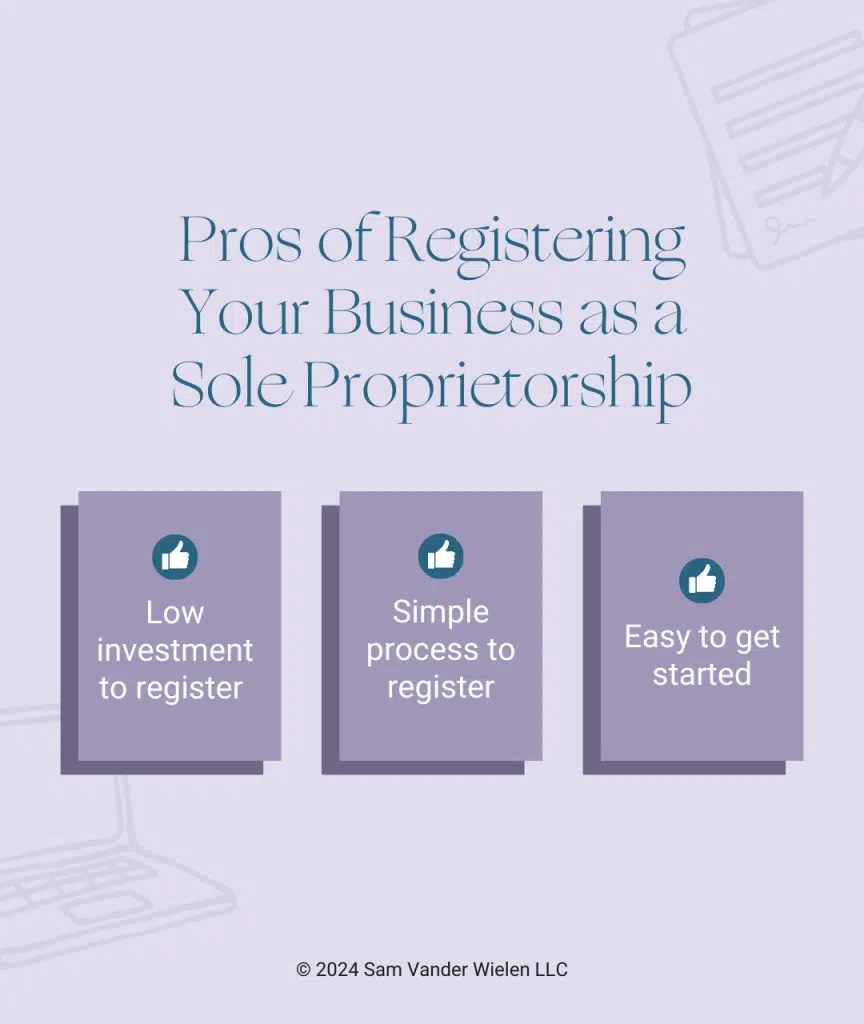
Establishing a sole proprietorship is essentially the simplest type of business entity. And that’s because most states make the registration process a little bit easier, a little bit cheaper and faster. Some states in which you want to be a sole proprietor don’t require that register at all. So in terms of just wanting to get your business started, I can understand why choosing to register as a sole pop would make sense!
There are cons to registering as a sole prop.
A business that is registered as a sole prop can only ever be owned by one person.
That means that you can’t have a business partner and it can’t have multiple business owners. You can’t own a sole prop with someone else as a sole proprietor. Or as someone who owns a sole proprietorship. You personally are the business.

With a sole proprietorship, you don’t have any personal liability protection.
That means if your business got sued, if you were threatened to be sued, you would be personally liable. And be on the hook for any debts of your business. So if there was a hundred thousand dollars judgment against your business and you didn’t have that money in your business bank account, you personally would be responsible for making that payment.
You can’t raise capital with a sole proprietorship.
This means that it’s self financed and you can’t
go out to a venture capital firm and try to get investment for your business. You just are relying on, at first, your personal income, and then your self-funded money through the business.
As far as taxes go, a sole proprietorship files taxes by a Schedule C, which is a form 1040. That’s just a personal income tax return or a C easy form. You can also file the Schedule SE for self-employment to report social security and Medicare taxes on the business and net profits. Whenever it comes to tax time, and estimated quarterly taxes, I always recommend, especially as a new business owner, working with an accountant and a bookkeeper so you make sure you don’t miss any step.
I’m teaching you everything you need to know about Sole Props vs. LLCs today in this YouTube video that you can watch right here:
Watch this to find out why registering as a sole prop could actually be a waste of your time, and a HUGE missed opportunity to legally protect your business.
If you like the episode, I’d love for you to:
- – Give it a like
- – Hit Subscribe to my channel; and
- – Leave a comment letting me know what your biggest takeaway was.
If you’ve already got business registration under your belt, watch my recent episodes on the California privacy law (does it apply to you?!) and how to send & e-sign contracts legally.
PPS. In my signature program, the Ultimate Bundle®, I give you 14+ DIY legal templates (contracts, disclaimers & website policies) AND 35+ video lessons where I teach you how to legally work with clients online (1:1, group, courses & memberships), form your business, protect your content with copyrights and trademarks, get the right kind of business insurance and so much more! Learn more + “Get Bundled” right here.
Next Step: Watch my free legal workshop
If you’re ready to legally protect your business and have the legal knowledge you need to know what to do with difficult clients, watch my free workshop ‘5 Steps to Legally Protect & Grow Your Online Business’ right now by saving your seat here.
In that workshop, you’ll learn:
- How contracts can actually save your (vegan, GF) bacon — if you have the right one.
- What your website needs to be legally protected.
- How to keep copycats off your content.
- The mindset shift you’ve got to make if you want to actually grow your business without looking over your (online) shoulder.
- The only way to form your business so that you’re personally and professionally protected.
Ready to watch? Sign up for my free legal workshop right here:


 0 Comments


So What Do you think?