



June 15, 2026
I’ve Sold $9M in Digital Products. Here’s My Honest Take on the Market Right Now
Listen on Apple | Spotify | YouTube
Listen Now:
Everyone keeps coming up to me like they’re attending my business’s funeral. “How are things?” And I’m standing there like… everything’s actually great? My business keeps growing. But I get it. There’s no shortage of people online saying digital products are dead, courses are dead, the whole thing is over.
Here’s the thing: the market has changed. A lot. And if you have a digital product or course, you’ve probably felt it. Buyers are taking longer to make decisions, coming in with their guard up, asking more questions. But “harder” is not the same as “dead.” After 10 years in this industry and $9M in digital product sales, I want to give you my honest take on what’s actually happening, what’s changed, and exactly what it takes to build and sell a digital product that still works in 2026 and beyond.
In this episode, you’ll hear…
- Why buyer skepticism is at an all-time high and what actually caused it
- How the 2020-2021 online business boom (and AI) flooded the market with low-quality products
- The real reason information-only products are struggling, and what to do instead
- Six things your digital product must do to succeed in today’s economy
- Why cold-audience funnels are suffering the most right now
- What “long game trust” actually looks like, and why it’s your biggest competitive advantage
- The honest truth about how much work building a successful digital product takes
Listen to On Your Terms® on your favorite podcast platform
Listen to episode 293 follow along so you never miss an episode, and leave a review to help introduce the show to more online business owners just like you!
Why Buyer Skepticism Is at an All-Time High
The 2020-2021 online business boom brought in a flood of low-quality products from people who had audiences but not necessarily expertise. The “six figures on your laptop” marketing promised the world and underdelivered, and buyers got burned. A lot of them. Add in the fact that free, high-quality content is more accessible than ever through YouTube, podcasts, Substack, and AI, and you’ve got a customer base that’s informed, a little jaded, and asking way more questions before they hand over their credit card. This isn’t a bad thing, but it does mean the bar has moved.
How AI Made It Worse (and What That Means for You)
AI made it incredibly easy to produce mediocre content at scale, which has clogged the pipe even further. Now anyone can ask an AI tool to generate posts, products, or entire courses about a topic they know nothing about. The result? More noise, less trust, and buyers who can’t always tell what’s real. If they can’t tell, why wouldn’t they just go to AI directly? Your job is to make it unmistakably clear that you are the real thing.
The 6 Things Your Digital Product Must Do Right Now
1. Solve a specific, undeniable problem. Not a vague transformation or an aspirational lifestyle promise. A real problem that your buyer knows they have, in their words, from their perspective. Buyers with a real and urgent problem will always pay for a real solution. The products that are dying are the ones that sell “vibes.”
2. Build long-game trust before you ask for the sale. Cold-audience funnels with aggressive pitches are the ones suffering the most. If someone has listened to your podcast, read your emails, and followed you for months, they are so much more likely to buy when you open the cart. That runway matters. Show up like you plan to be there forever, because you do.
3. Create a product that actually works. I know this sounds obvious, but apparently it needs to be said. Your product needs to do what it says it’s going to do and deliver real results. I don’t overpromise. I focus on over-delivering. That’s it. That’s the whole strategy.
4. Go beyond information. Information-only products are the most at risk right now. People have unlimited access to information, from AI to free YouTube tutorials to $5 Substack newsletters. If your product is just a pile of content, it’s going to be a hard sell. Think about how you can synthesize, guide, or transform, not just inform.
5. Be consistent. Talk about your product until you’re blue in the face, and then talk about it a little more. Buyers are skeptical of people who hop between offers every month. If someone sees you pushing one program this month and something completely different next month, they start wondering if the first thing ever even worked. Consistency signals expertise. It builds the kind of trust that converts.
6. Put in the actual work. Online business is not passive. It is not easy. It is not free. Behind every “set it and forget it” funnel is years of customer research, intentional copy, ongoing refinement, and real investment. The girlboss era sold ease and hid the hustle. I’d rather just be honest with you: this is hard, it’s worth it, and the people who thrive are the ones who do the work.
Transcript:
Sam Vander Wielen: If you have a digital product or course, you’ve probably noticed that something has shifted. Heck, if you’re in the online business industry, you’ve probably noticed something has shifted. It feels harder to sell than it used to. Buyers are asking more questions, taking longer to buy, and coming in with their guard up.
And you might be wondering if the market has just moved on and this whole, like, online digital business thing is over. Here’s what I actually think is happening, why it’s not going away, and more importantly, what it takes to have a digital product that still sells really well in today’s economy.
I wanna welcome you to On Your Terms®. I’m so excited to be here today and chatting with you. If you’re new here, welcome, welcome. On Your Terms® is a podcast for online business owners that want to be as present in their lives, as profitable in their businesses. And one of the ways that I’ve been able to do both, not necessarily always well or all the time, but do both of those things, be present and profitable, is by selling a digital product.
Because it’s really cool that you can create something once, and in today’s economy, you can market and sell that thing all over the world. Like, what an incredible opportunity. But today we’re gonna talk about whether that’s still true. Like, is that still an opportunity, or is that one that’s already passed?
I also just want to let you know that as of next Monday, June 22nd, the Ultimate Bundle®® is on sale for five days only. So if you’ve been around for a bit, you know that once per year, I celebrate the birthday of the Ultimate Bundle®, and I put it on sale for five days with some epic bonuses.
We’ve got some awesome stuff coming your way next week for the Ultimate Bundle®. If you’re not familiar, the Ultimate Bundle® is my signature program that gives you 10 DIY legal templates, as well as a series of video trainings that teach you how to start an online business the right way.
I will literally teach you how to form the business, get your contracts in place, get business insurance if you need it, and do all the things you need A to Z to have an online business that’s set up right. So if that sounds like something you’ve been looking for, keep your eyes peeled for next week. The best way to find out about it is to make sure you get my weekly email, my newsletter, Sam’s Sidebar.
It’s absolutely free. I’ll leave a link down below for you to sign up now so that you’re the first to know when the Ultimate Bundle® goes on sale next week. Even if you’re not interested in the sale, just sign up for the emails anyway. They’re pretty good. All right. Let’s get into today’s episode
Everywhere I go these days, people are acting like they’re at my business’s funeral. They’re like, “How are things?” I’m like, “Wait, why are you saying it to me like that? Like, everything’s great,” you know? And I just think it’s so funny ’cause I’m like, actually, my business just keeps getting bigger, right?
I think because I don’t spend a whole lot of time online, or at least I try not to, and especially try not to spend time online consuming things about our industry, I don’t always know that there’s a lot of rhetoric going around about how, like, online business is dead, courses are dead, webinars dead, everything’s dead.
And I always surprise people when I tell them, like, actually, mine is going really well, right? But the truth is that the market that I built my entire business in has gotten a lot harder to sell in, and I wanna talk about why and what I think it actually takes in 2026 and beyond to survive it that maybe I didn’t have to do back in 2016.
And before you go and say, like, “Oh, well, you’re only able to be successful ’cause you started before,” no, no, no. I have had to pivot a lot, right? So there– I’m gonna share throughout this episode a lot of the things that, in real time, I have seen get harder or different or just change and create new obstacles for me in my business, and I have adapted to those things.
Like, I’m not a dinosaur who’s just doing things the way I used to do and it’s just still working. I’m very much adapting as we go, and I think that’s part of the reason why I’m still here and thriving, frankly, in, in the business
Let’s first talk about how we even ended up here and why it got so bad. Because I’ve been doing this for 10 years and I’ve been through my fair share of ups and downs in the economy and wars and politics and all of these things that have gone on and been such a mess, frankly. Um, and I do think that it is a part of it, it’s undeniable, but I also think you can still thrive.
So let’s talk about why skepticism is perhaps at an all-time high, because I think that is a big part of what’s going on here. Essentially, I think that the 2020, 2021 online business boom created a flood of low-quality products from people who had built an audience, but not necessarily expertise. And the whole message of, like, six figures on your laptop, like, earn money while you’re sitting on the beach thing, that whole marketing scheme burned out a lot of buyers who followed their formula because they said it would work, but then got nothing from it
I think another big reason why we’re seeing skepticism at an all-time high is that free content is now so good, so available, so easy to access. I mean, easier than ever, right? To access through things like YouTube and podcasts and Substack and even AI, that buyers need a much stronger reason to hand over their wallet to get information in particular.
I think, I think such a big part of what we’re talking about here is the fact that when I started my business, and probably all the way through COVID, you could make a lot of money online by exchanging information, by selling information essentially. But now, think about all the different places that you can go to get information much faster, let alone cheaper, because it’s free
And then I think AI made it even easier to produce mediocre digital products at scale, which has made the noise even worse, right? I think AI in many ways has made our entire industry a lot worse because you now have these people who don’t have this expertise but see how easy it is to start an online business, and then now they have these tools to go out there.
Like when I started… I feel like a dinosaur. Um, but when I started, they used to have to just steal from other people in order to get the expertise and create the content. You don’t have to do that anymore ’cause now you can just ask AI, give it some prompt, and say like, “Give me all these posts about X, Y, or Z,” and let it be the expert.
You don’t even have to become an expert anymore. You don’t even have to waste the time trying to retype somebody else’s caption into your own. You can just steal it straight out of AI, which by the way, so much of the generated content that’s coming from AI is based on other people’s content, people’s websites like my own, right?
My own posts that are getting used, my husband’s own books that are getting used to generate information on AI. So that has just made it like way too easy. As much as it’s a easy tool for all of us to use for productivity’s sake and, you know, streamlining our processes and, and behind-the-scenes stuff, it’s also allowing a lot of people to come into the game and just put a lot of slop out there.
And the way that I always think about this is that it’s essentially like clogging the pipe, right? So it’s like the… If you think of social media as a pipe and you’re out there and you’re like putting one little piece of thing into the pipe, it’s now getting jammed. Like it’s like somebody’s stuffing a ton of toilet paper down there, and it’s getting absolutely jammed and clogged because there’s just so much slop on it, which is making your job a lot harder, and it’s making your viewer or your reader or whatever more skeptical that what they’re seeing is real, that you know what you’re talking about, that it’s not just some AI slop.
And if that’s the case, by the way, if they’re skeptical that it’s real or that it’s, um, not something generated by AI, why then wouldn’t they just go to AI themselves? They don’t need you to ask AI for something that you don’t even know and give it to them. They can just go to AI and do that themselves.
Personally, in my own business, I’ve definitely seen a lot more initial skepticism, upfront skepticism from buyers. And I’ve also seen more people that are, like, quote-unquote, impressed that I’m real or down-to-earth or honest or, like, a real human. Like, I’m literally seeing these phrases showing up, not only consistently, but more often than I used to see.
Um, and I think that says a lot about what people’s expectations are and also what their concerns are coming into interacting with a business like mine. I also see people asking me to prove myself more or explain why I’m the right fit. Like, “Can you tell me why I should buy from you?” Whereas I feel like when I started 10 years ago, or even, even as soon as, like, six, five years ago, something like that, I felt like people were more just, like, genuinely grateful or thankful or excited when they would find someone like me, and they would be like, “I didn’t know someone like you existed.
Like, this is such a relief.” And now I’m getting these people that are being like, “Why should I buy from you? Why shouldn’t I do this?” Like, “Why shouldn’t I use AI instead of you?” I’m getting much more of this, like, prove yourself language from people. I would definitely say… And by the way, I think this is a good thing, but I would definitely say that customers are more empowered and more knowledgeable these days, so they know the deal, right?
Like, they know now when they come to a webinar, they’re like, “I know, lady, you’re gonna talk about your product at the end.” Like, people, people know, and they know what to expect. I think that back in the day, people might have benefited from the fact that people, customers in our industry were very unaware, and so they would find, you know, an ad on Facebook probably at that time, and they were like, “Wow, this lady’s giving me this free class for one hour on this topic.”
And then they would go there, and then they’d be like, “Wow, she really knows what she’s talking about.” And then like, “Oh, she’s created this product, and it’s only gonna be $197.” And so it was just, like, a way easier bar. Like, people were easily impressed. It was like before we were dealing with a bunch of Labradors, and like, now we are dealing with, like, very highly skilled, trained police dogs.
And, and like I said, I don’t think, I’m not saying that as a bad thing. Like, I think it’s good that people are knowledgeable, and I always encourage my own customers to ask me questions and, like, ask why it’s the right fit. And I’m also upfront about the fact that I will be the first one to tell you if it’s not a good fit.
Like, I’m not interested in everybody, um, buying my product if they don’t need it, which by the way, I think is something that has helped me to survive this whole time, is that I’ve never been somebody who did that, and I’ve maintained it, which has built a lot of trust with my audience.
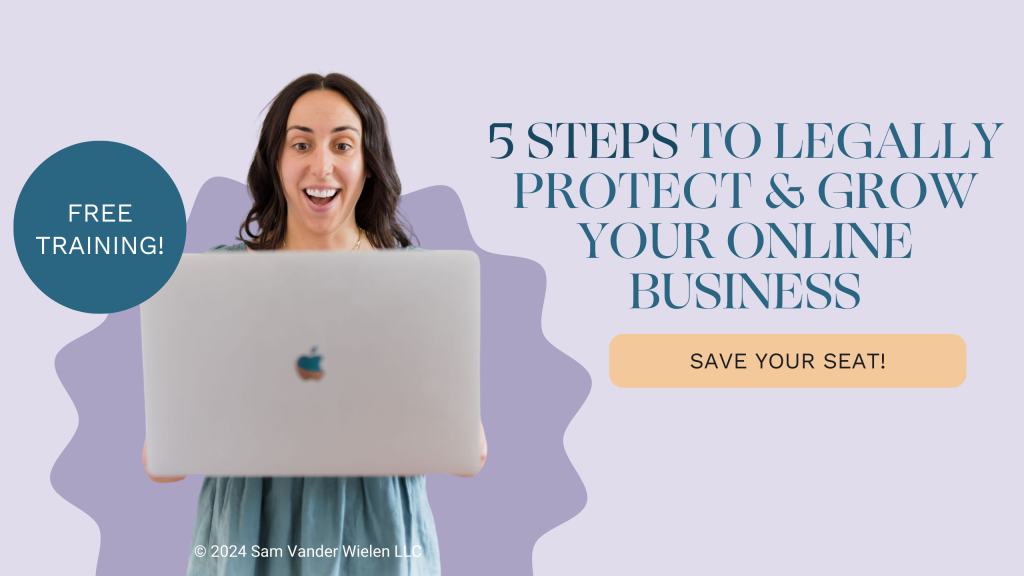
I can also tell you that I see a lot more people now come to my live webinar twice a year or my everyday, like, evergreen workshop, um, Five Steps to Legally Protect and Grow Your Online Business, and they come in thinking like, “Ugh, it’s gonna be one of those.
You know, she’s gonna tell me she’s gonna give me a lot of content or, um, value, but she’s not really. It’s gonna be a pitch thing the whole time.” And then again, people are super surprised because they’ve come to be kinda grizzled, I would say, about webinars or anything really that’s labeled as free. Even I would say this past month I’ve seen an uptick in comments on my ads of people asking me, “Is this class actually free?”
And I’m like, it, it… Yeah, yeah, of course. Like, I don’t even know what to say. I, like, get all tripped up ’cause I’m like, I’m, I’m advertising it as a free class. Like, I… What, what kind of person would advertise it and then charge for it? I’m sure there are people out there doing that, right? So people are clearly burnt by these people, and they, and then they’re gonna take it out on all of us, which is fair Just recently I’ve been seeing a little bit higher of a bounce rate on payment plans, um, or an even angrier tone when people want out of payment plans, which is interesting.
So, I mean, I’ll tell you that on the one side, this is a, I don’t know, a cautionary tale of like when you grow your business and you scale a lot, when you’re dealing with a lot of payments, you’re always going to start dealing with a lot of bounced payments. Like that’s just part of the gig With volume will also increase volume of bounced or skipped payments But I think what’s been interesting to me is to see maybe a shift in, like, the tone and the psychology.
It was probably a year or two ago I started getting… When I would get those kinds of, like, “Let me out of this thing even though I know it’s not refundable,” um, which is rare, but it happens for us. But people would say, like, “You make so much money. Like, what’s it to you?” Like, there was a lot more anger towards me, which I obviously just didn’t have before.
And I would say that nowadays I’m also seeing an uptick in people, you know, talking about what’s going on in the economy or saying that they’ve fallen on hard times or they’ve lost their jobs. And, like, I’m sure that some of it is true. I’m sure that there are some that aren’t. Like, it’s, it’s a very difficult, tricky position from my perspective ’cause it’s like I wanna believe everybody, but I also can tell that some people are lying based on, like, how they follow up and what they say.
Um, or sometimes people will just email me and say, like, “Can you just give me a refund? I just don’t want this anymore.” And then once you say no, they’re like, “Everybody died. My grandma died. My dog ate my homework.” Like, it’s all the excuses start coming out, so you never really know. But the point is I’ve definitely seen the tone of that shift
Okay, so if that’s kind of like how we got there and maybe even personally what I have seen as some of the changes in my own industry and my own business, what are some of the things that I think you need to do to create a digital product and course today in 2026 and beyond and make it successful?
And what are the things that have continued to make mine so successful and make my funnel continue to grow, and why I think everybody should stop treating me like my, my business’ funeral is upon us?
The first thing you have to do with your product is that it must solve a specific and undeniable problem, right? This is not a problem that you think they have or that they should have or that they should solve or anything like this. This is a problem … If, if we’re looking at the awareness scale, typically speaking, your consumer is, is probably problem-aware, ’cause otherwise they don’t even know what they’re really looking for.
So they’re problem-aware, they know they have some problem, and this is the problem in their words, in, from their perspective. The Ultimate Bundle®, the, the product that I sell today and that continues only to, to grow and get bigger, it solves a real and concrete problem that doesn’t go away. People need legal protection when they start an online business.
People who are not lawyers who want to start a business are confused about the steps that they need to take in order to start that business, and my people tend to be people who are a little bit concerned, you know, the double T-crossers, double I dotters, as I say. Like, they wanna make sure that they’re doing everything right.
And so they’re not gonna feel comfortable moving forward in their business until they really know that they’ve gotten everything, and the only way they’re gonna know that they’ve gotten everything and done things the right way is if they’ve worked with somebody like me, a- AKA a lawyer, right? So to me, that’s why the Ultimate Bundle® works. It solves a real problem, and it provides them a real solution that they need.
I think in 2026, you wanna be careful that you’re not selling a lifestyle or a vague transformation. I think people definitely used to be able to get away with that. I know firsthand many people whose primary way of selling their products online was just the fact that they had freedom in their own life and that they were making a lot of money.
They did not have the expertise. There was nothing particularly unique or transformational about what they were doing. I don’t even know that they were selling information. I think they were truly selling lifestyle and image and aspirational marketing. I just don’t believe that that works anymore, at least on its own.
Here’s the thing you need to remember. Buyers with a real and urgent problem will always pay for a real solution because it’s the vague products that are the ones that are dying. The second thing you need to do is build long game trust long before you ask for the sale. So if they’ve listened to your podcast, they’ve read your emails, they know who you are, right?
They are getting to know you in the process. You’re showing up on social media, you’re showing up on Substack, doing whatever it is that you’re doing. In a skeptical market, that runway matters so much because products sold to cold audiences with aggressive funnels are probably the ones that are suffering the most right now.
They were the ones that I was talking about earlier when I said people used to just be able to serve up, like, cold ads on Facebook to a random person who found out about this free training, didn’t know what a webinar was, didn’t know what a digital course was, and now all of a sudden finds out that this digital… creating their own digital course. They don’t even know that they want a digital course. They don’t even know what that is. They don’t know how to market it. But now they found out that through this ad, that if they create the digital course, this is their ticket to freedom, and therefore they buy something for $100, $300, $500. That part is the part that’s suffering the most. Those are the ones you’re seeing getting shut down
That’s why you might feel like, you know, you’re talking into a tin can with a string every once in a while in your podcast or in your emails, and you feel like no one’s listening. But I can’t tell you how important it is to show up consistently and for the long term. I think even having that attitude that you’re going to be there for the long term, it really relaxes you into being like, I don’t know, almost having this vibe or this attitude of like, “You know what? I’m here. Like, whenever you wanna come by, whenever you wanna come in, like, I’ll be here,” right?
Like, “I’m, I’m always here. It doesn’t matter to me.” I think having that kind of sales attitude really comes across to people, and that’s an attitude that you can translate to your content as well of like, “I’m gonna keep showing up. I’m going to keep doing this regardless of how many people are here right now, because I’m planning for the day when there are a lot of people listening.
The third thing you can do, and I’m shocked that this is even a tip at this point, but this is something, again, that people used to get away with and didn’t used to be true, which is very true now, is that you have to create a product that actually works. It does what it says it’s going to do, and it provides people with results.
Now, of course, all of you are going to have… That’s gonna mean something different for all of you, right? Like, my product, sometimes I get, like, sassy comments from people being like, “Well, of course you can sell your product, ’cause you do X, Y, and Z.” And I’m like, I feel that way about people who sell products that can get people money, right?
So, like, there’s always, there’s al- you’re always downhill from something else that you can create a story about. I have stories about how, like, there’s a ceiling for me because I can’t provide people with a financial transformation, and there are financial people I know who look at me and are like, “Yeah, but you’re, like, always in need, and that’s why you can do well.”
I can make this for any of you. I could make an argument for you if you transform someone’s health. Do you know how much money I would pay for somebody if I was, like, really having a problem and you could fix it, and you spoke to it, you had the expertise and you knew what to do? I’d be like, “Take my money.
I don’t care. I wanna feel better,” right? So your people exist. They are out there.
But honestly, I think that back in the day, people just used to get away with snake oil. I think they could sell snake oil and they could make a lot of money doing it, and then they could use the fact that they were making a lot of money doing it to make more money online, and that cut it for a really long time, and it doesn’t anymore
With the Ultimate Bundle®, for example, people love it because it works. Like, it does what it says it’s going to do, right? So like I’m not, you know, transforming someone’s living room or changing their body or improving their health or making them a million dollars. I am just doing what I say I’m gonna do.
I say that you’re gonna come in confused and overwhelmed and really worried that you’re not legally protected, and you’re gonna leave clear and protected, right? And you get those two things, and when you get those two things, you feel better. You tell other people that you feel better, and the whole thing kinda just keeps growing like that.
I don’t overpromise. I focus on over-delivering
The fourth thing that you have to do is create a product that isn’t just a bunch of information. So we talked about this earlier, but information-driven products are probably the ones that are the most at risk unless there’s some way that you’ve come up with of, like, delivering this information or synthesizing this information that is providing some sort of benefit or service to people.
People have, myself included, so much information, right? I have a bigger to-be-read pile, stack of books in my living room than I would probably ever be able to finish in a lifetime. And then you talk about AI. We add AI on top of everything. People have so many options at their fingertips. There are entire podcasts dedicated to solving problems that they have, I’m sure. YouTube channels, Substacks that they can pay $5 a month for, right? And read step-by-step analyses of how they can grow on Substack. There are so many different options available to people that didn’t exist in 2016 when I started.
So maybe that means taking a second look or repackaging, repurposing what you have already, but making people feel like it’s not just another information overload dump that they’re going to have to sit down and absorb like a college course, because I think between declining attention spans and the abundance of over information that we have access to, it’s just not selling in today’s economy.
The fifth thing you have to do is that you have to be consistent. You have to show up, you have to say the same things, you have to talk about your product until you’re blue in the face, and then talk about it a little bit more. People are skeptical, I think, of people who promote and bounce or promote and hop around, right?
I was just at a conference the other day, and somebody was talking about someone. They said, you know, “Yeah, they’re selling this product, but you know, next month they’ll be selling that product, because you know them, they’re always selling something different.” And I was thinking about how this, this just, like, is so important for your reputation, not only amongst your peers in the online business space, but with your customers and the people who are following you.
If they hear you talk about a program one month, and then the f- next month you’re doing this, and then the next month you’re doing that, and then two months later you’re offering some, like, breaking news, I have some new thing to offer you, th- there are… I think there are a lot of questions that come up for them.
First of all is how dedicated you are to the thing that you’re trying to sell, right? If I was trying to sell the Ultimate Bundle® and offering, like, 30 other things, I’m sure that somebody buying the bundle would be like, “How much time does she really have to dedicate? She’s saying that customer service is a part of it, but how much time does she really have?
‘Cause she’s off doing all this other stuff.” I think they also worry that maybe the product is not that good, right? Um, I know that when I see people doing this sometimes I’m like, “Maybe that group program they were talking about last month never filled, and so they moved on, and they’re doing, and they’re doing something different.”
I personally have… I have probably the biggest level of skepticism when I see people do this with, like, content topics. Like, they… Like, one day they’re, like, a health coach, and the next day they’re offering, like, habits, and then the next day they’re doing something else, and it’s just, like, very, like… I- uh, the energy I guess I get is like you’re kind of trying to figure it out, and that’s completely fine.
Everyone’s has their… deserves their time to do that. But I probably wouldn’t hand over money for a product or a program that I was afraid, like, wasn’t your thing. It doesn’t give expert energy. Like, I think when people are really truly experts in something, it’s like, “This is my thing.” Like, I’m a lawyer.
I spent a lot of time and a ton of money, multiple six figures worth of student loan debt, to become a lawyer, right? And if, like, tomorrow’s a doctor, and the next day I’m a dentist, and then the next day I’m taking out your trash, it’s just, like, it’s too much, right? And so just being really consistent with the fact that it’s like, “I am a lawyer.
This is my thing. This is what I’ve done for so long. You probably trust me, or I hope you do, because of how much time I’ve put in, and I’ve been consistent. I haven’t been changing colors every day.” So, I think that’s something to think about when, as much fun as it is to have different offers and to talk about various things in our businesses, I think that’s almost, like, a privilege that you get once you become known for your thing.
Last but definitely not least, the sixth thing that you should do to sell something in this economy is to put in the work. This is something that I probably undersell or underplay because I sometimes don’t fully recognize, uh, like the way that I work or how easy things feel to me now because I’ve been doing it for so long, right?
So like, it, it’s something like when I tell people, like, “I don’t work that much,” or like, “I don’t do that much,” I don’t think people realize how, how much of a freak of nature I am, first of all, with like how much I get done so quickly. But it’s also underselling all of the work I’ve put in to get to this point, and I don’t think that like- And one of the biggest differences is that back in the late 2016, ’17, ’18 era, the girlboss era essentially people were really selling the idea of ease, like how easy this all is. Like, “Look how easy. You can work from anywhere. This is so easy.” The irony is that behind the scenes, people like me, uh, were busting my ass and working the hardest I ever had. I was working more than I ever had. I was working more than I did as a lawyer by far, ’cause half the time at the law firm I spent Googling things about business or reading food blogs.
So I was working so, so hard, and yet people were projecting left and right this image of ease, right? And it’s like, but it’s not easy. It’s really freaking hard. And it only takes me about a minute when somebody asks me, like, “Hey, hey, quick question for you. Tell me this thing about your funnel.” And I’m like, “Uh…”
Like, my brain starts doing, like, beep boop, beep boop, like advanced calculus because I’m like, you have no idea how layered and textured that question is, and it’s not really until other people ask me that I realize just how much has gone into it. We think of every single freaking detail. Every single thing that happens in my business, in the funnel, in the words I use, in the words I write, in the images, like, everything.
It is super intentional. It’s a lot of work. It happens very naturally for me now, right now that I’ve put in the work and the time. Um, but it’s still really hard, and I don’t think that people understand that this is not easy, this is not fast, and it’s not cheap either. Because I can tell also from the types of questions I’ve gotten over the years that there’s a- people have also been sold this idea that it’s not supposed to cost anything to start a business.
And I write about this a lot in my book that I’m like, well, I- one of the things I love about online business and one of the things I think is so great about it is that it allows people to get started much easier than if they wanted to start a bakery, and you had to put out multiple months’ rent, outfit the, the bakery itself, you know, pay the plumber, do all the lights, do all the things, right?
You hire employees, take on tons of insurances, and all of these things, right? It’s way cheaper to start an online business. Don’t get me wrong. It’s not free. And so that’s, I think, like something that people don’t realize is that if you want this thing to be successful, you have to invest in it a bit like you would have to if you were starting your corner bakery, right?
You need to have, like, good branding. We should have a website. We should get your expertise up there. We should have some photos taken. Like, not everything has to be perfect. It doesn’t have to be what you end up with. But it’s takes money, and it takes money to start the legal side, right? You have to invest in the legal.
People will write to me and say, “I don’t wanna pay for a contract until I have, you know, lots of clients.” And it’s like, you’re not gonna have lots of clients if you don’t have a contract because you’re never gonna get up and running, or you’re gonna get sued by somebody. It’s not safe. So it’s part of the process.
But I truthfully, I mentioned at the beginning, I said something about how, you know, I’ve also adapted as things have changed, and I think that’s where maybe people don’t see the work that goes on now. A lot of people will make comments to me about how easy my business is because it’s kind of a set it and forget it.
Like, I created a funnel so many years ago for a product I created so many years ago, and it just sells every day, which is true. But the part that I, maybe people don’t see as, like, the hard work behind the scenes is that adaptation, is that, like, staying up to date and being like, “This is happening. Like, we all have to move over here,” or like, “We need to change this part,” or, “I’m gonna change the funnel because I see this thing happening in the industry.”
They don’t see the tens of thousands of dollars or probably the tens of thousands of hours at this point that have gone into the customer interviews and the customer research and the voice of customer that is painstakingly inserted in every single word of my webinar, in every single email that people receive very intentionally, right?
And so at this point, it’s like these little, like, boop, like these little moves that are big, big, essentially. They have a big impact. But no, I’m not building out an entire funnel. I’m not, you know, writing an entire email sequence from scratch. At this point, it’s refinement.
And so I think that’s where I will leave you with this conversation in terms of just really appreciating how much work this is going to take, and I hope that provides some sort of relief that, like, this was supposed to be easy or fast or cheap or free or, like, everyone can do it or something like that.
I don’t… I think anyone can do this, but not with every product. And so it really has to be, like, the right product for the right person, solving the right pain point, providing the right results, and that takes a lot of time and energy and expertise and intuition, a ton of intuition. So keep at it. Keep working at it.
I don’t think that online business… I definitely don’t think online business is dead. Maybe it’s dead the way we used to do it, but I don’t always think that’s a bad thing. Like, sometimes th- things need to change, and they need to evolve. And so, like, I, I hope that we’ve shed some of the things we needed to shed.
I hope we continue to shed some things that we still need to shed, and, and we add some new stuff along the way, but this is what makes the world go round. So should you still build a digital product in 2026? Yeah, for sure. I would just do it differently, and I wouldn’t do it as a passive income, like, super easy, working on the beach type of thing.
It is a lot of hard work. It’s super worth it, but it is a lot of work. And I think you should do it because… not because somebody told you it’s the move, because it’s the way to get out of your nine to five, or it’s, like, the easy way to make money. You should do it because you have a genuine expertise, and you’ve put in the time to build a genuine audience who trust you, and you can solve the problem that only you know they have.
With that, I hope you enjoyed this episode. I can’t wait to chat with you next week, and keep your eyes peeled for that Ultimate Bundle® birthday sale dropping on Monday, June 22nd. I can’t wait. If you get my emails, you’ll be the first to know and the first to join. I can’t wait to welcome you into the bundle.
Thanks so much for listening to the On Your Terms® podcast. Make sure to follow on Apple Podcasts, Spotify, or wherever you like to listen to podcasts. You can also check out all of our podcast episodes, show notes, links, and more at samvanderwielen.com/podcast. You can learn more about legally protecting your business and take my free legal workshop, Five Steps To Legally Protect and Grow Your Online Business at Samvanderwielen.com and to stay connected and follow along, follow me on Instagram at samvanderwielen and send me a DM to say hi.
Episode Resources:
- Get Sam’s weekly newsletter, Sam’s Sidebar
- If you have a question you’d like Sam to answer on a future podcast episode, you can submit it here.
- Click here to be notified when new episodes of On Your Terms® come out
Connect:
- Get Sam’s weekly newsletter, Sam’s Sidebar, to learn how build your email list, protect your biz & grow an audience online
- Watch Sam’s Free Legal Workshop “5 Steps to Legally Protect & Grow Your Online Business” to learn exactly how to start an online business the right way.
- Follow Sam on Instagram
- Subscribe & follow On Your Terms®️on your favorite podcast platform!
- Subscribe to Sam’s Substack, where she shares behind-the-scenes of building a life offline, after growing a multi-7-figure business online
Free Legal Class:
Want to make sure you start your online business the right way? Save your seat in my free legal workshop “5 Steps to Legally Protect & Grow Your Online Business” here: GET MY FREE TRAINING
Sam’s Favorite Business Tools:
- Kit // what I use to build my email list, send emails to my list, and create opt-in forms & pages
- Kajabi // use Kajabi to sell your course, program, or even build your entire website. Get a 30-day free trial with my link.
- SamCart // what I use for my checkout pages and payment processing, and LOVE. And no, not because it’s my name.
AFFILIATE LINKS: Some of the links we share here may be affiliate links, which means we may make a small financial reward for referring you, without any cost difference to you. You’re not obligated to use these links, but it does help us to share resources. Thank you for supporting our business!
DISCLAIMER: Although Sam is an attorney, she doesn’t practice law and can’t give you legal advice. All episodes of On Your Terms® are educational and informational only. The information discussed here isn’t legal advice and isn’t intended to be. The info you hear here isn’t a substitute for seeking legal advice from your own attorney.
© 2022 Sam Vander Wielen LLC | All Rights Reserved | Any use of this intellectual property owned by Sam Vander Wielen LLC may not be used in connection with the sale or distribution of any content (free or paid, written or verbal), product, and/or service by you without prior written consent from Sam Vander Wielen LLC.
–
–
 0 Comments


So What Do you think?