



May 11, 2026
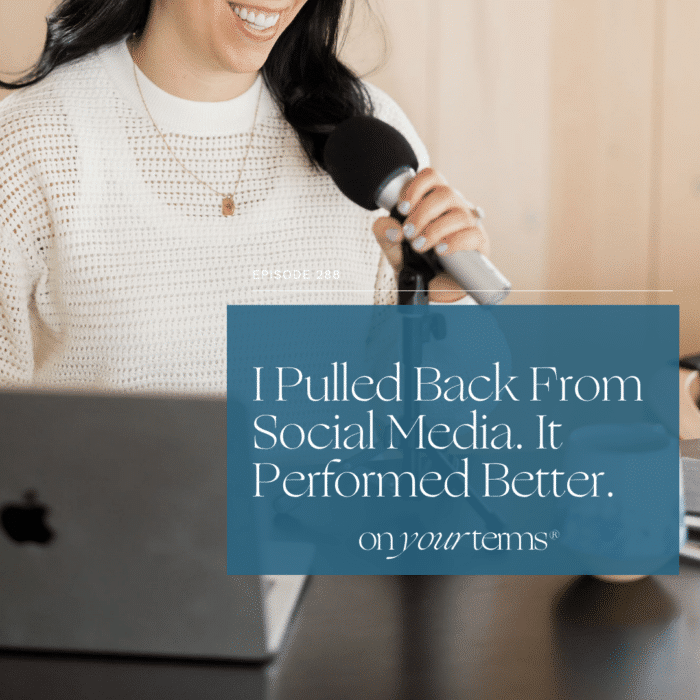
I Pulled Back From Social Media. It Performed Better.
Listen on Apple | Spotify | YouTube
Listen Now:
What if stepping back from social media was actually the thing that made it work better for your business?
I’ll be honest with you: my relationship with social media has been a lot. It helped me build a multi seven-figure business. Then it became my number one addiction. Then it turned into a coping mechanism I reached for every time life got hard. And then, after losing both of my parents, I basically wanted to throw my phone into the ocean and never look back.
In this episode, I’m sharing the full, messy truth of my relationship with social media, including the part that surprised even me: that since pulling way back, my content is performing better than it ever has. But here’s what’s different about this conversation: it’s not just a “hire a team and disappear” story. It’s a real mindset shift that I believe anyone can adopt, no matter what size your audience is or what stage your business is at.
In this episode, you’ll hear…
- Why my relationship with social media went from exciting opportunity to full-blown addiction (and how grief changed everything)
- The honest truth about why pulling back actually made my content perform better
- The specific tools and strategies I use to protect my time and attention without disappearing from my business
- How I restructured my content creation process so I spend less time on the app but show up with way more intention
- Why posting less might actually be the smartest move you can make, even if you have a small audience
Listen to On Your Terms® on your favorite podcast platform
Listen to episode 288, follow along so you never miss an episode, and leave a review to help introduce the show to more online business owners just like you!
From Slot Machine to Pacifier: How Social Media Became My Escape
When I started my business, social media felt like free money. The idea that I could just show up, create content, and have people find me and want to buy from me? I was obsessed. And that obsession worked. I hustled hard, and it built the business I have today.
But somewhere along the way, posting stopped feeling like opportunity and started feeling compulsive. I’d post something, it would perform well, and I’d immediately want to do it again. Like pulling a slot machine lever and hitting. I couldn’t stop.
Then, when my dad was going through chemo treatments, I started using social media for something else entirely: to avoid being present. I’d sit with him during his appointments, look down at my phone, and scroll until the hour was up. It became the thing I reached for in every uncomfortable moment. When my parents died, I found myself surrounded by the noise of everyone else’s highlight reels while I was standing in the middle of what felt like a personal emergency, screaming for help while the world kept scrolling right past me.
That’s when everything changed.
What Happens When You Step Back From the Scroll
When I started spending less time on screens, something surprising happened. Everything slowed down. In a really good way. I wasn’t watching everyone’s perfect morning routines or obsessing over how big someone else’s launch was — and suddenly I had actual white space in my brain to think about what I wanted. Would I even have a podcast if I wasn’t so wrapped up in what everyone else said I should do? It’s a question worth sitting with. Stepping back from the noise doesn’t just give you time — it gives you clarity about what’s actually yours.
The Mindset Shift That Changed Everything
The biggest shift wasn’t hiring a team or going off the grid. It was a simple but powerful decision: I picked social media up and put it down on my own terms. I am not a victim of it.
Once I started treating social media like work, everything changed. Work has hours. Work has a purpose. You don’t wander into the office with no agenda and just scroll around for three hours. You show up, do what you need to do, and then leave.
That reframe, combined with doing a lot less scrolling and a lot more intentional creating, is what I believe has led to my content actually performing better. The less time I spend on the app, the more time I have to make the content I do create actually good.
This mindset is available to you no matter how big or small your business is. If social media makes you feel terrible, that’s not a story about your audience size or your follower count. It’s information worth listening to.
The Brick, the Browser, and the Other Tools That Actually Work
One of the most practical things I’ve done is start using a physical device called The Brick (affiliate link). It’s a small magnetic device you put on your fridge (or desk) that you have to physically tap to unlock certain apps on your phone. The scheduling feature is the real game-changer. I have mine set to automatically lock all social media apps from 7 PM to 8 AM every day. No willpower required.
I’ve also started using Instagram’s browser version instead of the app whenever I need to go in for business purposes. The browser is clunky and kind of annoying, which is the whole point. You can still respond to comments and DMs, do content research, and check in on what’s trending, but you’re not going to fall into a 45-minute scroll spiral. It’s boring in the best possible way.
I also keep my phone physically in another room at night, treating it like it’s a landline wired to the wall, just like my dad’s old rotary phone. Creating that little layer of friction is surprisingly effective.
Show Up Less, But Make It Count
This is the part I want you to really hear, especially if you have a smaller audience and you’re thinking this doesn’t apply to you.
Posting consistently but carelessly is not a growth strategy. I’d actually argue it’s the opposite. Showing up every day with content you threw together in a hurry because “it’s Wednesday and I need to post something” is creating noise, not connection.
What I’m doing now instead is batching. Once or twice a month, I sit down for a full creative day. Recently, I knocked out 10 voiceover scripts in one sitting, recorded all 10 voice memos the next day, and every single one of those pieces aired in a single month. All of that was created from one focused, intentional work session rather than the daily scramble of “oh no, what am I posting today?”
I’m also asking myself with every piece of content: what else is this doing for my business? Is it leading people to my email list? To my free legal workshop? To my book? If it’s just adding to the noise without a purpose, I don’t make it.
The result? Less time on the app. More focused content. Better performance.
Transcript:
Sam Vander Wielen: If you’ve ever thought about getting off of social media or at least stepping way back, but you’re scared to because you have an online business and you think you can’t afford to, this episode is for you. I’ve had a really complicated relationship with social media over the years. It helped me to build my multi seven figure business.
Then it surpassed popcorn as my number one addiction. Then it became my digital binky. And then after losing both of my parents, I’ve basically wanted to throw my phone into the ocean ever since.
Today, I am sharing my honest thoughts and true relationship status with social media, including the part that surprised even me, that my social media is doing better than it ever has.
Today I am sharing what’s actually changed and the answer might surprise you.
if you’re new here, I just wanna welcome you to On Your Terms® and if you’re returning thank you so much for listening. I appreciate you so much. On Your Terms®, is a podcast for online business owners who wanna be as present in their lives as they are profitable in their businesses and we can build really profitable businesses off social media that’s just the truth of it. Social media is a fantastic tool to reach a lot of people. It’s a marketing channel, that’s all it is. It’s kind of free advertising.
Although I would probably make a pretty big argument that there should be a big fat asterisk after free, that it’s not really free considering. It costs a lot of us, our mental health and our time, and probably our posture and our sore necks.
But in general it’s a great tool to use to build your business, and I couldn’t have built this business without it. I couldn’t have started off without it. That’s for sure. But I also know that we’re here a lot of us because that’s, we’re not just our businesses, right? Like I, I hope that I’m a lot more than my business and I want to live a lot more of my life offline than I do online.
So today I thought I would talk a little bit about how pulling back from social media has actually helped me to grow on it. But I think within all of this, there’s a deeper story about my relationship with it and kind of my. Uh, time spent. I mean time, definitely like the, the addiction that I developed to it.
And then, um, hopefully like unraveling. Also, I got a really good question on Instagram yesterday when I said I was going to talk about this topic and someone said, you know, rightfully so, but they were like, respectfully, whenever anybody talks about this topic, it’s somebody who has a really big following.
Like, what about the rest of us? And I was like, totally. Good point. Very valid point. And that’s why a lot of what we’re gonna talk about today is actually not just like. Hey guys, I never show up on social media and I do great and like all I did was go off and hire a team and like, now things are great.
So if you just do that and like pay $4,000 a month, you too can be successful online. Like that’s kind of true. That’s like part, part of my story. But I actually think that the deeper part of my story is a mindset shift related to social media, how I show up on it and how I create the content that has led to a lot better results there and a better relationship. And I think that all of those things can be adopted by anybody at any size, with any budget. And in fact, I think what’s gonna surprise you the most in today’s episode is when I talk about how much time I’m actually spending towards creating content. Because I would actually say that my amount of time has gone up while my amount of time somewhere else has gone way down. And I think that that’s the big difference. So we’ll talk about it.
Before I hop into the bulk of today’s episode, don’t forget that you can send me a quick video or a voice note or a text message using the link to submit a question to me down below. If you don’t have a question, leave me a comment, send me a note.
I don’t care what it is, as long as it’s not mean, I don’t care. But send me something down there. If there’s something you wanna talk about, um, something you want me to talk more about on the podcast, this is the place to do it. So please go ahead, click away. Use it judiciously. Click and let me know. What questions do you want me to answer here on the podcast?
All right, so I don’t know about you and when you grew up and like what you were into when you grew up, but let me just paint a little 2003 picture for you. I was a girl obsessed with California. My whole life was about how I was going to get to California. Everything in my life was focused on it. Okay. I, I was a volleyball player. My whole life. And then, and then got like insanely into it in high school. Went and played on the Junior Olympic team, got to travel to, uh, China to play, then started getting really into beach volleyball.
I’m five four by the way, in case anybody wants to talk about this. Um, my friend Natasha thought that I was like 5’11, uh, when she hadn’t met me in real life and then was shocked when she met me in person.
Um, so I’m not, not tall. By any means, I can jump like an insane human being. Michelle, here, my producer’s nodding along because she feels like I have freakishly high jumping capabilities, which is true. Okay, so just to clear that hurdle, I, I played volleyball, got into beach volleyball. I had this just like whole dream of moving to Huntington Beach, California and like I was gonna live my life there and be a beach bunny and then like, also like a Roxy Surf girl on the side, and I was gonna be like sponsored by them and have all this like Billabong and Roxy stuff and live in like the Roxy house. And I had a whole, I had a whole thing going then. You can imagine my surprise when this show comes along called Laguna Beach, right?
Unbelievable. Blew my mind. And all it did was confirm that I too, in fact, wanted to live in Laguna Beach and date Stephen Colletti. And now, I don’t know if you’ve seen it, but they, the Laguna Beach kids, they’re not kids. They’re older than me, but they, they went, they went and did a reunion. So this is now like making all the marketing circuits, like all, every single place I look, it’s all Laguna Beach people and I keep getting hit on YouTube with all these YouTube videos of like LC and Kristen like sitting down and talk about their like high school beef. And I, I just can’t help but imagine for myself like thinking this would be like me sitting down with a girl I didn’t like in high school. And I just couldn’t imagine ever having this conversation or anyone ever carrying to listen to it. And that’s why I would like to announce that this podcast is now becoming a podcast where I confront all of my bullies in high school. No, just kidding.
So anyway, watching all of this has made me very nostalgic for a simpler time. I haven’t been able to stop thinking about this. This is like, has blown my mind. What would Laguna Beach have been like if they had social media? Can you imagine? Can you imagine what their life would’ve been like? What like would’ve happened to their careers? Like I just. I cannot picture it. I would’ve been a woman addicted. I wouldn’t have been able to go to school. I would’ve been sitting there figuring out like what was Stephen Colleti doing and all of that.
And when I think about like how like, I don’t know, envious, jealous, like reminiscent I am about that time, I realize honestly how bitter I am, like how bitter I am about social media and everything that’s happened. I’m so like grizzled and old about it where I’m just like, look at what this has done to us and it’s ruined society.
And like I, that’s just honestly where I’m at with it. I can see and feel how much disdain I have for social media, and yet I am on it. Every single day I’m on it every day I’m there running a business on it. That’s bigger than anything I’d ever imagined building. I have a Instagram following that I don’t think is anything to write home about, but I can tell you in real life, people automatically treat me differently once they see it.
I’ve seen it happen where people have treated me like shit to my face, and then literally the very next time I see them, they go, oh my God, I didn’t know that you have this. And now they’re nice to me. It happens all the time. All the time. And so I have this thing. It’s so strange to me. I feel like I’m in the middle of it where I’m like, I hate this thing.
I kind of need it. I mean, I recognize I don’t need, everything is a choice. Like I could say, I just don’t wanna be on it anymore. And then I’d have to just take the consequences of what that means for the business and for me.
So many of you feel similarly where you’re like, I hate this thing, or I don’t love it. I don’t like how it makes me feel. I don’t wanna spend all this time on it. Also, I kind of feel like I have to for my business, or I have some sort of obligation there.
I have to say, like when I started my business, social media felt fun. I mean, for one thing I had a much better attitude about it that it just felt so like. It felt like free money, like free, free house money that you were playing with. ’cause it was just like, wait, I can just go on this thing, create some content, and then like people just see it and then they wanna buy from me.
Like, just the fact that that like cycle could happen. I didn’t have to pay for, it felt like such a privilege. Like I, and I still feel that I definitely still, like when people get really pissy about social media, I’ll usually just be like, it’s, it is what it is. Like it’s a gamble. You know, like people act.
People act very entitled when they talk about like the algorithm changing and they don’t like that this happens or that happens and it’s like, well, we’re not guaranteed. Nobody told you like, this thing is guaranteed to be this way and it’s free and if you don’t like it, we can go somewhere else market our businesses that way, you know?
So I still have that, like somewhere in between attitude, but I felt, I guess a lot more of the just like excitement of the opportunity and potential of this platform back then.
I also hustled and hustled and hustled my little tush off, um, on, on social media and elsewhere to get my business out and admittedly, I think this is what started to build a really unhealthy relationship with it, I don’t think I’ve ever played slot machines before, but I’ve seen a lot of people do it in Atlantic City. Um, ’cause I’m from Philly and, uh, I kind of envisioned this thing of like, I would go on social media, post something, it would go well and then I’d be like, oh my God, I wanna do it again.
Like, it’s, it’s the equivalent of like pulling the lever, like, you hit, you wanna go again, pull the lever, hit go again. And it really, to me, developed that pattern in myself. And I think that that me honestly, having an unhealthy relationship with it and being so addicted and being on it so much and all of that built the business that I have today, like there’s no way around it.
Uh, that hustle period definitely did it, on the one hand I have this, still have this opinion that I think like everyone has to go through a hustle period. I don’t think it has to be so unhealthy or so extreme, but I do think there’s a hustle period regardless. , And I think like most of our anxiety, I can build a very well crafted story about how that anxiety actually helped me and like got me where I wanted to go.
And it may have, that may be true that that like obsession and me being like, I have to build this, this has to be successful. Did help me, but that it doesn’t, it no longer serves me. Right? And so like you can, something that used to work for you maybe just doesn’t anymore.
I would say that I then sort of turned social media into a pacifier. Um, because for me it started to turn into the thing that I turned to in uncomfortable moments, moments of pain moments, uh, whether they were literal, actual moments or just like phases in my life when my dad was sick, when I’m sitting with him in the chemo room, I, I literally, when my dad used to get chemo, I took him to all of his appointments and I would sit there and I could not physically see them, poke his chest. He had a port in his chest and I could not physically look at them poking him in the chest with this thing, because to me it was like, well, for one, I, I mean, I don’t mean this in like a weird Maha way that like chemo was poisoned, but I, I, you know, obviously it’s not great, but he had terminal cancer and there’s, if you’ve not been down that path, I really don’t want to hear what you think about it and it’s like, that’s, that’s the truth of it.
Some lady wrote me a nasty email one time about how my dad drank an Ensure shake. And I was like, lady, until your dad is on the, on like death’s door and ensure’s the only thing you can get down your throat without throwing up, like, please shut up. I don’t wanna hear from you.
So anyway, I, I just honestly, it feel like, uh, just take me at my word that it feel, it felt like poison, but I understood he needed it right. And so I couldn’t even look at it. So I would look down at my phone and then I would scroll Instagram, and then I’d be like, oh, a food video. Oh, a dog video. Oh, an animal video. Here’s a dog and an elephant that became best friends. And then like, you know, an hour later, my dad’s done his chemo. I’m completely vegged out, like hadn’t looked and that repeat that every single day for years and years of him being sick.
It was also the thing that I turned to when I felt nervous or uncertain about the future, and something tells me this is something that you can relate to, which is like when I would have my more, uh, kind of like second guessing myself moments in my early stages of my business, I would look to Instagram for probably confirmation of what I was feeling. So if I felt like, oh, this other person’s so much more successful than me ’cause they’ve already done this and that. And then I would go to their profile and be like, see, look how much more engagement they have. Or look at this giant speaking gig they got, or look at how they already got a book deal and I can’t get one.
And I would use it for, to like almost look for the reasons why things weren’t working for me or why they weren’t possible for me almost as a way to like count myself out.
And then my parents died, both of them, same year, and I wanted to just honestly throw my phone into the ocean. I mean, yesterday somebody wrote to me and said like, you know, people don’t understand until they lose somebody like that, that you just start to, you, you like reorganize every single thing in your life.
Like everything gets re prioritized. You look at everything differently. You see the world differently, and social media just made me angry. Like first, at first it was like, how can you guys all be having fun when this like gigantic thing just happened? Like I kind of felt like I was like standing in the middle of the room, like screaming for an emergency and everybody was like just still partying around me. That’s kinda what it felt like. And then it just started to become like a place where I would go to see everybody else’s, like family photos. And I’d be like, oh, well that’s nice you have a family. My family’s dead, but that must be nice, you know? And then I would see world events and politics and obviously for many years now, that’s just made me filled with rage and anger and sadness and frustration, right?
To then just feeling like, oh my God, this place is just so damn loud. Like I can’t, like there’s just so much coming in. I think that started to really, really build when a lot of video content came in and specifically, like really fast paced, short form content started to come in. There was like ala, TikTok. That to me is when it started. Just like bubble and bubble and bubble. And at the same time I was feeling very alone and very isolated in my life. ’cause like, you know, my family had just died.
I had moved away from where I was from. I’m from Philadelphia, I moved to New York and then I would turn to this thing that’s called social media and I would just feel worse. It was not social at all. I felt more disconnected than ever.
I actually wrote about this the other day, what this has actually felt like, like the grief, the, the addiction to the phone and social media, the disconnection that I keep bumping into everywhere I go. And I thought it would be fun to try something a little different here. And I thought I would read to you what I wrote, and then I’m gonna come back and talk to you a little bit more at the end about how this has impacted my ability to show up on social media, how and why I think my social media is actually doing better now than it ever has before, and what my recommendations are to you if you want to adjust your relationship to social media, regardless of how far along your business is, how much revenue you’re making, or how many followers you currently have.
So this was a piece I wrote for my substack called Beyond Business, and the title of the piece is, I’m Trying, but Everyone’s on their phone on grief locked doors and what it feels like to look up from your phone and still find yourself alone.
Lately, when I’m out, I feel like I’m surrounded by zombies. Zombies who have been taken over by little rectangular devices that endlessly play short, allegedly entertaining videos. They never look up. They’re so closely hunched over their phones that it could perform an endoscopy. It might sound like I’m about to write a piece ripping everybody’s phone usage to shreds, but that’s not really what this is about.
This is a story about someone, me, I am the someone who’s grieving the loss of both parents and reentering what feels like an entirely new world. I’ve spoken about this many times, but since losing them, I’ve never felt so alone in the world. I have a wonderful husband and the world’s cutest dog, but I’m telling you, until you’re in my seat, you do not know how weird it feels to be in the world without the people who brought you here.
The word I always come back to is untethered because all I can picture is me as a little girl floating around the world, holding onto a string of a balloon that’s been ripped off its base. As I try to find my way in the dark of this new to me world and connect with something, anything, I feel like I’m running into a series of locked doors as I try to open each one.
I’m met with resistance: zombies staring at screens. I’m not talking about all this zombie dom from some high up pulpit or anything. I’m seeing it because I was slash am of them. I can feel myself stumbling out of the zombie coma, still disoriented, but also wanting to scream, what are we doing? We’re wasting this one wild and precious life.
I imagine as you work to undo any addiction, you start noticing how prevalent it is around you. If someone stops drinking, they’re the one who notices the White Claw in their local pizza joint’s fridge, or the boozy brunches that start at 10:00 AM.
For me, my phone and the apps on it are slash were my addiction, but now that I’m getting off the sauce, I’m noticing things I didn’t before because my face was buried in my phone too.
A few months ago, as I weaned off of it more and more, I started taking notes in a pocket notebook on what I saw.
A mom and her 10-year-old son are waiting for their haircuts on a bench in front of the salon. Neither of them responds as I say hello. After walking in the door.
They’re both hunched in the shapes of seas with their noses nearly touching their iPhones. They haven’t said a word to each other or interacted the entire time. I feel a gut punch in my stomach. I’d give anything to sit on that bench and chat with my mom and dad. Right now.
When the stylist calls up the sun for his cut, he plops into her chair still slumped over his phone. I wanted to tell the mom how cute her new balances were, but she never looked up.
I’m standing in line for Spaceship Earth and Disney World by myself. There are families and couples all around me, every single one of them on their phones.
I try to make a conversation with them as we wait, but when I do, people look at me like I’m asking for their social security number in exchange for a free cruise, I have a, I’m celebrating my dad Norm pin on my backpack, and I’m dying for someone to ask me who’s Norm? I’d tell you how much he loved Costco and how I called him the accidental vegan.
I’d tell you how much I miss him and that I’m here to honor our trips together. I’d tell you how hard it is to be here without him.
I’m not trying to be judgy. I’m just noticing what I see. Of course, there are totally fine reasons for people to be on their phones, and while I agree with Mary Oliver that we have this one wild and precious life. It’s also true that it’s up to everyone how to spend theirs.
Who am I to say that life is better spent off of devices? I’m going through this whole life thing for the first time too. There are also so many good reasons to be on your phone. It lets us keep in touch with people we love Cute dog videos on Instagram due, in fact, sometimes lift my spirits and we have apps that help us meditate, work out, and eat better.
As my mom always said, nothing is all good or all bad. I know that not everything I see is the result of someone having a bad day or needing to check in with a loved one. A lot of it’s habitual and systematic. In fact, I’d argue it’s automatic and totally subconscious.
In my defense. In many of these cases, I can actually see what they’re doing and 99.9% of the time they’re watching Instagram reels or tiktoks. I’m fighting the urge to yank out my phone while I wait for my coffee to arrive on the counter.
I’m putting my phone away when I’m waiting in line for my harissa chicken kava bowl, and I’m trying yet still failing to do the most impossible thing. Sit quietly in the doctor’s waiting room without scrolling TMZ and the New York Times.
It’s not easy and I don’t always do it, but I’m trying to do it more and more and more. What I can tell you is this.
When I do put my phone away, I feel better. I feel more clearheaded and present. I don’t feel as jumpy and agitated as I do when I spend a lot of time on social media. Am I the only one, by the way, who social media makes you feel so agitated? But if I am doing it alone, I’m still looking up. At a bunch of zombies.
I feel so disconnected from the only world I ever knew. Yet the new world I’m trying to navigate feels more disconnected than ever. Everything I knew to be sure is gone. I’m wandering around looking for something to grasp onto something that feels as safe and familiar as my dad’s hand or my mom’s beach house railing.
I stretch out my hand only to grasp the air. It’s all gone. I haven’t found anything yet, but I’m looking up XO Sam.
So as you got a little bit of a flavor of, in that essay that I wrote for my Substack Beyond Business, grief really has impacted my relationship with my phone. I mean, I would say that grief has just fundamentally changed me as a human being, and then therefore, like the phone, like everything else has changed.
I think that when you’ve gone through this kind of like radical change or like you know what? I feel like I’ve been like burnt to the ground and them like being rebuilt kind of is that you just start to reorganize- and re-question everything around you. Like if your house burnt down, God forbid, you, I’m sure wouldn’t put back the same mess the way it was before, right?
You have this opportunity to do things over to get a little bit better organized.
At first, I think when I, my parents passed and I wasn’t on social media or on my phone as much, I would say that my social sort of took a hit. But after a while I found a really nice balance where I feel like I’m spending a lot less time on the app itself, but yet my content itself is performing better on the app than ever.
I thought I would share with you a few of the things that I’ve done and then what I recommend you think about doing regardless of where your business is at or how many followers you have.
For one, I really leaned into the mindset that I picked social media up and put it down on my terms. I am not a victim of social media.
I get to choose when I’m gonna be there, how I’m gonna be there, how often I wanna show up, and what consequences I’m willing to accept in my business, regardless of how far along you are, right? Because if you’re sitting here listening to this episode and you’re like yeah, social media makes me feel terrible, but I have to be there because I have a smaller business or fewer followers.
That is still a story because in your situation, you could actually choose to go out and find your customer base in other places other than social media, you could find them or maybe just not even on like the app that’s particularly problematic for you.
Like a lot of people, for example, are feeling like TikTok and Instagram aren’t great for them, but they’re not getting that same feeling from something like Substack.
Some people feel that way about Pinterest. I feel this way about being on, you know, recording my podcast and marketing and producing this podcast. And I also felt like that about being on YouTube. Like I don’t get the same icky, weird feelings being on YouTube. For some reason, YouTube’s like doesn’t, I can’t, like, I can’t correct the YouTube cone personally, and I find it pretty exhausting, to be honest, to do so many videos.
If you were really, really into that, I don’t think that gives people the same ick as platforms that are so heavily focused on short form content. I think really when we have this conversation, so many of the problems come down to what’s going on with short form content.
Honestly, so much of this has to do with reevaluating your boundaries and the rules that you have around your phone usage and your social media usage. So I wrote an article a couple of months ago about how I got the brick, so it’s this little tiny brick looking like device that you can put on any magnetic service.
I have it on my fridge. Um, some of my friends put it on their desk or whatever else, and basically you have to like tap in and tap outta your phone to use certain apps that you designate. The thing that I actually find the most helpful about the brick, um, to be honest, is its schedule feature because you can schedule it automatically without having to go tap it to go into brick mode and you get to define what brick mode means. So you can, you can label them like I have cutesy names, like called like lockdown. And then like another one’s like antisocial, which means like just all not social apps, like so you can name them and you can create all these different ones and then you can schedule it to automatically go into, for example, anti-social mode.
Um, which what I have is 7:00 PM to 8:00 AM the following day. So I cannot access any social media apps, um, and a bunch of other apps that I’ve kind of put in, in that category, um, from that time period automatically. If I do need to use it, I need to get up, go tap the fridge with my phone and unlock it.
Which honestly, I just don’t do, I, I also have started keeping my phone out of sight. Like I, I landline my phone at night, so I keep it on a table in the front of our house and I just kind of pretend, like, pretend like it had a wire and it was wired into the wall, like the rotary phone that my dad used to have in his kitchen, right?
I just pretend like that’s what it is and I leave it there. And then if there’s something I do wanna look up or something, somebody I need to write to, I have to go to my phone, do that, leave it there, and then walk away. It, there’s something about just creating these little levels of friction that I think really work.
We have an affiliate link for the brick down below. It’s not that expensive, I think, for what it is and, and the amount of like freedom and time it’s brought back to my life. I think it’s worth it. Um, definitely something to check out for me. It works a heck of a lot better than all the apps. I know everybody tells me about like Opal and all these other apps. They’re, they’re good and I think I’ve used them before. I think there’s something to having a physical barrier. Also, one time , I bricked my phone and then Ryan and I went to our house in Vermont and I forgot to unb brick it.
I had to spend the whole time in Vermont with my phone. Basically, the whole phone had been locked out except for texting and calls. That was it. And it turned out to be great. And I was like, oh, I should do this. Every time I go to Vermont, I don’t need it. So, yeah, there’s just something like if I had had the app, I could have just undo that in a heartbeat, you know? So it’s, it’s a lot different.
But leaning into that, I think that you can create a lot of rules for yourself as to like. Lean into the mindset that I talked about earlier, that posting on social media is work. It’s for your job. Your business can be your job. And so your job would be normally nine to five or whatever hours you like to keep, whatever hours you can keep and you can say to yourself, I can use social media during those hours, or better yet, let your phone brick itself and only unb brick for two or three hours at the same time every afternoon. That way you know that on those days you go in, you post to your post that you have to, you do any engagement, you have to, you post a story and then you’re out.
I personally, I delete the app off my phone even though it’s still getting brick. It’s like a double layer of protection in my mind, but I delete it. But even if you didn’t, if you gave yourself however much time you needed and then got out, the app is gone and so it, it does allow you to start treating it like work and going to the app and on the app on your terms.
When I do show up on social media, I make it count, and this, I think, is a tip that can apply to you regardless of your Instagram or social media size, or your business size or anything like that.
When you’re there, be there. Be there to be a business owner. Be there to promote your business, to sell your stuff, to get your message out there, to let people know about your free event or your freebie, or your email. Whatever it is, like be there and then get out.
I think if we’re honest with ourselves, and I certainly know this is true for myself, the majority of the other time we’re spending there is not for our business. It’s consumption time. So that’s when we really start to spiral. That’s when we don’t feel good, right? That’s when we go down all these bad rabbit holes.
So the biggest difference that I’m seeing these days in how I spend my time and on what is that I’m putting way more effort into actually creating the pieces themselves, like the pieces of content that you see. And then that has like taken away from all the time I used to spend on the app.
And so it’s kind of this like funny balance where it’s like I actually am spending less time on social media, but my content is on social media way more, if that makes sense, because I’m spending the time creating these, you know, hopefully more thoughtful pieces of content that then go a little bit further.
They’re performing better than they did before, but that has left me with less time to hang around and do nothing but scroll.
When I’m there and when I create, when I like kind of conceptualize any piece of content that’s going to go on social media, I’m always thinking about what else it’s doing for my business.
Is it pulling people to my email list? Am I asking people to buy my book? Am I asking people to come join some event? Like, so I’m not just creating to create, to kind of continue to add to the noise of social media. I’m making sure that it’s going somewhere. I pretty much only ever batch content these days.
So I take one or two days per month and I sit down and I do a whole big chunk of creating posts. So this might look like, a week or two ago, I sat down and I did 10 voiceovers in one day. So I had, I had taken one day where I had written all the scripts for all 10 of these voiceovers. I knew the concepts I wanted to do. Did a little research, looked at some examples of other people who in other industries, who had done like a similar post, but I was going to translate it into like what I do. And then I conceptualized it, sat down, wrote the 10 scripts for these voiceovers, and the following day I just sat down and knocked out all 10 of these voiceovers in independent voice memos.
Um, so that those could get laid over some B roll. So, uh, just, you know, regular, everyday video of you doing something around the house or out and about or whatever. And all 10 of those pieces of content will have aired just in April.
So I’m definitely not doing what I used to do, which was like create like, oh shoot, it’s Wednesday, I have to post. Okay, let me think. Okay, let me think of a topic. Okay, now let me sit down and record it. Now let me edit this real quick. Okay, now let me post, oh, I gotta write the caption. And it was just so hurried, let alone anxiety producing and had me in that mode every single day.
I think what’s great about batching is that you can sit down and be in that mode, like really put your content creator hat on for the day, knock out however many pieces of content you need to in a day, and then you can get outta that mode again. You don’t have to be in performance mode thinking about how things are gonna be perceived. You can switch back into taking care of your clients, doing more marketing in your business, writing your emails, whatever else you have to do.
So I talked earlier about how sometimes a bit of this is about what you’re willing to sacrifice, and I think the biggest area that I’ve learned and still am learning to sacrifice on are around Instagram stories.
So you have to understand that when I started my business, Instagram stories were still very popular. Well, first they didn’t exist. Then when they came in, they were very, very popular and it was something we spent a lot of time on. I used to do a literal training on Instagram stories. Every single day, which I cannot believe, and it expired in 24 hours.
But anyway, I used to do this and I, and obviously this has changed a lot over the years, and then it became like, oh, stories are a place to like show the behind the scenes and like the personal stuff and like more like a diary of your day and like taking people along with you, which still took a ton of time and I’ve seen over time that even that is not quite the thing anymore and also starts to make me feel really tired and exhausted.
And honestly, the thing I don’t like about it the most is that it pulls me out of being present of whatever I’m doing, what I’m out about because when you get in the habit. Of doing what I was doing, which was like, oh, I have to post on Instagram stories every day to like, I don’t know. I don’t even know why.
I just was like, oh, I guess I have to like be there, right? Like you have to be relevant. You have to be there. Or something’s terrible’s gonna happen. I don’t know. And so then when you’re out and about, you’re thinking like, oh, I got, oh, I’m meeting my friend for coffee. Well, I need a video of the coffee obviously, because now I need something for this.
And then it just starts to get you thinking like that all at the time, so I slowed down quite a bit on stories, definitely over the past year. Um, and I haven’t seen it made a big impact. I actually took this, um, I don’t know, tip or method from my friend Natasha pierre is so good at this. She’s at Shine with Natasha on Instagram, and she was really the first one that opened my eyes to this idea that it’s like she posts on stories when she posts, and when she does, she really just makes it count.
And so maybe she does it, I don’t know. I’d have to ask her maybe three times a week or something. And you have to remember these last for 24 hours. So if you post on Monday, you’re now gonna have stories for like Monday, Tuesday. I don’t think she shows up again until Wednesday. So on and so forth. So it’s a very smart strategy actually of like you show up, you create like one good one.
But she also has a very hard policy. I know from talking to her behind the scenes that it’s like she only posts if she knows that she has something really good to share. Like if she has something to say and if she’s not feeling it, like whether she’s having a bad week or she’s traveling and wants to be present with her family, she doesn’t do it.
So much of what we do in our businesses is like, I think an accidental ego problem where we just like think that everyone’s gonna miss us or something’s gonna happen.
If we don’t show up, and then you realize that like everyone’s really overwhelmed and inundated and, and doesn’t really matter if we don’t show up like that, but if you’re going to show up, make it count. Right? And so I think this is where you can apply this mindset of like, maybe you have a story around how often or how much you need to post, but instead you could probably play with something of like do I actually have something of value to share? And I don’t mean value, like, oh, this has to change somebody’s life, or no one’s ever said this before. I just mean like, do you have something you really feel called to say? Are you creating to create? And if you’re not feeling it or you’re not having a good day or whatever, then that’s a sign that you don’t need to do it that day.
And like giving yourself a bit more permission. And yes, I absolutely think this applies even if you have a small audience or a small business, it doesn’t matter. I, I don’t think that like, once you have like that, I don’t think you need to post a bunch of slop and, and just like check off boxes because you have a small audience.
Because I would actually make the argument that you’ll never build a big audience by doing that. So I actually think you’re better off pulling back and doing better, but fewer things.
One of the things that I noticed by pulling back on Instagram stories is that it gave me more time to do what I would just kind of generally categorize as bigger things like whether it was actually on Instagram, you know, in terms of, uh oh, I can take this time and focus on creating a reel that might have longer reach and will lead everybody to my free legal workshop, which helps me more in the end, right? And so there’s that, or I would say that what I’m noticing now more than ever is that I just have more spaciousness to be more creative to hopefully plan better podcast episodes to put more time and effort into the podcast episodes.
For my writing, I hope to be getting better and stronger. My sidebar emails, I’ve been pretty proud of my, uh, substack.
I’m working on like every, it’s just giving me time to work on things that I think matter to me a little bit more.
The last thing that I do now that I would highly recommend is that I use the browser now most of the time when I need to do things on Instagram instead of the app itself.
The browser just doesn’t do it for me. The way the app does, it’s, it’s kind of boring. And even like, it’s funny, like watching stories, it’s kind of annoying and like there’s no way to pause them so they jump ahead and you’re just like, uh, and you just get frustrated and you leave. Like it’s just not, I don’t know, it’s like going back to dial up internet.
And so I think it’s a great, it’s a, a great, um, little hack if you need, quote unquote need to be on or want to be on Instagram. Because you have a business there and you want to promote stuff, but you don’t wanna get sucked in first of all, it’s a lot easier to respond to messages and comments on the browser ’cause I can use my keyboard instead of my little tiny phone. So I use it for that. But then also, if I need to do any research of like I wanna create a certain reel or see something that’s trending. One thing I personally like to do is watch a couple of trending reels in my brain instantly flips it to be like, oh, I, it could be about a duck in a pond.
And I’m like, I see how I can make that into a thing. And I’ll see like trending audio or something like this. So. It’s helpful for those purposes, like whatever you have to do, I think for your business, you really can do most of it through the browser.
Everyone I know right now who is readjusting their relationship with social media but has a successful business, is using the browser and is using the brick, I feel like it’s like the one two punch of what pretty much everyone is doing.
Before we go, I just wanna mention to the person who very, very smartly had written to me saying like, yeah, but whenever people have this conversation, it’s because they have big businesses or big audiences already. I just wanna remind you that just because you have an online business doesn’t mean that it always has to be marketed online.
I know that sounds a little counterintuitive, but you can do a lot of in-person marketing and networking for an, uh, an online, like a business that delivers its services virtually, right? So you can get out in your community and you can meet people. You can go to conferences and meet tons of people who then you could talk to through Zoom and go in and teach a training to their group through Zoom. Like I just think sometimes people think too limited about this ’cause we’ve grown up in such a like social media world now that you think that’s the only way.
It’s not the only way and depending on what you sell, like you might not need to sell as many. Like I can’t sell one or two bundles, for example, and keep this business afloat. It’s not expensive enough, but for some of my friends, like I have a friend who charges like $5,000 for a coaching package, right?
He doesn’t need to have 50, 60, 70, a hundred people a month like I do right. To, to keep my costs and to be profitable and all of that. So he can’t, he can’t physically, he can’t help that many people. So being on Instagram, sure, it’s helpful to him. He can also very easily reach that number by doing a little bit of in-person networking by reaching out to his contact. Like he doesn’t have to be on social. In fact, he is not really on, he just, he just told me today, which I did not know, that he has his phone bricked six outta seven days of the week and it only on bricks on one day for social media apps. And he goes in, he responds to everything and then goes out. And I was like, that’s the most baller move.
But also that just goes to show you that that’s like, that’s because I think sometimes we just like buy into the story that because you have an online business, you have to be on social, and I know so many of you are coaches and you sell bigger ticket items or whatever, and you don’t need that. Even for those of you who are selling things like courses and memberships, there are so many ways to network with other people and get people into your orbit that aren’t on traditional, you know, TikTok, Instagram kind of things.
So I’ll leave you with that. I’m so curious what you think, like maybe you don’t agree with me. Maybe you, maybe this has opened your eyes to something I’m curious to hear from you. You can reach out to me on Instagram at Sam Vander Wielen you want. I do, I do check. It’ll just be on my browser. Um, but I would love to write back to you from my browser and say hi, um, or respond to any of my emails. I read my emails and respond to you there. I would love to hear from you.
Otherwise, thank you so much for listening. We are inching ever closer to our 300th episode, which I cannot wait for. We’re gonna have a big, I don’t know, we’ll have to have a virtual 300 episode party and that you’ll have to come to. Um, but I cannot believe it’s been almost 300 episodes. Thank you so much for listening, and I’ll chat with you next week.
Thanks so much for listening to the On Your Terms® podcast. Make sure to follow on Apple Podcasts, Spotify, or wherever you like to listen to podcasts. You can also check out all of our podcast episodes, show notes, links, and more at samvanderwielen.com/podcast. You can learn more about legally protecting your business and take my free legal workshop, Five Steps To Legally Protect and Grow Your Online Business at Samvanderwielen.com and to stay connected and follow along, follow me on Instagram at samvanderwielen and send me a DM to say hi.
Episode Resources:
- Subscribe to Sam’s Substack, Beyond Business
- The Brick (phone-locking device) [affiliate link]
- Read Sam’s Substack Post About the Brick
- Shine with Natasha on Instagram: https://www.instagram.com/shinewithnatasha/
- If you have a question you’d like Sam to answer on a future podcast episode, you can submit it here.
- Click here to be notified when new episodes of On Your Terms® come out
Connect:
- Get Sam’s weekly newsletter, Sam’s Sidebar, to learn how build your email list, protect your biz & grow an audience online
- Watch Sam’s Free Legal Workshop “5 Steps to Legally Protect & Grow Your Online Business” to learn exactly how to start an online business the right way.
- Follow Sam on Instagram
- Subscribe & follow On Your Terms®️on your favorite podcast platform!
- Subscribe to Sam’s Substack, where she shares behind-the-scenes of building a life offline, after growing a multi-7-figure business online
Free Legal Class:
Want to make sure you start your online business the right way? Save your seat in my free legal workshop “5 Steps to Legally Protect & Grow Your Online Business” here: GET MY FREE TRAINING
Sam’s Favorite Business Tools:
- Kit // what I use to build my email list, send emails to my list, and create opt-in forms & pages
- Kajabi // use Kajabi to sell your course, program, or even build your entire website. Get a 30-day free trial with my link.
- SamCart // what I use for my checkout pages and payment processing, and LOVE. And no, not because it’s my name.
AFFILIATE LINKS: Some of the links we share here may be affiliate links, which means we may make a small financial reward for referring you, without any cost difference to you. You’re not obligated to use these links, but it does help us to share resources. Thank you for supporting our business!
DISCLAIMER: Although Sam is an attorney, she doesn’t practice law and can’t give you legal advice. All episodes of On Your Terms® are educational and informational only. The information discussed here isn’t legal advice and isn’t intended to be. The info you hear here isn’t a substitute for seeking legal advice from your own attorney.
© 2022 Sam Vander Wielen LLC | All Rights Reserved | Any use of this intellectual property owned by Sam Vander Wielen LLC may not be used in connection with the sale or distribution of any content (free or paid, written or verbal), product, and/or service by you without prior written consent from Sam Vander Wielen LLC.
–
–
 0 Comments


So What Do you think?