



September 22, 2025
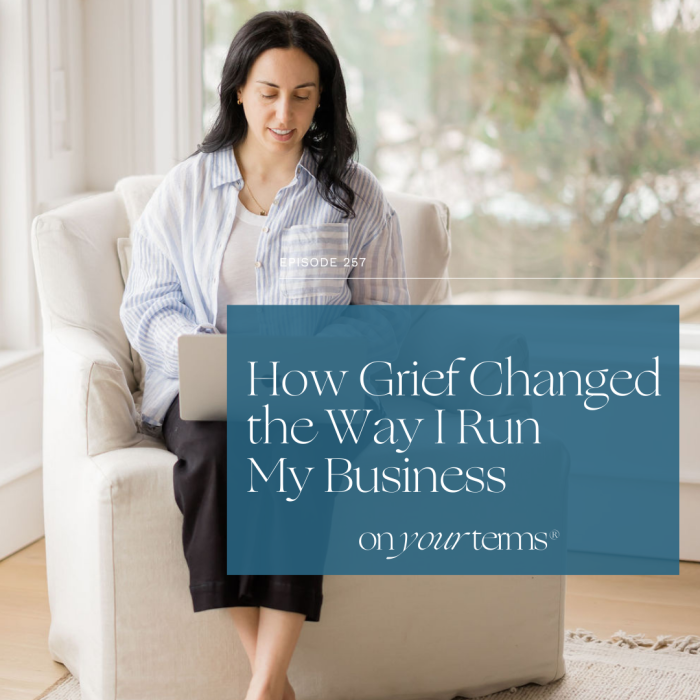
How Grief Changed the Way I Run My Business
Listen on Apple | Spotify | YouTube
Listen Now:
Grief isn’t something most of us plan for when we map out our businesses, but it will change you, and by default, your business too.
In this episode, I open up about losing both of my parents within a year and the ripple effects grief had on me as a CEO, business owner, and human. I’m not sugarcoating it—grief is messy, unpredictable, and permanent. But I also share how I navigated those darker seasons, how I adjusted my business when I had no capacity for “growth mode,” and what it looks like to run a business alongside grief today.
Whether you’re in the thick of anticipatory grief, have lost someone, or simply want to understand how grief impacts entrepreneurs, I hope this episode helps you feel less alone.
In this episode, you’ll hear…
- Why anticipatory grief can feel invisible and misunderstood
- The way grief changed my identity—and how that shows up in my business
- How I made decisions in my business when I had zero bandwidth
- The role of steadiness (not hustle) in navigating tough seasons
- Why grief doesn’t go away, but how I’ve learned to live and work with it
Listen to On Your Terms® on your favorite podcast platform
Listen to episode 257, follow along so you never miss an episode, and leave a review to help introduce the show to more online business owners just like you!
Anticipatory Grief is Real (and Lonely)
Before my dad passed away, I lived in years of anticipatory grief—constantly bracing for the inevitable while life looked “normal” from the outside. This experience taught me how isolating grief can feel when the world doesn’t recognize it as grief yet.
How Grief Reshaped My Identity
Grief imprints you. It changed how I show up in life and business, the choices I make, and the priorities I hold. I no longer see business decisions as just “strategic”. They’re filtered through this new version of me.
Holding Steady Instead of Scaling
When I had nothing to give, my focus was on holding the wheel steady. That looked like cutting non-essential expenses, reducing output, and not forcing new projects. Steadiness, not hustle —got me through.
Living with Grief as a CEO
Years later, grief is still my passenger. It hasn’t gone away, but I’ve learned how to carry it while running a business. This means giving myself permission to work differently, and to honor both my business goals and my emotional reality.
Episode Transcript:
Sam Vander Wielen: [00:00:00] You’re an online business owner who also just so happens to be grieving. Whether it’s the loss of someone in your life or someone who you love, or whether you’re anticipating the same. And you want to keep running your business, you probably have to keep running your business. Or you might even be dreaming of taking the leap from your nine to five to start one. But how do you do all of that while also being a grieving person?
In today’s episode, I’m gonna talk a little bit about how grief has changed the way I run my business, how I show up in my business, and even how it’s impacted me in my life. I’m hoping after today’s episode, if you’re a grieving person or somebody experiencing a lot of anticipatory grief like I did for so long while my dad was sick, that you feel a little more heard and seen and understood, and also even maybe just get some, I don’t know, inspiration [00:01:00] or guidance as to like, how are you to proceed with all of this stuff that you’ve got going on in your life.
If you’re not a grieving person or you don’t wanna hear about grief, maybe today’s episode’s not for you. I still think you might find it helpful, but I would definitely encourage you to forward this episode to a friend who you know is going through something tough in their life and also has a business.
So with that, although I’m not talking about anything too graphic today, I do just wanna let you know and give you a heads up that I will be talking today about grief. I will briefly mention my grief journey, talk about cancer, and just talk about what it’s honestly been like not holding anything back.
So if that doesn’t sound like something you wanna hear, obviously, completely, okay and you should always do whatever is best for you. But I just wanted to give you a heads up before we hop into today’s episode.[00:02:00]
In case you’re new to my world, or you haven’t heard my grief story before, the very brief version is that my dad, Norm, who’s my best friend, um, he got leukemia in 2018 and passed away from AML from Leukemia in May of 2022. And within that same year, within a year, my mom was killed in a horrible and horrific way, in my opinion. So I had, I had a back to back grief experience, but I also had from that period of my dad being sick, um, in 2018, the end of 2018 to when he passed in 2022, he was only given a max of 11 months to live and I think maybe a, a year, year and a half in, he was given like six months to live and he lasted much longer than that, but still had a terminal prognosis, which, uh, is why I was saying at the top of the [00:03:00] episode, like, I really relate to you if you’re in an anticipatory grief phase.
I hear from so many of you who have loved ones who are experiencing Alzheimer’s or dementia or who also have cancers like my dad did that aren’t going to go away, but you know, that you’re managing for the moment or something like this. Or, um, I know many of you have written to me about having loved ones who have Parkinson’s.
There are just so many different diseases and, and all different kinds of things that people struggle with that, you know, you might feel like you’re not a grieving person because the person’s technically still here.
But poof, I’ll tell you, anticipatory grief is one of just like the most difficult things that I, I experienced personally, and I felt like no one ever talked about it and I almost felt like I wasn’t, it’s like I wasn’t in the club for the first several years because I had people who I knew who had lost people, and it was like, you’re, you haven’t lost your person, your person’s [00:04:00] still here, but there’s so much grief around navigating the end of someone’s life or even like the change in a, in a relationship in like the status of someone’s life so greatly impacts, like if you used to always go out to eat with your aunt and now she can’t, or you and your dad always used to go to the farmer’s markets and now he can’t ’cause like touching a raw vegetable could kill him from the bacteria, there’s a lot of grief around that. And that’s a very, very difficult place to be.
So, at least in my circle in my community, if you’re here, all grievers are welcome in terms of like all, um, points on the spectrum, essentially. I also very much believe, and my, my friend Gina Moffa, who wrote a, a wonderful book called Moving On Doesn’t mean Letting Go, which I highly recommend. She was with the same publisher as I was actually. She talks a lot in her book about how there’s also a lot of grief around things like other than losing a person. I mean besides also losing a pet or something. [00:05:00] But there can also, which for me I think will be the worst grief I ever experience. I have a lot of anxiety over like thinking about losing my dog Hudson ’cause he is beyond my best friend and I just can’t, I can’t. So I, I have a, I have a lot of trouble with it, especially since I lost my parents, so I get it if you’re a pet griever. But there’s also like loss around job or relationships and all different kinds of things, right? People experience a lot of loss through miscarriages and there’s just so many, like the list goes on and on and on.
You know, we’re gonna talk today a lot about how I’m currently dealing with grief or how I’m currently, how, how grief is currently impacting me and my business, and also impacting me as a CEO, which then, you know, impacts my business. But you might be at a different stage in your grief and so I thought it was worth mentioning that like when I first lost my dad or when things had gotten really bad or something like that, like things for me were very, very dark [00:06:00] and, and I went pretty dark in my business, right?
So I wasn’t like capitalizing on opportunity and like turning it into my greatest inspiration and writing about it. Like I was just dark, like dark, quiet and dark in all senses of the word. Um, and I just wanted to mention that because actually, someone wrote to me the other day, and she had written to me a long time ago and told me that her dad had also had leukemia and he was doing okay, and now he’s taken a turn and so she was just asking like, not from a business perspective, but like how did you manage, you know, like as a person. Like just how did you, what did you do? You know? And honestly, my best answer in that time period, if that’s you, is just like. I just met, like, you just hang on. There’s, there’s nothing you need to be doing other than taking care of yourself.
So that, and it’s just messy and there’s like no right way about it. It’s just really a really crappy experience. So I could do a whole, I could do a whole situation on that, but my point was just that I went really dark in my business for a bit, uh, around that time period. I would [00:07:00] say a few months after my parents passed away, each of them, I kind of held everything steady. Like my take on that period was just like, just, hold steady at the wheel, like don’t add anything, don’t make any crazy drastic moves to take anything big away. Like I reduced some expenses that were just kind of easy, no brainer. Or I like maybe dropped down my frequency of my podcast once every other week or something like that. Or you know, stuff like this where it was just like some easy stuff, but it wasn’t like I’m canceling everything. I’m not doing this anymore. And I also didn’t do it too far the other way where it was like I didn’t start adding a whole bunch of new stuff either, like I just kind of kept at it steadily and did the best I could, which changed daily or weekly or something like that.
Now that it’s been two and three years respectively with my mom and dad, I am managing, I don’t know, I’m like a always grieving person. The AGP.. I feel like you should get a, like a badge [00:08:00] of some sort, I don’t know. It’s just like. I know everyone talks about this in like the grief community and so it’s kind of feels like cliche, but it’s, it just grief doesn’t leave you and like this whole idea that it gets better at some point, it’s like it like does get better on the one hand, it’s always so hard. It’s there’s so much nuance, which is why I really like having a podcast because this is one of the only places where you can do that in like the online space. But it’s like, yes, it gets better in terms of, I mean, I’m not in bed crying all the time or something like that, like I’m fully functioning human.
But, uh, well, you know, as much as I ever was, it hasn’t gotten any better or any worse, but I’m functioning like I’m going to my job. I’m technically taking a shower every day. As far as I know. Definitely if I exercise, definitely taking a shower. And, uh, I’m doing, I’m doing all the things, so I’m managing, but like the grief doesn’t go away. It sits with you as you know, it’s, it’s very much a passenger in my life that I, I say I’m a permanently changed person. My therapist tells [00:09:00] me not to say permanently, but like I can’t help but feel as if I’ve been imprinted. It just feels like any other experience, like whether you’ve maybe had a child or had some sort of like, I don’t know, big other life experience that.
It just feels like you’re, you’re not the same person on the other side. Right? Like, it’s just, it’s, it’s like I’ve gone through something and I’ve come out really differently.
My losses were back to back, which, from what I understand from my therapist is unique. I experienced a lot of, you know, a lot of that anticipatory grief with my dad being sick for a long time. And so that was, that was a lot and like really wore me down for a long time. And it was horrible to watch him go like that over time. Anybody who thinks that because you get more time with someone because they’re sick, as opposed to like, uh, an immediate loss, there is no winning in this game. They both suck for different reasons.
It’s [00:10:00] really hard to watch someone you love, like go down the tubes and it would be horrifically tragic to lose someone so fast like I did with my mom. So I kind of feel like I got both. So I have that experience of like having lost them so quickly. But my mom’s experience with being killed was just, it’s left me a mess. It’s just something I can’t even still articulate and at least from where I sit right now, I think like, well, I don’t, I think it would take a lifetime to get, to get quote unquote over this or to get past it. There’s a lot of processing and like a lot of work on my end to, to continue to do better of course.
With all that being said, of course this has all changed the way, that I run my life, the way I run my business. Uh, just I feel like I don’t know, who I am as a person. And I thought I would kind of start off by talking a little bit about how it’s impacted me as a person, because that has influenced how then me, Sam, the [00:11:00] owner of Sam Vander Wielen, LLC, the person who sells legal templates runs the Ultimate Bundle®, how I show up in my business and then there’s like also separate grief stuff that’s impacted my business and how I think about my business. So I’ll talk about that in the second half.
Grief has impacted me a lot of, as a person and the way I show up in my life and I guess I just like don’t want people to think I’m saying like, this is how it’s impacted me and that’s great, like, like these are all positive changes. Like some of these things are ways that’s impacted me that I’m currently working on. I’m just being honest about how I’ve been impacted. That’s all I can say, so one of the biggest ways. That I’ve noticed is that I don’t want to be as social or in a lot of social situations, or I get really tired by being in big social situations, particularly with just people I don’t know, right?
For me personally, I think it’s like weird when something like really big happens in your life and then you’re around all these people and you’re like, they don’t know that this big thing, like it’s very, I don’t know, it’s [00:12:00] like almost hard for me to connect with other people about it. And if they’re not like grieving people or people who have ever experienced loss, it can sometimes make me feel a little isolated. Especially when you’re in a lot of those groups too and like people are talking about like their parents or like, well, why don’t you and Ryan have kids yet? And then like in the next story, they’re telling me about how like their mom lives down the street and watches the kids four times a week and their dad watches the kids and their husband’s parents watch the kids and I’m like, yeah, you see everybody you just mentioned, they’re all dead for me. So like when you’re asking what’s causing me some hesitation, that might be one thing.
So, yeah, which just like makes me feel like, I don’t know, isolated or withdrawn or whatever, you can also obviously feel a little jealous of other people when you see other people’s like family situations and I’m like, I wish I had that.
In some cases I never had the family that I see a lot of other people have, or what I perceive, [00:13:00] like what I see from the outside my, my projection of like what their family looks like, I never really had it. Uh, I had an extremely dysfunctional, like traumatic, abusive childhood, so a lot of it I’ve always lusted for, but now I’m just like, boy, I would just take a parent. Like just any parent, anybody. Is there anyone?
So it’s, it can be a little weird in those, I don’t know, in those situations or even I notice it, like when I’m out and about, if I’m at like Starbucks and I see like a mom and a daughter, it always makes me very sad. It made me very sad before my mom passed away. ’cause my mom wasn’t really available to me as a mother. So, that’s one of the biggest ways it’s just been this kind of like social situation, wanting to interact. One very interesting side effect has been that I feel very overstimulated very easily. That’s been a big one for me.
I just like, I’ve never liked a lot of noises or a lot of like loud noises or anything like that. Anyone who did grow up with some abuse. Probably also have some PTSD and so like [00:14:00] the noises or like startling thing is a, is always been a serious issue for me that I’ve worked on, but I’ve noticed that the kind of like overstimulation, like I’m over, this feeling comes on much quicker and it just leads to me feeling like I don’t, I don’t wanna do this.
I would say I am just like overall a sadder person or like that the sadness can be kind of random. I mean, I have days, hours, whatever, that are better. And then you have time when you’re just like, yeah, I’m feeling sad about grief stuff today or just like, I’m sad. I wish my dad was here. Like I’m pissed my dad’s not here. Or I’m just pissed at my mom’s not here. I’m pissed at the guy who killed my mom. Like I’m just,pissed. you know, and so, or you just have these days and sometimes that, that lasts for whole days and other times it’s more of like a weird feeling that comes and I’m able to kind of get back into the moment. But so far that’s, that’s kind of been my experience.
Grief has given me a lot, even more empathy than [00:15:00] I, I think I was already a pretty like sensitive, empathetic person, but it’s given me a lot of empathy as to how people react to grief, um, how people deal with like death and dying. Yeah, just people in my life who, who then go through it. I know, I know for me, I have a friend I’m thinking of who I feel like is really similar, that like when I find out about somebody who’s now whose parent is sick or some loved one is sick, it’s just like I have that like codependency feeling of like, it’s happening to me. Like it’s just very hard for me to separate and not be not feel it for them.
I knew somebody in my neighborhood whose, , parent passed away recently, and like I was crying every day about it. I had never met their parent. I felt so badly for her because I knew, or at least I thought I knew what my neighbor was going through, right? And so it like kills me. It’s like you’re reliving it all over again. It’s very, very strange for me.
I think one of the best ways that grief has [00:16:00] impacted my life is how it’s changed my relationship with my parents themselves. Like this was never something I thought about or would’ve anticipated, but I just thought, or, I mean, honestly, I probably just never thought about it, but like if I had to have told you three years ago, I would’ve said like, well, when a person dies, it’s just over. Right? Like the relationship’s over, everything’s over.
Maybe this is just my way of like reconciling and trying to make myself feel better, but I personally feel like my relationship has continued because, especially because it was my parents. Like they, you know, they teach you so much, they, they imprint you so much and you are half of them as well. So like, I feel like the things that they talked about that they taught me, like the things we used to do together, that they still continue on as long as I sort of carry that torch.
Like my dad and I hung out constantly, and so this has showed up for me as like continuing to do those things I did [00:17:00] with Norm, my dad. So going to diners, going to the farmer’s markets, you know, that kind of stuff. It’s almost like I have a conversation with him going and so like when see things or hear things like I jokingly will be like, see Norm, like can you believe that Norm? Yesterday my trainer told me that I had long legs, which I’m five four, I don’t have long anything, she told me I had long legs and I was like dying, laughing. And I said, Norm, you hear that? ‘Cause like he always wanted me and I always wanted to be really tall because I played volleyball and I’m only five four. So I was just like, I kind of keep this like, I don’t know, maybe this makes me sound crazy, but it helps me a lot to keep that relationship going and like almost keep that conversation going.
I, I knew my dad so well that I knew everything that he would say, like we used to joke that if he ever lost his ability to speak, I would be able to speak for him and we would play a game where we would go back and forth and have a conversation and he would just die laughing because I would, I would do the whole [00:18:00] conversation for us and he would be like, that is exactly what I would say because I knew him so well. I can anticipate some of those things. Like I will often just blurt out when Ryan does something or, uh, my husband Ryan, or when my dog Hudson does something, I’ll just be like, oh, my dad would’ve said X, Y, and z. Or my dad would’ve thought that was so funny. Like, Hudson started farting when he jumps onto the couch, that’s like a relatively new thing for him. So when he is like mid air, he toot. And I find it to be the funniest thing in the world. My dad would have died laughing, he would’ve just died. And every time Hudson does it, I just like look up and I’m like, dad, oh my God, you would’ve died. Uh, he had very sophisticated humor, as do I, but that, that’s what makes me like, that’s really impacted my life and like made me feel connected to them. It’s the most, it’s the most amount of connection I’m really going to get.
Now transitioning into how grief has impacted me and my business, I think the very first thing [00:19:00] actually, it really changed me as a person, but it’s really, I, I think, impacted my business the most, which is how I spend my time and what I spend my time on.
I mean, I think it’s no secret that when you lose someone, you realize that life is precious. Time is precious. You shouldn’t waste time, and you don’t wanna take things for granted. I remember I listened to this meditation from a Buddhist teacher one time that was talking about how, like the root of all unhappiness in the world is the fact that we all.
Think we are a little too immortal, and if we were to really get in touch with or face the fact that we actually are so mortal, that we would actually be much happier because if you would recognize your mortality, you would take advantage of what’s in front of you, and you would actually realize that just being here right now, listening to this, believe it or not, is a gift, right? That you were [00:20:00] not guaranteed, this morning when you woke up that you’re not guaranteed right now and you’re not guaranteed 10 minutes from now. And so if we started living like that, instead of living like what, what many of us are living like, which is that we are immortal and so that’s why we continue to say, when then and when this thing changes, I’ll take action, or I’m gonna stop doing this one day or, you know, just not taking action in our lives. It’s because we believe we’re immortal and that really clicked with me. I think I, I heard this when my dad was actually sick, but losing my parents definitely shifted my experience with time.
I mean, on a practical level, it really impacted my ability to just show up in my business, period. Full stop. After my parents, each of them died, I took a few weeks, month off as best I could, and. I just came back at a reduced capacity, and I would say that sitting here two, three years later, I have never gotten back to the capacity that I was before they died [00:21:00] and I actually think that’s a really good thing because I think that before they died, I was working a lot out of a place of just keeping myself busy and working from a place of anxiety of like running towards something or running away from something or even, you know, using work, like work is something I can control.
My dad, I lived and, and breathed and died by his blood numbers, if you’ve been. Through anything related to leukemia, you know, I, I knew what the guy’s red blood cell count was every day and how neutropenic he was and what his white blood cell count and how many lymphocytes he had versus neutrophils and like, I knew every single layer of that man’s blood. Uh, I was his go-between, between every doctor, every treatment, every everything and so I couldn’t control. That at all. But what I could control or what I felt like, you know, I feel like I have a lot more control over, I know what to do to get more subscribers, listeners, [00:22:00] downloads, purchases, like I can do that stuff, that comes pretty naturally to me. So like what a great way to channel your energy and control something when everything else feels so out of control. But after they died, I mean, first of all, it’s such a bizarre experience to shift from being somebody’s caregiver to then just like, you just feel like you’re like plopped into the world and you’re just kind of like, wait, well, what do I do now?
My whole life for the last several years, it just felt like my responsibility was to take care of this other person, and now you’ve just like taken this responsibility away and it leaves you feeling a little bit lost.
So I think that it really shifted my relationship with time, my energy, like how much I wanted to show up, how much I just physically could show, it’s not even like a want to, it’s not even, I mean, yes, part of it, especially initially was like more of a depression. Not wanting to show up ’cause I just didn’t wanna do anything, uh, because I couldn’t, couldn’t manage. But it, it then morphed into like, that’s not even how I want to spend my time.
The biggest area where I saw this [00:23:00] get impacted and, and has remained until today has been with social media. I was just talking to somebody yesterday who was like really high up at a big company that you all, you guys all know, , in the online business space.
And she was saying how, like being on social media, she, she also doesn’t wanna be on as much and, and just hearing this from a lot of other people and she was saying like, I think people really realized how precious their time is. And when she said that, it just clicked. Like I had, honestly, I had never put this, these two and two together to say that like I feel like time has become more valuable and more like protected, like I wanna protect time and slow down and be present and savor things. Like all of that has felt really like important to me. And then I had this like less desire to be on social media and I couldn’t understand the connection, until she said this, it was like, yeah.
When you realize that time is really precious, it makes sense that you wouldn’t want to spend as much of [00:24:00] that time on social media because I don’t wanna be consuming other people living their life instead of me going out and living my own. Like I just want to go out and live mine and I don’t want to also share every single moment of mine or or like, while I’m living my life, actively be thinking about how do I need to position this? Or like taking me out of the moment to being like, oh, let me go make sure I set up my tripod. Let me set up my camera. Let me capture this. Let me grab a picture. I need to get something for the social team to give them some content.
Grief just gave me so many fewer Fs to give, to be honest. And I guess that’s one of them is just like where you’re, you’re in the moment. You’re doing something in your life and you do realize that this is precious and you want to take advantage of it. And so would it be great to help your business to capture some content? Sure. But you don’t feel like it And that’s just where, that’s where I feel like grief has just almost given me this like, I don’t know. Cockiness is not the right word in [00:25:00] terms of just being, I dunno. It’s like a, a calm, quiet confidence of just being like, yeah, you know what? I don’t care.
Yeah, this would be great to capture. It would be helpful to get this B-roll. I just don’t feel like doing it. That’s like how, that’s how I feel. The truth is too, if you’re anything like me, you probably just already have an abundance of things you can already use and we, you know, because I’ve realized how precious time is and, and gotten better with time, I. I think I also realized like, oh, I could actually spend less time and just have fewer, like higher quality pieces of content so that I can then be very present in the moment when I’m doing things.
So speaking of social media becoming less desirable as time, to me is becoming more desirable and like more protected. I thought this was so interesting that the other day Taylor Swift was on her boyfriend, Travis Kelsey’s podcast and you’ve probably seen the viral clip. I have been off social media all summer, so I did not see it, but someone told me about it and then I Googled it old fashioned [00:26:00] style and I was able to find a clip of it on YouTube, it’s really funny when you’re off social media, by the way. It just feels like there’s like a whole world happening. You don’t even know, like, I didn’t know about any of this stuff, but I was glad to find this clip. Um, but I wanna read to you something that Taylor said on the podcast. She was talking about her relationship with social media. She was talking about it a little bit more in the respect of like, seeing people’s like comments and taking feedback and like getting a lot of like, I don’t know, being perceived all the time, which is something that I have also struggled with and just not wanted to like, I don’t know.
I just like don’t want to hear everybody’s opinion about every single thing I do in my life. When your business or your account or whatever gets big enough, every single thing you post offend somebody. My, literally my salad. I think I’ve gotten like more comments on like stupid things like my salad. Maybe you should try that without cheese next time. Or like, oh, you’re eating chicken. I thought you loved animals. Or [00:27:00] some other, they were like, I wish we could all have something so expensive. It’s just like, it’s always a comment about something, which is fine, and then, and sometimes they’re like, you know, valid or right, or I understand the perspective or whatever.
But I think the point is something that everyone might not understand until they get to that point, you start like almost thinking about every single thing in your life from that perspective preemptively. So when you’re making the salad and you’re thinking about posting a picture, you all of a sudden start being like, well, maybe I shouldn’t have cheese in this ’cause the vegans are gonna get pissed. And then the protein police are gonna be like, is that five ounces of chicken? But then the vegetarians are gonna be upset about the chicken and you just go crazy. And I’m just giving a stupid, silly example, but, like, leave my salads alone. People, I love salads so much, but the, the serious part of it is like, I don’t think people understand how much that impacts you on a day-to-day basis, where you actively just start thinking about that, and then it completely erodes your confidence.
It completely [00:28:00] erodes your self-trust, your intuition. Your creativity and you start creating and doing everything and twisting yourself into a pretzel for other people. So that’s kind of how Taylor was talking about it. But I really related to this in terms of our conversation today. So I wanna read you the quote from her.
Taylor said, you should think of your energy as if it’s expensive, as if it’s like a luxury item. Not everyone can afford it. Everyone has invested in you in order to be able to have the capital for you to care about this, because what you spend your energy on, that’s the day. And she goes on to talk about how. You know, if you, if you thought of your energy as a luxury good and didn’t hand it out to everybody, right? And understanding that not everyone can afford the luxury good, right? Not everyone’s getting the G Wagon or whatever, then we can protect it a little bit more. Understand that it’s just not meant for everyone to have in places like social media, that’s, that’s what it’s there for. Like, you put out a video and [00:29:00] everyone thinks that they have access to you. And that their opinion is, you know, that they should even share it, right? Like that, that somebody even asked. I don’t know. So that can cause just a lot of issues and I, I just think that like the grief thing, maybe it’s again, this connection with like time being precious, but it really just made me start to see social as like, oh, this is not, this doesn’t feel like a healthy, desirable place to hang out. I wanna live my life, like, yes, there’s definitely this like more, I don’t know, sad grief, like depressed part of me that goes there and is like has my moment.
Like I just have my moments if I’m being honest. Especially with everything going on in the world, I’m so upset about, you know what’s happening here. I’m so upset about what’s happening elsewhere in the world about starvation, about war, about all kinds of things, and I am very sensitive, very empathetic person as it is, and it’s, it’s a lot for me to take in. [00:30:00] And I do go on there and I see like Amazon clothing halls, and I just wanna smack somebody. Like I just can’t, I can’t, I just, I can’t. I don’t know, maybe it’s just me, but like when, you know not only what’s going on in the world or or in your own world, you can have your moments with social where you’re just like, what is this all for? Like I just, I just feel like I’ve been having like my existential crisis of like, why are we doing this? Like, why, why are we doing this? We’re missing out on life and there’s like a little part of me that wants to stand on a street corner on like a little soapbox. And I guess that’s what this is, with a little microphone and scream to everybody, like guys, We’re missing out and like, by the way, we only have one shot at this. So like, time, time is ticking.
So yeah, it makes sense to me that that is, that is related to like losing big, big relationships in your life and shifting, yeah, what, what all comes along with having lost those big relationships in my life.
Another way this has impacted my business has been [00:31:00] that I’ve realized I need to really protect my creative mornings. So this was actually something I talked about in episode 254, I believe that I posted on August 18th just talking about a shift that I was making in my, like how I manage my days and my weeks. That’s really been helping.
And so since all the grief stuff, I’ve just noticed that having these more like protected, creative mornings in my business. So whenever it is that you sit down to do your work. Not consuming anything from anybody else, not taking care of everybody else’s needs in your business first. Instead, like letting your mind be a little bit protected, keeping, keeping a bit of a creative cage around your mind first and doing your most creative work first, that has been, uh, a necessary shift for me.
I think because of all the stuff that we’re talking about already, like as the day goes on, I just get, I don’t know, I get worn out or like, I never know when grief lightning is gonna strike honestly. It’s just like sometimes you’re [00:32:00] just trucking along and everything’s fine and this happens a lot more rarely now than it used to. But like, I’m trying to think of like the last time this happened, I feel like I accidentally like played a voicemail from my dad and then boop, there went the day.
So it’s like you just don’t know when these things are gonna happen or something pops up. So personally, I’ve, I’ve like protected my mornings a bit more or even had like a whole day blocked off on my calendar during a week where I say like, this is just a day of creation for me and I’m just writing, recording something.
You know, whatever it is that you have to do. But I guess a point of this is not necessarily that you have to adopt my tip or my way of doing it. It’s more that grief might change the way you create, let alone the way you show up in your business.
And there’s so much talk in the grief world, or by people especially who are not grieving or haven’t grieved about, like bouncing back and like getting back to how you used to be like, don’t worry, you’ll get it again. Like don’t worry, you’ll get it back. Very similar to like the baby [00:33:00] body disgusting language, right? There is no going back because now you have been through something, you know, you, in the baby example, you have birthed a full human, and in this you have lost a full human and you’re just different. So there’s no going back to the old one and like old me could have pumped out four podcast episodes at 3:00 PM in the afternoon, current me, which is just the reality of what we’re dealing with can’t do that. A little bit of this is like letting go of like, just because something maybe used to work for you a certain way in your business, it just as a grieving person, it just might not work for you anymore. And so part of this just might be letting go of this like restricted thinking around, like, you have to go back to how you used to do it, or I, or even like, um, beating yourself up for like, I used to be able to record four podcasts in one day. Well, that’s great. That’s just not where we’re at. So it’s kind of just dealing with the reality of, of where things are at and giving yourself a lot more compassion that it makes sense.
Like personally, I feel a little bit like [00:34:00] an injured baby animal where I’m just like, I just have like reduced capacity. That’s, that’s just the reality. And like I’ve said 17 times maybe that is not forever, but that is how it is right now. And so you, you need to adjust for like what works for you in your business.
One of the other things I’ve adopted over time, kind of by accident, are something I call reset mornings. So, some days I wake up, this tends to happen after I have bad grief dreams, which I’m not sure, you’ll have to tell me if you also get grief dreams where you dream about your loved ones. Sometimes you dream about them still being here or being sick or like something, or they’re just in it or whatever.
But sometimes I can wake up and that puts me in a weird mood. Other times it’s like maybe I’ve just been having some tough grief days and like the next morning I wake up, so I kind of crafted this, what I call a reset morning routine, and yours can look completely different than mine, but I just recommend you having one, almost like a little menu in your back pocket that you pull out when you need a snack.
For me, my [00:35:00] reset morning when I wake up and I’m just like, not feeling right, maybe like this actually happened this morning. I was like feeling really anxious. I had a dream about my dad. I’ve had a dream about my dad like every night this week. So I’m just like, enough with the dreams already, but it’s bothering me.
I had a kind of a tough grief day yesterday, just for some reason, it’s okay. Don’t need to know why. And yeah, I woke up like that this morning and I had my creative day today, so I had that scheduled and I was really looking forward to doing this podcast episode and the one that I just did before it.
And so I didn’t want to just cancel it. I, you know, also I’m on like deadlines. I need to get things done. So I thought, okay, institute the reset morning. But it’s only because I already had the menu set that I was able to like quickly draw on it. And I just kind of forced myself to go into action. Like I have my little reset morning in my back pocket and I’m just going through it.
So the first thing I do in my reset morning is that I have my vitamins. I eat a healthy breakfast that I feel like full. I always used [00:36:00] to just skip breakfast if I was stressed or anxious or whatever, i’m not hungry when I wake up, and so, uh, that’s always what I would do. But now I have the vitamins. I have a good breakfast and I have light caffeine.
I love, love, love coffee as you hopefully know by now, but I keep half calf capsules in my freezer of Cometeer, they’re like these little frozen pods that you just pour hot water over of fresh coffee from like the best roasters in the country. I love it. But, um, I keep packs of their half calf options in my freezer for, I actually drink them most days now, but, uh, especially on these reset days because I love coffee and I wanna have some, but I know what will make it worse is having a lot of caffeine. So I have one of those and then I always do a 10 minute meditation.
Personally, I love meditating on the Peloton app. I just love the Peloton app in general and like all their programming. So I tend to just do a Aditi Shah’s morning meditation or something like that or I’ll use the Headspace app and do the same, [00:37:00] but I always meditate for a few minutes and that. It just helps me so much.
The Peloton meditation that I like doing, they have a morning meditation that gets you to focus on your day and you kind of like, first you tap into how you’re really feeling today and then what feeling you really want to evoke, and then you start actually visualizing and walking through the parts of your day.
To see like in real life how that feeling or action would take place. So personally, I have a hundred percent success rate with, with doing these meditations and like. Really going from like a starting off as a place of being like, I don’t, I’m feeling so frazzled, I don’t know. I don’t know what to do to really like having that boop light bulb moment. And so like today’s clarity, for example, was that I really wanted to tap into my creativity today and I specifically knew what was really important to me was that I didn’t wanna consume anything from anybody else before I recorded [00:38:00] these podcast episodes, and I didn’t want to use any tools or resources or Google any articles or find any YouTube videos about like how to structure a podcast episode, how to better do this, how to ask questions like that. Like I just was like, you know what? I’m going with my gut. I want to be creative. I just wanna talk about this issue and then I’m coming from a good place, I’m coming from the heart, and hopefully this lands in yours and like, that’s, that’s a win for me. But if it doesn’t, it doesn’t. Like this is what was important to me today. I just wanted to be creative. This was my form of expression and I didn’t wanna filter it through anybody else’s stuff, you know? So that’s what I did.
Right now, I’m in the midst of doing the a hundred day journal challenge from Suleika Jaouad Book of Alchemy. I love her. I love her Substack. Uh, she unfortunately has the same kind of leukemia that my dad had, AML and so I have just always been drawn to her story. But anyway, her book of Alchemy is incredible, and I highly recommend it if you don’t have it [00:39:00] already. Just to give you a really quick breakdown, because I wouldn’t have known what it was or what it was about but it’s actually a series of very, very, very short passages, like maybe a page or two from a hundred different contributors, ranging from actors to singers, to writers, to therapists, and everybody in between. It’s a little passage about something and then there’s a journal prompt at the end of each one, and you’re supposed to do it for a hundred days. So I did my journal right afterwards because I’m in the midst of that.
Then I always include some form of movement. I have to move the energy through my body. It doesn’t have to be intense. Today, it was a walk. That’s what felt right to me. It’s supposed to rain today. Part of what I’ve gotten really good at with grief is knowing like I have to get outside. I need fresh air. We live in a beautiful place with a lot of greenery, but it doesn’t do me much good if I just stay inside.
So I’m very like tuned into the weather these days because I’m like, okay, it’s gonna rain later, so I’m gonna go out and walk now I have to be really proactive about protecting [00:40:00] my mental health. So I move and then I create, that all happens kind of seamlessly. So it’s that light, caffeine, and breakfast. I meditate. In this case, I was journaling ’cause I’m doing the a hundred day journal. I move my body and then I create without consuming first. That’s my little like reset morning movement, menu situation.
Speaking of having, you know, fewer Fs to give in, in life in general, since being a grieving person, I, I think that’s made me a little bit more open and vulnerable in my writing, like my writing to my email list. If you get my weekly newsletter, Sam’s Sidebar, which if you don’t go click on the link below to make sure you get my newsletter every single Tuesday, but I write a lot openly about some difficult topics. I mean, I’ll write about grief, but it’s like, it’s not really like about grief. It’s always about like, so I don’t know, transitions into something else. But I guess like every once in a while I’ve had that moment of doubt of like, why am I talking about this when I sell legal templates? Like not everybody’s a grieving person. And [00:41:00] then I get the responses and I’m like, oh, that’s why we talk about it. So it does resonate with a lot of people. It’s, it’s surprising.
So, yeah, those are a lot of the ways that grief has impacted me and my life and my business so far. But I would say, like, I also see and have flirted with different, different things. Like I also hear from a lot of you that maybe it makes you not wanna be on camera so much. Like some people have not wanted to be so like, forward facing or like you don’t feel camera ready anymore all the time.
Um, or like you feel like you’re not yourself. So it’s like, well, you don’t wanna have like a YouTube channel or a podcast ’cause you’re like, I don’t feel like myself.
The other day someone I know was like kind, kind of joking, but being serious ribbing me that she listened to one of my podcast episodes and she said it was a downer and that it was depressing. And I’m like, okay, you know, she’s a very, very upbeat, high energy person, and which I’ve never been like that’s, I’ve never been a like a super like, Hey, guys! like, that’s never, that’s never me. It’s not in my personality, [00:42:00] but also like it was interesting to hear her go on and on with this feedback about how, like, I was such a downer in this episode that I was just thinking like, yeah, you know what? That’s just where I’m at. Like, that’s, that’s where I’m at. And I could understand why that might make you not wanna show up. So I wanted to mention that in the sense that it’s like, i’m not here be like necessarily being my quote unquote self, like in, in terms of like five years ago, me would probably think, I do sound sad now, but I am sad. So it’s like I don’t, like how do we proceed? I don’t, I don’t know. You know? It, that’s what’s so hard about having an online business and going through all of this is like, how do we proceed? And you have a choice to make of like, yes, you’re going through this thing. Yes, you also are still allowed to be ambitious and want to grow your business.
Some of that is that you just have to give yourself some grace and space to show up as you are right now. Look at me, [00:43:00] look how long it’s been, and I feel still like a diminished person. Like I still feel like I’m just different. Maybe this is it. I don’t know. I just don’t know. And so I, I don’t want to wait. I still have the desire to like, create and do stuff and like, yeah, maybe there are some people who might look at it and be like, she is a downer. All right, well, they’re not my person. Right? Just like, When I meet people who have never experienced any loss, and you tell them and they’re like, well, your parents are in a better place, and you’re like, you don’t get it.
I, it’s just like, not, it’s just not the person that you should be seeking that stuff from. You know, all that to say like. Your grief might show up differently. Your grief might inspire you to create more. Your grief might create something really beautiful. I think a lot of what happened to me came out in my book.
You know, I have one friend who like, feels like it gave her a lightning bolt of an idea in her business, and she recently lost someone in her family. Like everybody reacts really differently, [00:44:00] so that’s great. There’s not like a, there’s no prize coming to anyone about how, about how you deal with it. But yeah, I just, I, I just wanted to say that in the sense that like, this might show up differently for yourself and I hope that you’re as gentle with yourself as you can be and like allowing yourself to show up and I guess just trusting that the right people will understand that and that the other people will either leave or they just won’t listen to this stuff. Like I’m, I’m hoping no one’s listening at this point in the episode, if you like, hate grief stuff, I don’t know. Otherwise, sorry for like the last hour.
But yeah, I’m here to hear your reflections. After listening to this episode. I’d love to hear from you in my inbox. Just reply to any of the emails that you get from me. I read your emails, so I would love to hear from you or send me a DM on Instagram @ Samvanderwielen. I’m back on Instagram, so I’d love to hear from you what you thought and like how has grief changed the way that you show up in your business or are you going through [00:45:00] it right now and like you’re seeing there’s a little bit of a sticky point for you.
I’d love to hear from you. I hope that this episode landed with you somewhere in some way. So I will chat with you next week. Thanks so much for listening from one grieving person to another. Take care.
Thanks so much for listening to the On Your Terms® podcast. Make sure to follow on Apple Podcasts, Spotify, or wherever you like to listen to podcasts. You can also check out all of our podcast episodes, show notes, links, and more at samvanderwielen.com/podcast. You can learn more about legally protecting your business and take my free legal workshop, Five Steps To Legally Protect and Grow Your Online Business at Samvanderwielen.com and to stay connected and follow along, follow me on Instagram at samvanderwielen and send me a DM to say hi.
- Get Sam’s free weekly newsletter, Sam’s Sidebar
- Ep 254: The NEW Way To Structure Your Workday for Better Content
- Moving On Doesn’t Mean Letting Go by Gina Moffa
- The Book of Alchemy by Suleika Jaoud
- Get $25 off Cometeer Coffee [affiliate link]
Connect:
- Get Sam’s weekly newsletter, Sam’s Sidebar, to learn how build your email list, protect your biz & grow an audience online
- Watch Sam’s Free Legal Workshop “5 Steps to Legally Protect & Grow Your Online Business” to learn exactly how to start an online business the right way.
- Follow Sam on Instagram
- Subscribe & follow On Your Terms®️on your favorite podcast platform!
- Subscribe to Sam’s Substack, where she shares behind-the-scenes of building a life offline, after growing a multi-7-figure business online
Free Legal Class:
Want to make sure you start your online business the right way? Save your seat in my free legal workshop “5 Steps to Legally Protect & Grow Your Online Business” here: GET MY FREE TRAINING
Sam’s Favorite Business Tools:
- Kit // what I use to build my email list, send emails to my list, and create opt-in forms & pages
- Kajabi // use Kajabi to sell your course, program, or even build your entire website. Get a 30-day free trial with my link.
- SamCart // what I use for my checkout pages and payment processing, and LOVE. And no, not because it’s my name.
AFFILIATE LINKS: Some of the links we share here may be affiliate links, which means we may make a small financial reward for referring you, without any cost difference to you. You’re not obligated to use these links, but it does help us to share resources. Thank you for supporting our business!
DISCLAIMER: Although Sam is an attorney, she doesn’t practice law and can’t give you legal advice. All episodes of On Your Terms® are educational and informational only. The information discussed here isn’t legal advice and isn’t intended to be. The info you hear here isn’t a substitute for seeking legal advice from your own attorney.
© 2022 Sam Vander Wielen LLC | All Rights Reserved | Any use of this intellectual property owned by Sam Vander Wielen LLC may not be used in connection with the sale or distribution of any content (free or paid, written or verbal), product, and/or service by you without prior written consent from Sam Vander Wielen LLC.
–
–
 0 Comments
![Sam Vander Wielen scrolling on her iphone. Text overlay reading "How I Stopped Doomscrolling and Started Watching This. [Summer Read-Aloud]"](https://www.samvanderwielen.com/wp-content/uploads/2026/08/How-I-Stopped-Doomscrolling-and-Started-Watching-This.-Summer-Read-Aloud-1024x1024.png)

So What Do you think?