



January 12, 2026
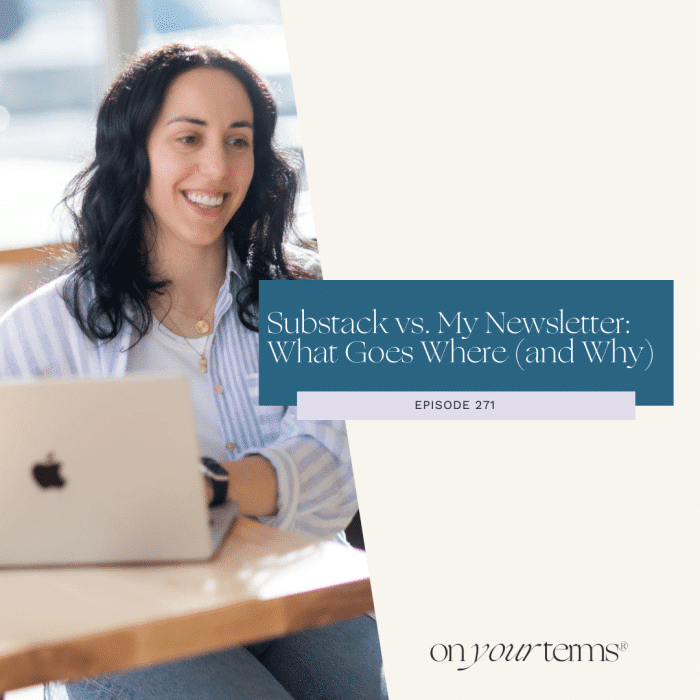
Substack vs. My Newsletter: What Goes Where (and Why)
Listen on Apple | Spotify | YouTube
Listen Now:
If you’ve been side-eyeing Substack trying to figure out whether you should start one, what you’d even put on it, or how it’s different from your “regular” newsletter… this episode is your permission slip to breathe. Because guess what? I’ve been figuring this out in real time too — and today, I’m breaking down exactly how I’m using both Substack and my newsletter, why I treat them differently, and how YOU can create a simple, sustainable content structure that actually supports your business.
I’ll also walk you through the discovery → nurture → conversion framework I use to decide which platforms get my energy — and which ones simply get a presence without becoming a second job. Because you are absolutely not meant to create cornerstone content for 19 platforms. No thank you.
Whether you’re Substack-curious, newsletter-confused, or trying to design a content flow that doesn’t make you want to run away to a cabin in the woods, this episode will give you clarity.
In this episode, you’ll hear…
- How I’m using Substack differently from my weekly business newsletter
- Why your content should flow from one or two core platforms (not all of them)
- The discovery–nurture–conversion method I use to understand where each platform fits
- How I’m thinking about Substack as an experiment (and why that’s OK!)
- What goes on Substack vs. what stays in my main newsletter
- How to decide where YOUR content belongs without overthinking it
Listen to On Your Terms® on your favorite podcast platform
Listen to episode 271, follow along so you never miss an episode, and leave a review to help introduce the show to more online business owners just like you!
Core Content Recap
Your content needs a home base — not 12 of themI kick things off by explaining why I only create true cornerstone content in one or two places — for me, that’s my podcast and my email list. Everything else (LinkedIn, Threads, Substack Notes, etc.) is where content gets repurposed, not reinvented. Because creating new content for every platform? That’s a great way to burn out and start a pottery hobby instead of running your business.
The Discovery → Nurture → Conversion framework
Before choosing platforms, you need to know what role each one plays:
- Discovery: where new people find you (Ex: SEO, YouTube, Substack)
- Nurture: where people get to know you more deeply (Ex: your podcast, your newsletter)
- Conversion: where your audience becomes your customers and members
I share why the podcast is one of my strongest nurture → conversion tools (Ultimate Bundle® members constantly tell me they listened to tons of episodes before joining).
This framework helps you avoid overloading your business with discovery-only platforms — or the opposite, nurturing tiny audiences who never grow.
How Substack entered the picture for me
I started leaning into Substack in August. I renamed it Beyond Business because I wanted a place to experiment, practice my writing, and talk about things outside entrepreneurship. It’s also the first platform in a LONG time that I’m openly allowing myself to not have a perfect plan for. I’m letting it be creative, low stakes, and fun — a rare twist for me.
And honestly? Seeing other creators thrive on Substack helped me see what was possible. It normalized the idea of writing more personally — and even charging for it someday.
Give yourself permission to experiment
You don’t need a master plan before you begin. Substack can be a space to try ideas, grow your writing muscle, build community, and see where your creativity leads — without abandoning your business strategy.Your content doesn’t need to be everywhere. It just needs to be intentional.
Transcript:
Sam Vander Wielen: On Instagram. Angela asked me, this is a super random question, but I’m genuinely curious, why do you choose to do Substack and Kit? I know you have Sam’s Sidebar, my weekly newsletter, and you pour a lot of effort into those emails. Is this content on Substack more like personal life content? I thought that this was such an interesting question from Angela and people keep asking me how I decide, what I’m going to put where.
So I thought we would sit down today and yeah, sure, i’ll break down how I think about. Writing a weekly newsletter that over 55,000 online entrepreneurs get every single week and why in the heck I started a substack that has almost a thousand subscribers and how I’m going about it with deciding what to post where.
But I also thought that this lends itself to an even deeper conversation about how we think about different platforms where we’re posting, spending our energy, and kind of the strategy behind where we show up online.
And by the way, I wanna welcome you back to On Your Terms®. If you’re new here On Your Terms®, is a podcast for online business owners who want to be as present in their lives as profitable in their businesses and if you’re going to be present in your life and profitable in your business, then you can’t be posting everywhere all at once, and running yourself ragged and not making it count. So talking about focused content creation, anti hussle scaling options are very, very much on brand for you, if you want to be super present in your life, but you’re also not willing to sacrifice having a successful profitable business, whatever that looks like to you.
All right. Now, if you’ve been listening to On Your Terms® lately, you know I’m doing a little new weekly segment at the top where I randomly pull a question from a deck of cards. I invite you to think about or even journal about this question this week as well. So let’s go ahead and pull this week’s question.
This week’s question is what tends to be a common quality in people you really like? Like the quality that I admire in people the most is when they care about things that are bigger than themselves, especially when those things don’t actually even impact them directly. When people care about things like animals or environment or like care about things that can’t necessarily speak for themselves or that need protection from other people, I really, I really, really admire that, and I will give a close second to people who are like I have, and I’m fortunate to have so many people in my life and my closest friends. That are like this, but like people who are really interesting and like quirky and are in just like really into very cool, diverse things and follow their passions regardless of what those are, however, like funny or seemingly weird. Make sure you send me a DM on Instagram and let me know what your answer is to the question, what tends to be a common quality in people you really like? I can’t wait to hear what you have to say.
So I’ve done tons of episodes all about how important email list building is and how to build an email list and why I prioritize it on over everything else and if you know me, you know that my number one go-to motto in business is, all Roads Lead to the email list.
I really believe very strongly in building an email list and I would say I have a pretty successful email list. I have an email list that’s, yes, it’s full of a lot of people. I have over 55,000 people on the email list, that’s, that’s amazing. But I think more importantly. To me is that it’s, it is full of the right people, first of all, and second of all is a very engaged list.
So we get a lot of engagement and replies and also people saying to me every week like, these are the emails I’d love to read, and I look forward to it, and yada yada. So those things are very, very important to me.
Over the past eight plus years. Social media has been basically the main traffic driver to that email list. Whether it was my organic social media, meaning stuff I created myself without ad budget behind it, or whether it was through ads that are run on social media. I would also say the SEO in general has been one of the biggest drivers to my business. That has become less so as things like AI have kind of captured these like AI summaries at the tops of, um, Google search results. But I still, and for many, many years have gotten so much traffic to my website and to different pages because of the SEO work that we’ve done. And my podcast, I’m just kind of giving you like an overview, a tour here of the different content channels and how I think of them, my podcast, although I initially started it because I thought that it was going to be a discovery platform, meaning it new people would be able to discover me through this podcast.
What it actually became in reality is a fantastic nurture and conversion tool and that’s good. Like that’s fine. It’s not, not any better or worse than a discovery tool. It’s just really important as you’re gonna hear a lot about in this episode, that you understand the difference and you understand which platform fits which role, and you don’t treat it differently.
So like me starting out treating a podcast like it was a discovery tool, wasn’t great because I was getting frustrated that new people weren’t finding me, and I was almost judging the podcast by a metric that it just shouldn’t have been judged by because it tends not to be what podcasts are really for in, in this industry.
But this past year really had me, I, I would say, questioning a lot of things about the, the way I look at different platforms, which platforms I wanna be on, the way I’m approaching them for the first time in years, like I would say, I’ve basically approached these tools and these platforms the same way for many, many years until this past year, because this year had me questioning for one, where is my community hub?
Like I thought also that my podcast, for example, when I started it, it was going to be this like really great like community experience but because of the nature of podcasts and the platforms that they’re on, it doesn’t really naturally lend itself to a community type feel unless you create that elsewhere on a platform like Patreon or you create some sort of like circle community or mighty community.
So that’s something that started to, I dunno, creep into my mind this year was like, man, I feel like I have people like spread out all over the internet. I wish I could kind of find a room where I could put them all in, because they’re all really cool people who’re all doing really cool things and one like each other and benefit from each other. But I don’t know how to bring them all together.
You know definitely, I don’t know about you, but I, I know you’ve all been saying this in my, my inbox and my dms, but this year has definitely had me questioning like, where else can I start finding people for my online business outside of social media? When I started my online business in 2016, social media was it like That was the beginning and the end of the conversation.
Now, I mean, there are many different options, including, but not limited to people building online businesses only using traditional in-person methods, like networking in person and holding workshops in person and giving little talks at like your local library and a cafe in person, right? That’s completely valid and I think fantastic way to actually build a business regardless of how you deliver your services, right?
So we’ve got that going on, and then we’ve got this kinda like sliding scale. Of course we still have the people who are Instagram and TikTok obsessed. I’m not one of them, but like we have that that’s still going strong. There are millions and millions of people using it. And then you have a lot of us who I imagine you’re pretty similar.
We have a lot of us in between, who are like, I don’t wanna spend so much time there anymore, but I’m not exactly sure where else to go and where else to find people. I, I know that Substack or other platforms like YouTube, for example, can be considered social media. I think they are social media, but I would say like there’s almost like social media buckets, and to me, Substack is in a different kind of bucket than something like a TikTok or an Instagram.
Where the, first of all, it’s heavily algorithmically built on, on like your personal preferences. It doesn’t necessarily respect your decision to like follow someone or ask to consume their content and it also is built off of an attention economy, right, of just getting you to as quickly as possible, blow through something and move on and, um, showing you ads. So it’s, it’s, they’re different right?
I also, I mean personally started questioning where I can practice my writing because I mean, let’s face it, however many characters you get for like an Instagram caption or whatever, that’s not it. Like that’s not where I want to practice more long form writing.
I know that I want to write another book. I came out with my first book last year called When I Start My Business, I’ll Be Happy. But I know I wanna write another one. I don’t quite know what I want to write that about yet, but I want to get better and better at my writing. So I started thinking about like, where’s a place that I can do that? And start building an audience based on that writing.
So that you essentially are, I don’t know, like future proofing the audience. You’re like creating future demand for the thing that you’re building. I’m a big fan of building things in public, building things in real time, letting people in on the process. And so whether that’s right now, like one example is attracting people talking about a certain topic or certain starting to do like a certain style of writing and then that might attract like a certain group of people or with my first book for example, it was starting out saying to everybody, Hey, it’s my dream to write a book one day, let’s go out and try to write a book proposal. And then I documented that whole thing and then I said, let’s go find a, an agent and like, let’s try to get Wendy Sherman, she’s the best. And we went out and got Wendy Sherman and then we were like, Hey, let’s go get a big five book deal. And I documented that and so on and so forth, the whole way through so that by the time that the book came out, it was not, not only not a surprise, but people had bought into the journey, right?
So I also think about like practicing your writing or whether you’re trying to start a podcast, start creating music. Like whatever it is, you’re also starting to build a bit of a future audience, a future consumer of this thing.
Last but definitely not least, I started thinking about where I could build a platform that would have potentially new revenue, um, so that I could get paid for my work, right? Because. One of the, I mean, there’s so many, so many benefits about having an online business.
Starting an online business, but one of the downsides is that because of social media being free, we have kind of started to train people to think that everything should be free, and that is a dangerous path to go down if you also have a business. Right?
So. If you are producing really high value content, um, like I was just telling my friends that I, I just saw that my friend Ellen Yin just announced, uh, very understandably so that her podcast is going to become a paid podcast because on her podcast Cubicle to CEO, which I have been fortunate to be on twice, she’s the best.
She does these things. This is what I did on her podcast, she does these things that are case studies. So she gives her listeners these like really in depth experiences walking through not only someone’s business but like a specific tool that they’re implementing, a specific strategy and you can literally walk away from Ellen’s episode, um, about these case studies and go and implement that thing, or you start doing it yourself and make money off of it.
And so Ellen just announced that she’s going to start charging for that. It’s going to be like a subscription model. That makes sense to me. And it’s so interesting to me that like. We’ve just kind of trained ourselves to expect everything to be free and sometimes we don’t understand how much this all takes from somebody to do a podcast like this.
To do a podcast like Ellen’s, to write a substack like I do, to write my weekly newsletter. It takes me and the team a lot of time, a lot of resources, a lot of energy, right?
So, all that being said, those wheels were all turning this year of like, maybe I could create something that has another stream of revenue.
Maybe I could also practice my riding. Maybe I’m looking for a community feel. Also don’t wanna be on like traditional social media so much like where’s, where’s there a place that sounds like that? Well, to me, that’s Substack That, that screams Substack
I’m a huge personal Substack user, which I think helped.
And it’s funny, I talk about this in my book, but I’m a really big fan of you developing a platform on a platform that you love as a consumer. Because when you do that, like if you love podcasts, right, and you’re just like bingeing podcasts all the time. You already have know-how that an average person wouldn’t have never having listened to a podcast before.
You already know. What is it that you love about the way your favorite podcasters talk or structure their episodes or like you just understand you already are kind of used to the fact that they’re always gonna be ads in it, right? It’s not gonna like freak you out. Or if it’s YouTube, like you’re really familiar with all the trends and maybe the structure, some of the editing styles, maybe you’ve seen several vlogs, for example.
And so you kind of understand how they go. And so I get Substack because I subscribe to so many Substacks I I have so many, uh, both paid and free subscriptions on Substack You will not be surprised that most of mine are related to food and like so many food bloggers and recipe creators that are amazing and health and wellness people.
I love so many writers that I love. And so spending time there starting to see the possibility also of like, oh, I see how people are turning their community like one of my favorite content creators on Instagram, Jen Eats Good. So it’s Jen Lueke She, she started a substack, uh, I would say at least over a year and a half ago, um, after creating tons and tons of free content on Instagram.
She’s a perfect example where people who create food content are just expected to constantly pump out recipes for you, for completely, for free, right? Just keep giving you recipes. And although she still does that, she slowed down what she does in terms of free. Social media content and started a paid substack where her subscribers now get weekly shopping lists, weekly recipes, like all of her favorite kitchen tools, all this kind of stuff, right?
And she answers questions about cooking. It’s just starting to open up your mind about the possibility of like, what I have to say is valuable. It’s okay for me to charge for this thing. It’s okay for me to think about creating another stream of revenue in my business. So, that is all, uh, I think like was all very helpful for me in terms of, and that’s why I think it’s helpful for you to be a fan of where you end up creating, because I started seeing that and it’s almost like seeing all your friends do something and you’re like, oh, okay, it’s okay. And it’s acceptable and like they’re doing it, they’re thriving. So like I see how I could do that for me too.
So I started a Substack, uh, this year. I definitely had one before this year, but like in August is when I actually started to pour a lot of energy into it and I called it, or I renamed it Beyond Business because it was really a place where I wanted to play and experiment beyond my business, but also talk about things beyond business.
And it’s just really funny because people keep asking me, especially lately like. What is the plan here? Like why, what are you doing with this Substack? Like what’s the, how’s, what’s the delineation? Like, how are you thinking about it? Usually I am so a, like this is the plan person. I don’t do anything until I have the plan, right? And I’m like immobilized until I know the exact strategy and the plan.
What I think is really interesting in this case is that this is an example for probably the first time in a long time that I’m like, I actually don’t have a plan for this. I don’t, I, I know I have an idea and yes, I have a lot of like marketing know-how and marketing strategy that’s kind of baked into my head, but I am also okay in this situation, experimenting and being curious about, like, I don’t exactly know where this is going, but I am clear on those goals that I talked about earlier, like, I wanna practice my writing, I want to create more community. Maybe that’s a place where there could be a private community for the podcast in the future.
Maybe this could be an additional stream of revenue in the future if my writing is good enough and and has value and I have some focus so I can tell people. This is what you get for the five to $8 a month or something like that.
So all that to say, this is sort of how I’m thinking about this newsletter versus Substack breakdown that Angela asked me about, that I talked about at the top of the episode.
So my newsletter, my weekly newsletter, Sam’s Sidebar, goes out through Kit. I’m a huge Kit fan where I built my, so much of my entire business, my, uh, email list, my, all my funnels are built off of that. So my newsletter, Sam’s Sidebar, goes out every single Tuesday, and that newsletter is all about business.
Whether that means that it’s about legal stuff that week, or it’s about marketing stuff related to your online business, but it is all about business. It’s business strategy, business tips, business advice. It’s also where I sell things. More importantly, you know, I talk about my products. I run sales through my email list.
So when we run a big live sale, like the one that we’re going to have in a couple of weeks on the Ultimate Bundle®, by the way, you wanna make sure you know about that, make sure you sign up for my sidebar emails. That’s how you’ll get it. But when I run those promotions and those campaigns, they’re all done through my email list platform through Kit, right, where I talk about my products, I run ads to the freebies or to the different things that I offer that then put people onto that email list. So those, those people, those 55,000 people, they’re coming to me through some sort of mix of social media, content, organic stuff, ads, SEO, all related to things like business stuff and legal stuff.
Kit as a platform also is a place where like, I think it’s important for people to know this when they’re asking like, why are you on Kit and Substack? There’s a huge, huge gap in terms of the tools and like technology that’s available. So on a platform like Kit for example, you have things like landing pages and opt-in forms and freebies and funnels and tagging and sequences and all of the things, right? You can’t do any of that on. Substack I would never, ever use substack for any of those kinds of things, at least as of now.
So to me, I think of these things as completely different. Like Kit is an email management software platform to help creators manage the backend of their businesses when it relates to email, whether that’s your email newsletter or your email marketing, right? Which is like more my sales emails. They’re just completely different.
Substack is like a social media platform for long form writing. And it’s a huge discovery platform. It has discovery platform potential, which Kit does not. So, although technically speaking, kit gives us the ability to like add some SEO to our newsletters and to make our newsletters public, I still firsthand have seen the SEO capability in Substack that has a lot of promising potential.
So when I write my Substack, uh, each week for example, I go behind the metadata, behind the scenes and make sure that we change the title, we change the slug was the URL that you see at the end of the, um, website name. And then we also change the meta description and add alt text for the images. So all of those things help to tell Google and other search platforms what this article’s about, who it’s for kind of summarize the document, I add headings, subheadings to the subject itself that I write. I usually pick some sort of keyword and I make sure that I repeat it like all the traditional SEO tips that I’ve learned over the years. The same things that I implement on my own website or in any other piece of content that I create.
So there is a lot of potential when it comes to Substack in terms of being discovered, right? So this is a very different option than when it comes to like you building your email list on a platform like Kit, you are sending people there who have already discovered you in some way, and then we are nurturing them.
I’m also really intrigued when it comes to Substack, when we talk about the community features. I mean, first of all, I love that on the posts themselves, um, I’m not sure if you know this or how familiar you are with Substack, but when you send out a Substack post, it both goes to someone’s email, but it also is just posted on the platform itself.
Like, so if they have the app. Or they go to the website, if you go to my Substack, you will see all the articles, all the posts that I’ve written that also ends up in people’s inbox. So it’s kind of like double dipping. The cool thing is that at the bottom of these individual posts, um, they actually have a community feature.
So there’s a chat and you can post there, you can talk with each other. You can talk with me, that’s really cool. And now they actually have a private chat feature. So if you’re a subscriber to my Substack for example, there is a chat that can go along with that and we could all communicate with each other in there too.
I’d be lying if I said that something that didn’t, you know, draw me to Substack this year was a little bit of like hedging my bets if social media goes belly up. I have just felt for like a long time, well, I’ve definitely felt for one, that we’ve, we’ve already like hit peak social media and that we’re sort of on the backside of that, that slide right now.
Just like people feeling really burnt out. I think people have seen a lot of the negative effects of like feeling disconnected from themselves, from their community, from, you know, I think everyone’s sick of sitting with their partner through like an entire dinner and they have their phone out or like on the couch and they have their phone out and you’re like, wait, we just sat here all night together and I don’t feel like I connected with you at all.
Like we’re just, I think we’re all there, right? Or have been there and so I’m, for one, hedging my bet that we’re like at peak social media, but also i’m literally watching in real time. I feel like people changing their behavior and leaving, and so I want to be ahead of it in terms of thinking like, if they’re not here, then where, you know, where am I reaching people?
I’m not saying Substack is necessarily it. I don’t know. I am not a, uh, I’m not the nostradamus of online business, but I, although I would love to be, um, but if I get a hit, I’ll let you know. But I, I just am willing to try and like, see, I think from, um, like a strategy tr trend perspective, I would just say that I see a lot of people on Substack who have left social media, which just speaks to me as in terms of like what the vibe is there that people are seeking and how they even feel like it’s different and even how like they identify as being off of social media while being on Substack, which I find just very interesting from like a psychological perspective. And so if they feel that way about it, I’m kind of just guessing that other people who are going to leave or spend less time on social media will also be on platforms like Substack
So that’s why on my Substack, Beyond business, I’m really focusing on more behind the scenes type stuff. I’m focusing on personal stories sometimes, like recently I wrote a story about trees and how that relates to grief. Um, I’ve written more like founder stories of like what it’s really like to run a multi seven figure business, like stuff like that.
My goal here in 2026 is also to really bring you along, on the journey behind the scenes, like as of the time you listening to this, I should have a post up now that’s talks about the recent trip I just did for the mastermind that I’m in, I just traveled to Kansas City for that. I’ll have a recap of my trip to Chicago where we reshot all the videos for the Ultimate Bundle®, like just a lot more stuff like that this year when I go on these big trips, I’m going back to Kit’s Craft and Commerce Conference in Boise in June. I’ll be writing about that. So I really just want to bring people along more behind the scenes. And again, just kind of flex and practice that writing.
Okay, so if I had to summarize how I sort of go through and think about, I have this piece of information or this like thing, I wanna talk about this topic. How do I think about where to post, what, where?
So the first thing I do is think about what type of information do I have to share and which platform is the best way to communicate that information. So obviously if it’s visual, right, and if you have like a YouTube channel and also an email list, like I tend to think like, oh, okay, let me take the visual representation of this thing and put it on YouTube, and then I will write about it to my email list. But I will be directing them to the visual representation on YouTube.
The way that I sort of think about this for myself, having an email list, having Substack and having a podcast, is that if I’m gonna be talking about something related to business or marketing, like this past week I wrote a email to sidebar all about the top lessons I’ve learned in creating one digital product that has generated well over $8 million in revenue.
And so I just did my like biggest takeaways of why, you know, I was able to build that kind of product and how you can do that in your business. That to me is just like automatically sidebar, that is to my weekly newsletter.
If I’m gonna do some sort of like personal stories, writing about grief, writing about behind the scenes, like recaps of trips or events, that kind of stuff, it’s going to go in Substack And then when something needs a conversation or more nuance or depth that’s going to happen on the podcast. That’s why I started the podcast. And this medium lends itself to being able to have a more full conversation.
In general, I just recommend that you keep your content focused to one or two core platforms. So let’s say your core platforms are a podcast and an email list, like those are the places where you are creating the bulk of your core cornerstone content, and then you take that content that you’ve created for your podcast or for your newsletter, and that’s what you use to disseminate on all the other platforms.
So you break down your newsletter into a carousel on Instagram, you take a clip of your podcast and that becomes a reel on Instagram. Like let it flow from your cornerstone pieces of content. You don’t need to over complicate it.
I just sort of like to think of having a presence elsewhere, but not necessarily making my main focus those other platforms, so like I have a presence on LinkedIn or Threads, or even things like Substack notes, for example.
I don’t have the capacity to create cornerstone original content for every single one of those things. I’m okay taking the content, the cornerstone content I’ve created for my one or two core things and just using it to have a presence there.
I would also encourage you to make a little list, like take a piece of paper, draw three columns, and put discovery, nurture and conversion at the top. And take a look at your different platforms and think about what platform are you focused on that is helping you to discover new people or for new people to discover you. So where are people able to find you? Is it, are you relying on a platform like Instagram? Is it YouTube? YouTube’s a fantastic discovery tool. I think Substack is a good discovery tool. SEO is a great discovery tool, right? Those are all examples.
In terms of nurture, it’s really looking at like once people have discovered you, where are you nurturing them? What is the natural next step where now you’ve hooked them in, they’re into your community, but like where can they go to just get like more and more and more for you?
So for example, my podcast would probably be the thing where once you join my email list maybe you didn’t know I have a podcast then you start listening to the podcast every week. It becomes part of your routine. You’re used to hearing me in your ears, and then you know, Hey, when I run a sale, you know you need the thing. And that’s what helps to convert you.
And that’s why our last column is conversion, and your nurture tool might also be your conversion tool or maybe even one of your discovery tools can be but it is helpful for you to think about that because where are you focused on getting people to take that next step from listening and consuming and watching to actually purchasing from you next?
I actually think the podcast has been a, a fantastic nurture and conversion tool because I hear it consistently from people who buy the Ultimate Bundle®, for example, that they listen to a lot of episodes before purchasing the bundle. I think it helps people to feel more confident and comfortable, and it also just helps with the repetition of them hearing me talk about it all the time, being familiar with me and what I do and then they also might hear, like on the podcast itself, Hey, I’m running a sale and make that decision to join.
You need all three. It’s really not about having like only discovery, only nurture, whatever. It’s about having a split and so this exercise is really meant to help you look to see are you too like top or bottom heavy, right? Do you have all discovery with no nurturing conversion? Do you have a bunch of nurturing conversion stuff with no discovery? It’s really helpful to try to balance that out.
So all that to say, I feel like that’s why I have a Substack and a Kit newsletter. That’s, it’s really as simple as that, it’s between thinking about these things differently in terms of nurture and discovery. It’s also about playing and experimenting. You don’t always have to know the answer to exactly what thing, like what roles this thing gonna play, where exactly is it gonna fit? Where is this going? It doesn’t have to be that. It also doesn’t have to be like, you know, something that. You stick with forever. On the other hand, I really do encourage you to try it consistently for a dedicated period of time at the very, very least 90 days, if not six months.
I was actually just showing the team yesterday. We’re all here in Chicago filming the bundle and I was showing the team that, uh, on my Substack It’s really funny, um, when you go behind the scenes and look at the data, I really started giving in an effort like the second week of August and when you look at the chart or Beyond Business, uh, and see how the subscriber rate has gone. It’s, it’s like a little flat, but with a small climb for most of August, like into September and then all of a sudden it’s just like an arrow straight up for re especially recently. So it’s like you can’t expect immediate results with any of these, um, different platforms, but I think consistently sticking with them is really helpful.
So I’m curious for you, like whether it’s Substack or something else, like how has this conversation made you think differently, maybe about the platforms you’re going to show up on in 2026? Are you more intrigued about Substack? I don’t know. Maybe you’re on it already. I hope. If so, I hope you’ll come say hi. But yeah, I’m just curious like what this all brings up for you, maybe how it changed your mindset about in terms of like approaching the platforms and all of that.
I’d really encourage you in 2026 too. Not just, you know, make it the goal or the focus to just add a new platform because it’s the one that’s popular or it’s the one people are talking about but being intentional about which platform you’re adding under which bucket, right? Is it a discovery platform and you’re focused on that because right now you don’t have one. Are you looking for a new nurture platform because you realize that the one that you have isn’t working? Like be intentional about where it is.
I’d just so much rather have you focused on fewer platforms, more intentionally. I hope you enjoyed this episode. I hope that you will reach out to me on Instagram at Sam Vander Wielen or hit reply to any of my emails I’ve got, speaking of emails, I’ve got a really exciting, um, sale coming up for the Ultimate Bundle® very soon, including my first live free legal training of the year. I only host this training twice for the entire year, and the next one won’t be until the end of the year. So if you’re interested in getting your legal ducks in a row for your online business in 2026. You’re definitely going to want to keep your eyes open for when we open the free seats to that class.
All right, with that, I’ll chat with you soon. Thanks so much for listening.
Thanks so much for listening to the On Your Terms® podcast. Make sure to follow on Apple Podcasts, Spotify, or wherever you like to listen to podcasts. You can also check out all of our podcast episodes, show notes, links, and more at samvanderwielen.com/podcast. You can learn more about legally protecting your business and take my free legal workshop, Five Steps To Legally Protect and Grow Your Online Business at Samvanderwielen.com and to stay connected and follow along, follow me on Instagram at samvanderwielen and send me a DM to say hi.
- Get Sam’s free weekly newsletter, Sam’s Sidebar
- Subscribe to Sam’s Substack Beyond Business
- Get Sam’s book “When I Start My Business, I’ll Be Happy”
- Listen to Sam on Cubicle to CEO Episode 293. 46k List Growth Case Study: From Snooze-Worthy To Subscriber Magnet
- Writing a Book Podcast Playlist
- Kit – what I use to build my email list, send emails to my list, and create opt-in forms & pages (affiliate link)
- Grab the Ultimate Bundle®
- Click here to be notified when new episodes of On Your Terms® come out
Connect:
- Get Sam’s weekly newsletter, Sam’s Sidebar, to learn how build your email list, protect your biz & grow an audience online
- Watch Sam’s Free Legal Workshop “5 Steps to Legally Protect & Grow Your Online Business” to learn exactly how to start an online business the right way.
- Follow Sam on Instagram
- Subscribe & follow On Your Terms®️on your favorite podcast platform!
- Subscribe to Sam’s Substack, where she shares behind-the-scenes of building a life offline, after growing a multi-7-figure business online
Free Legal Class:
Want to make sure you start your online business the right way? Save your seat in my free legal workshop “5 Steps to Legally Protect & Grow Your Online Business” here: GET MY FREE TRAINING
Sam’s Favorite Business Tools:
- Kit // what I use to build my email list, send emails to my list, and create opt-in forms & pages
- Kajabi // use Kajabi to sell your course, program, or even build your entire website. Get a 30-day free trial with my link.
- SamCart // what I use for my checkout pages and payment processing, and LOVE. And no, not because it’s my name.
AFFILIATE LINKS: Some of the links we share here may be affiliate links, which means we may make a small financial reward for referring you, without any cost difference to you. You’re not obligated to use these links, but it does help us to share resources. Thank you for supporting our business!
DISCLAIMER: Although Sam is an attorney, she doesn’t practice law and can’t give you legal advice. All episodes of On Your Terms® are educational and informational only. The information discussed here isn’t legal advice and isn’t intended to be. The info you hear here isn’t a substitute for seeking legal advice from your own attorney.
© 2022 Sam Vander Wielen LLC | All Rights Reserved | Any use of this intellectual property owned by Sam Vander Wielen LLC may not be used in connection with the sale or distribution of any content (free or paid, written or verbal), product, and/or service by you without prior written consent from Sam Vander Wielen LLC.
–
 0 Comments


So What Do you think?