



September 8, 2025
You’re in a Perfectionism Trap (and Your Business Is Dying)
Listen on Apple | Spotify | YouTube
Listen Now:
Have you ever caught yourself stuck in “plan to plan” mode? You know, where you’re endlessly researching, collecting info, or waiting for the perfect time to finally start that new project, pivot your business, or chase down that dream idea?
If so, this episode is for you.
I’m sharing why waiting for that “right time” is usually just procrastination in disguise, how my own big life pivots were shaped by unexpected challenges, and why the “first pancake” approach is the best way to finally move forward. Whether it’s watercolor painting, launching a program, or simply sending the dang email, it’s time to stop overthinking and just start.
In this episode, you’ll hear…
- Why waiting for the “perfect moment” keeps you stuck longer than you think
- The real dangers of endlessly gathering info (hello, overwhelm!)
- How to build your business confidence without outsourcing your gut instinct
- Why conflicting advice online is a recipe for paralysis
- The “first pancake” method to get moving even when you don’t feel ready
- A personal story of how I finally stopped waiting and took action
Listen to On Your Terms® on your favorite podcast platform
Listen to episode 255, follow along so you never miss an episode, and leave a review to help introduce the show to more online business owners just like you!
Stop Waiting for the Perfect Time
I’ve been there—I thought I’d leave my legal career when everything lined up just right. Spoiler: that day never came. What actually pushed me forward was a scary life event that reminded me there’s no “perfect” moment.
Why Endless Research Is Hurting You
Research feels productive, but it’s often just disguised procrastination. The more content you consume, the more contradictory advice you find—and the harder it is to hear your own voice.
Building Your Confidence Muscle
Confidence doesn’t come from someone else’s strategy; it comes from taking messy action and proving to yourself that you can handle it. Each step teaches you more than any YouTube video ever could.
The First Pancake Approach
Your first attempt might not be perfect—just like the first pancake out of the pan. But without that first one, you don’t get to the good stack. Progress comes from doing, not endlessly planning.
Download Episode Transcript
Sam Vander Wielen: [00:00:00] Hey there and welcome back to On Your Terms®. This episode is for you if you are the kind of person who’s planning to plan, to plan, to plan, to launch something or to take a new direction, whether it’s in your business or your life, but you just keep putting off this thing that you’re talking about, and we’ve been talking about it for longer than we’ve been doing anything about it. This episode is for you.
So look, I think we can all probably relate to some moment in our life or in our business or career where we were waiting for the perfect time or the ideal like opening or window to come up in order for us to actually take action and I just feel like as humans, we can be really good at this, where we can put a lot of obstacles and when, then statements in our path where we’re like, well, when this thing happens, then I will finally take action or I just need life to calm [00:01:00] down before I start reading more books or something like this, but then, you probably all know what happens next, it doesn’t, or life just gets more complicated.
I think about this all the time. When I left the law in 2016 and you know, I was doing the same thing, I was saying like, oh, I’m gonna leave when there’s this like, perfect window of opportunity for me to leave, everything’s all wrapped up, like life is good, yada, yada. And that moment never came and as I share about in my book, I open the book with this, for me, this kind of like scary plane incident flying home from Amsterdam to literally shake me awake and take some action. And I often think back about this moment because if I hadn’t taken that moment, if I hadn’t just seized the opportunity and continued to wait for some window to open, boy would I have been in for like a big surprise because shortly after I left, um, and started my business, I had brain [00:02:00] surgery and I found out on Tuesday and had brain surgery on Thursday, and then I had a really, really tough recovery.
I would’ve, I don’t know how I would’ve managed that as a lawyer. And I’m sure afterwards I would’ve felt indebted to, or maybe even been required to come back for a certain period of time and literally as soon as I got better, um, for my brain surgery, my dad got leukemia and I became his caregiver. And I, I always, I always hate like saying like, oh, everything works out, or everything’s like, meant to be the way it’s supposed to be, but at the same time that can be true in life, right? Like I, we have to be smart about it, but it, it is also true that I just think as life goes on, things just get more complicated and there are new and unexpected surprises like you might be thinking about right now, like, oh, once this one thing goes away in my life, um, then I’ll take action or once this one thing happens in my business, then I’ll take action or something happens in my career and then I’ll chase after starting a business and you’re thinking about that [00:03:00] one thing, right? Like the one thing in your life that has to change. There might be something else around the corner, good or bad, right, that we just don’t know. That’s just the life. Like I’m not saying that to scare anybody, it’s just the way that life works.
I think we also think sometimes that there will be some clarity if we wait as well. Like, and this causes a lot of searching within us, right? So we’ll be searching for the perfect course, the perfect guru, the perfect book about business, the perfect, you know, strategy, the tactic, the person who has all the secrets on YouTube. We look for this like clear strategy or path to tell us what to do next. And in my experience, what that causes is us just kind of running around, uh, like it’s, I don’t know, it’s almost like gathering, like we just keep gathering, but because we simultaneously don’t know what’s going to happen, right it’s an unknown and we’re not taking action. We just keep gathering without taking any of the action, which just causes us to keep gathering, which just is like further delaying, I think you can just get [00:04:00] yourself really overwhelmed with information, like way too much information and get yourself into a tizzy, collecting more and more information.
I think a lot of what we’re talking about today relates to business, but I also think that our conversation relates to a lot of things we do in our lives as well. But in the business sense, this is so true because people will put off taking action whether that action is to go actually start the business or to take the next step in the one that you already have, or to pivot in the one that you have.
And in that time period, they will fill that time period with a lot of like “research”, which we kind of put under the umbrella of work, right? Especially if you already have your own business, you might be considering what you’re doing, working right? It’s just like gathering more and more information, taking more courses, consuming more content, really thinking other people must have the answer or some secret, straightforward, easier path than what you have access to inside of you [00:05:00] already.
And one of the dangers, or one of the biggest dangers I think when you have a business is that the more that you gather that information, you don’t develop the muscle to actually start learning how to differentiate these things yourself and start to like really build up the confidence, the business confidence in like what you know to do and what you know is right for your people and like what you know works for you and your people. ’cause you’re relying on everybody else.
The other danger when you have a business in collecting a lot of information is that you’re always going to find competing, contradicting information. So you find one guy on YouTube who says, you have to do X, Y, and Z. The next video will be a woman saying, no one should ever do X, Y, and Z, if they do, their entire business will fail, right? How many times have you seen this with like, you’ll see a video about never being on social media, and then you’ll [00:06:00] see like the very next video is about how you have to be on social media, or businesses nowadays will die.
Or like AI is the devil. Or if you’re not using AI, your whole business is going down and you’re like, which is it? Do I need AI? Am I going down? Or if I use AI, does everybody hate me? ’cause it gives too many em dashes and it’s too complimentary, like, I don’t know, because it literally, you will literally get served both of those pieces of content. I know I have.
My point is just that the more you gather, the more confused you will get yourself and the more that confusion will then continue. Like it’s just a self-fulfilling prophecy. It will just keep you searching for this quote unquote right answer the clear path, the the best strategy whatever. And all of that is leading you to just not take any action, right? So no wonder you’re not pivoting. No wonder you’re not starting the business.
I also feel this just come up a lot when it comes to life stuff and like hobbies and things. Like, I’ll talk a lot about like, oh, I’m [00:07:00] going to get into you know, painting, for example, or like, like I’ve really wanted to do watercolor and so I went through for a long time, like this phase where I would just be like, well, I’m going to do watercolor once I learn how to do watercolor. I was like, well, how am I gonna learn if I don’t start? But then I would put all these obstacles in my path of like, well, I’ll start once I take a class.
Like that’s learning is taking a class, right? And okay, well now you have to find a class. Oh, well, the classes are only offered on this day at this time when I’m working, so I can’t do it. Well, I guess I can’t watercolor then. So it just like continues to get put off, right? Versus this like. Just starting, right? Just starting. Just taking some action, stop gathering information about watercoloring, about the best watercoloring supplies. I don’t need the best watercolor pigments right now. I don’t need the best brushes. Like I can just start small, just literally getting started. And that’s really what we’re here to talk about today. This, this idea of the first pancake approach and just getting started.[00:08:00]
This idea for this episode even was actually sparked out of a recent visit to my local bookstore, we actually got our first like local independent bookstore recently. A young woman opened it and I was so excited. I’m always so excited to support small businesses, and I went in and on my way out I saw actually a book I was interested in, she just had like one sitting on the counter and I was like, oh, I’ve been wanting to read this and she said, oh, this is actually our first book club pick. And I was like, oh my God, you’re doing a book club? Like I wanna join, I wanna do this. And she said, well, I would love to have you, but actually it’s full. And I was like, oh my gosh, it’s full. Like that’s, that’s amazing. ’cause she had just opened just weeks prior to me asking her about this. I was like, that’s amazing, but like let me know if you know somebody drops out or something or if you expand it. And she was like, well, actually I filled it and then I opened up like a second cohort, like a second meeting time and it filled again so [00:09:00] I’m not. Filling it anymore. And I was like, wow, that’s amazing. And so I was like, well, you must know a lot about filling a book club, like just making a joke about it. And she’s like, actually I don’t, I’ve never run a book club before. She obviously has never owned a book store before. She’s very young and she was like, you know, I’ve never done this before and I’m considering it, my first pancake. That’s what she said. And I was like, huh, that what a great attitude from like a young entrepreneur. I mean, this is her first time being an entrepreneur. She actually used to be one of my favorite waitresses at a local restaurant that I go to in Port Jefferson, New York.
And I don’t know, I just found it really refreshing that like a young, entrepreneur who hadn’t had to learn that lesson the hard way, you know, was just doing that off the bat. And so she was, you know, she made a joke about how it’s probably a good thing that I’m missing the first one. She’ll work out the kinks and I can join for the second one and all of that. And I was just like, that’s a really good attitude to have. And I think it’s one that we all need in life, let alone in our [00:10:00] businesses in general.
There’s something to be said for Nike’s, uh, tagline, Just Do It because I think that, you know, I’m assuming that you’re similar to me, that you probably are a planner and a doer, and you’re like, I’m gonna make sure I have all my T’s crossed and like everything locked down and you know, I know exactly why I am doing this and where it’s headed and what the plan is and you want a really safe and secure. Exit strategy from your job or transition strategy if you’re doing something else. And , I understand that feeling of wanting to just have every single thing planned and predicted almost in a way before you forget taking a leap it’s like taking a little hop off of a step, but at the same time, and really just the point I wanted to drive home today was that, you cannot stay in this place of continuing to search and gather information, waiting for the perfect moment [00:11:00] opportunity window thing, because not only is it not coming, but I actually think that there’s something really important that you’re missing as an entrepreneur, especially. But even if, if we were applying this to, you know, the watercolor example or you wanna go out and learn how to throw pottery or how to garden or something like that.
You really need to start something. You really need to try. I’m a big, big fan of starting and trying with what you have, right? Whether we’re talking about gardening or business, I like to say like, you know what? Let’s just get started. Let’s like take a first step. Even if that first step. Is pretty small. Let’s take that first step. Let’s see how it goes, and then we can like layer and add on as we go, as opposed to like building the whole castle only to realize that the foundation was bad.
In my watercolor, for example, I had these like watercolor, well, I say crowns, which I know is wrong. They’re crayons.
[00:12:00] But if you’re from Philadelphia, you can understand, we say crowns and so just humor me, my husband always like, oh, a fancy hat, no crowns. You know what I mean? Okay. So we had, I got these watercolor crayons that, um, I was like, you know, this is good enough. It was like $12. They sold them at a bookstore and I had been talking about wanting to get into watercolor, right?
So I take home these crayons and I start doing watercolor in this book that I have. The crowns were terrible. Okay? You could not, it was like this fat nubby point on the end of the crayon and you couldn’t, like, really control where it was going. So the color was like bleeding all over and you had to add water to the tip of the crayon to get it to spread.
And I just, the whole thing was kind of a mess and I was like, I, couldn’t see in the package. I thought that it was more of like a brush, and so it wasn’t what I was looking for, right? But you know what? I did a couple of pages in this watercolor book that I got. It was kind of fun [00:13:00] to just play with them and like learn how to like bleed it a little bit and like spread the water and kind of play with that a little bit. And I did learn like some of the different mixing of color and all of this kinda stuff, right? Like it was just a great way to get started. It was also a great way to show me, I like doing this. I just wish I had the proper tool because now like I see where the tool is actually causing some tension and so that’s when I went and spent like, I don’t know, $20 on a very simple starter set of the actual like pigments with a very, very basic set of brushes.
So it was like, okay, let’s like add that on. So then I started doing that and I got pretty decent at that part. And then it was like, well actually now I wanna have a, like a big watercolor book essentially like that fits almost like the size of my desk so that I can like free, free draw. ’cause I started by just drawing things that were almost like stenciled in, um, or penciled in. And so then I started doing some free, you know, watercoloring and the, the story goes on and on, right? The [00:14:00] point is like, I just got started and I started layering on.
I did the same with my business, whether it was my podcast or when I started writing my emails to my newsletter, it’s like people ask me all the time like, what was your strategy?
How did you go about it? And I’m like, I didn’t. I wrote, and then I wrote again. Then I wrote again and I wrote again, and it just kept going. The point is, when you do all of these things, you actually start to gather some data. First of all, like especially in the business sense, but you also start noticing some patterns. And if you’ve listened to my podcast before or you’ve read my book, When I Start My Business, I’ll Be Happy, I talk a lot about something my mom taught me, um, my mom was a physician. She was brilliant, and she talked a lot about, she was just like obsessed with the science of medicine, you know, she was an integrated physician, so it was really important to her to actually understand why things were happening to people, right? So if people came in with a, a symptom [00:15:00] or a diagnosis of some sort. She wasn’t comfortable with only giving them medication. She, of course, prescribed whatever people needed. But she also would reverse engineer and she’d be like, let’s understand why this is happening? What’s happening in your environment, in your body, in your genes, in your history, in your family, in whatever. And let’s see, right?
So, she would say, we have to understand the mechanism of why this is happening. She would say it all the time. And when, just as an aside, when you would open her kitchen cabinets on the inside of her kitchen cabinets, she would have all these papers from notes, usually from some like bar or restaurant that she would go to.
She ate out like every single meal because she could not cook to save her life. And she would, on the back of any menu that was like a paper menu, she would write out the chemical biochemical, I guess. I don’t know. I’m not a doctor, so I don’t know. She would write out the like biochemical pathway of something and so all the backs of her cabinets in her kitchen when you would open them up, had [00:16:00] all these menus, um, with some pathway for estrogen or progesterone or some other thing, which I just thought was so funny. But the point being, I think she really ingrained in me this idea of understanding why things happen and I see that this is the one of the biggest problems, in my opinion in the online business industry, that when people are stuck and they’re waiting and they’re researching and they’re consuming too much, they’re not doing, and, and the part that they’re really missing in the doing and the trying and the experimentation phase is starting to understand the mechanism of what they do.
So let’s say for example, that your email list is like not, is not working for you, like it’s not bringing in sales or no one’s, no one’s responding. Let’s go with no one’s responding. Like right now, one of your goals is to get more engagement because then if you got more engagement from your email list, no matter how small it is, by the way.
If you got more engagement from your email list, then you would be able to start conversations [00:17:00] with people, and those conversations would probably lead to clients. This is true. , I believe in that for you.
If one of your goals was engagement and you’re like, well, in order for me to get more people to engage with my newsletter, I’m not going to write another newsletter until I learn how to write an engagement worthy newsletter or I’m going to watch some YouTube videos and listen to some podcast episodes, read some articles, and join a course about email list growth, um, so that I understand how to write emails that actually get people to subscribe to them. To respond to them and to buy from those emails, right?
Well, the big part that’s missing here is just getting you to write some emails so we could actually start seeing what in your writing and the way that you write it, in the way that you ask the call to action, even in like in, in such minute details is like where you place the call to action in the email, we’re missing that opportunity to figure it out. Let’s say in this [00:18:00] example, like you writing every single week. Regardless of, of whether you’ve cracked the code on how you’re supposed to write your emails or how to get more people to join it, right now you only have 12 people on it, a hundred people on it, no problem. Just accepting everything as it is right now and just committing to like, I’m gonna write my email every single week. And then you start to pay attention, like, hmm.
As you know, if you’ve listened to my podcast before, my favorite word is curiosity. And so you lead with curiosity and you’re like, I wonder what would happen if I try ending my email with a specific question and let’s see if people respond to it, or what if in my email I experiment with calling my email list out. I do this all the time, so I’ll be like, by the way. Michelle, this is not a, this is not a one way street. This is a two way street. If you’re gonna hang out here, you reply to my emails, so reply and tell me, and then I ask something specific, right?
I say that all the time. I do [00:19:00] it, I try to do it like at least once a month to, to just like set the tone and remind people. So like, what if you experimented with that? What if you experimented with ending with a call to action to say, which one of the, like let’s say your email is about three things and you’re like, which one of these three things rings true for you?
Or, which one of these three things do you love the most? Or something like that. Right? Something specific. That makes it really easy. So we experiment and then you send out that email and you try that question or asking it in that way, and you’re like, oh, when I ask a question like that, specific people actually responded.
When I used to just ask people like, so how you doing? How’s your week going? How are things? Nobody responded. Hmm. Specificity seems to work. So in the next week you have another email newsletter and you try, you write about a different topic and you try another specific question, and then you’re like, oh, that question worked too. Right? And over time, you start seeing.
When I’m specific, people respond. Or whatever it [00:20:00] is, like maybe your audience responds differently. I know mine when I’m specific, they respond, right? Do you see how that could multiply and like ripple throughout your entire business? That that mindset, that attitude, and how over time you. You just really start to know. It’s like, it’s almost like a mother’s intuition about your business, right? Like I know now, I, I’ve referred to this as levers before, like I know what the levers are. I know if I need to increase engagement, I do this. If I need to get more leads into my email list, I know to do this.
It’s all because of what I’m talking about, it’s because of taking action, taking note of the actual data. Right. Not, not making it about my feelings, like no one’s responding. That’s because people don’t like my email. No. Let me see if I actually make it specific and ask them a specific question and maybe even call them out. ‘Cause my people respond to that. Let me see if that gets some engagement. Oh, it did. Lemme try it again. Oh, it did. Let me try it again. Oh, it did it [00:21:00] again. Right? And so then I become more and more confident that I know what to do. I’m not waiting for anybody to teach me about engagement. I’m not waiting for people to teach me about how to craft an email.
I’m also not afraid to ask. So if I was trying to make my email newsletter better, for example. Why don’t we ask the very people who are already reading it, right? We don’t have to continue to do research and take courses and listen to this, that, and the other thing. We can just try, like you could try a new format. Let’s say, for example, as you become more confident, you’ll also kind of like bring the change to the table and like bring the, the pivot and then be like, what do you all think about this? You know, this is where I’m headed, this is what I’m thinking. This is kinda why I am thinking of it. Um, what do you think? And poll people, take feedback. I mean, you can do that too.
But really all of what we’re talking about here is this, what my mom would call learning the mechanism, right? You can learn the mechanism of what works and doesn’t work in your business as long as you take this like first pancake mindset mentality [00:22:00] of like, you know what? I’m just gonna try, it’s okay to, to try out something. And if it’s that first pancake that, you know, people always talk smack about first pancakes, by the way. And I personally take issue with this because I find all pancakes to be desirable pancakes in my life, but I will gladly, you can ship all your first pancakes to me because I will take them, but I, I get the concept they’re, they’re not as like golden and crispy. Um, but if, if that first pancake didn’t work out and you have to toss it, like at least you tried because then hopefully if you’re, if you’re taking the approach that I’m suggesting here, you also then learn something about why it didn’t work.
Why doesn’t, I mean, why doesn’t the first pancake work in a, in an actual stack of pancakes, right? It’s because the griddle is not hot enough. There’s, there’s none of the like grease or crispy bits, the browned butter essentially that’s left over that is what browns the next several, so like there’s a mechanism to why that is not like freaking magic. It’s not like Harry Potter’s [00:23:00] pancakes. It is for a reason, you know?
And there’s probably a bunch more chemical reason than what I’m talking about. But the cook in me is saying, I understand that. That’s essentially what happens, right? So that’s what’s also helpful about like, just trying is we, we understand why that first pancake didn’t work out or, um, you know, how to pivot and make the second one better. So I hope that this episode was insightful or helpful to you. I hope it serves as a little bit of motivation on this Monday. I know we’ve been off the last couple of weeks for a little summer break, but I’m so happy to be back now weekly with you every single Monday here on, On Your Terms®. I’m so excited. To, to dive in for, for now until the rest of the year.
I said in my last episode, in case you missed it, that I am trying something a little bit new. I don’t think I have any legal podcast planned for the rest of the year. I’m trying more episodes like this. I’m trying more business related, life related, uh, email list related episodes. So [00:24:00] I’m so curious to hear from you if you like them and, and how it’s going for you on the listening side, I know that I’m really enjoying it.
So I really appreciate you listening and I’d love to hear from you on Instagram @samvanderwielen, or send me an email sam@samvanderwielen.com, or you can hit reply to any of the emails you get from me.
Speaking of emails, if you don’t get my weekly newsletter, Sam’s Sidebar, you definitely wanna click the link down in the show notes to sign up for my free weekly newsletter that 50,000 of your online business peers get every single week so that they know how to use marketing strategies that actually work, that also don’t drive them crazy in their life.
If you like my podcast, then you will definitely like the content in my free weekly newsletter, Sam’s Sidebar, so make sure you go down below and sign up for that. With that, I hope you have such a good week. Thanks for being here.
Thanks so much for listening to the On Your Terms® podcast. Make sure to follow on Apple Podcasts, Spotify, or wherever you like to listen to podcasts. You can also check out all of our podcast episodes, show notes, links, and more at samvanderwielen.com/podcast. You can learn more about legally protecting your business and take my free legal workshop, Five Steps To Legally Protect and Grow Your Online Business at Samvanderwielen.com and to stay connected and follow along, follow me on Instagram at samvanderwielen and send me a DM to say hi.
Resources Discussed in This Episode
- Get Sam’s free weekly newsletter, Sam’s Sidebar
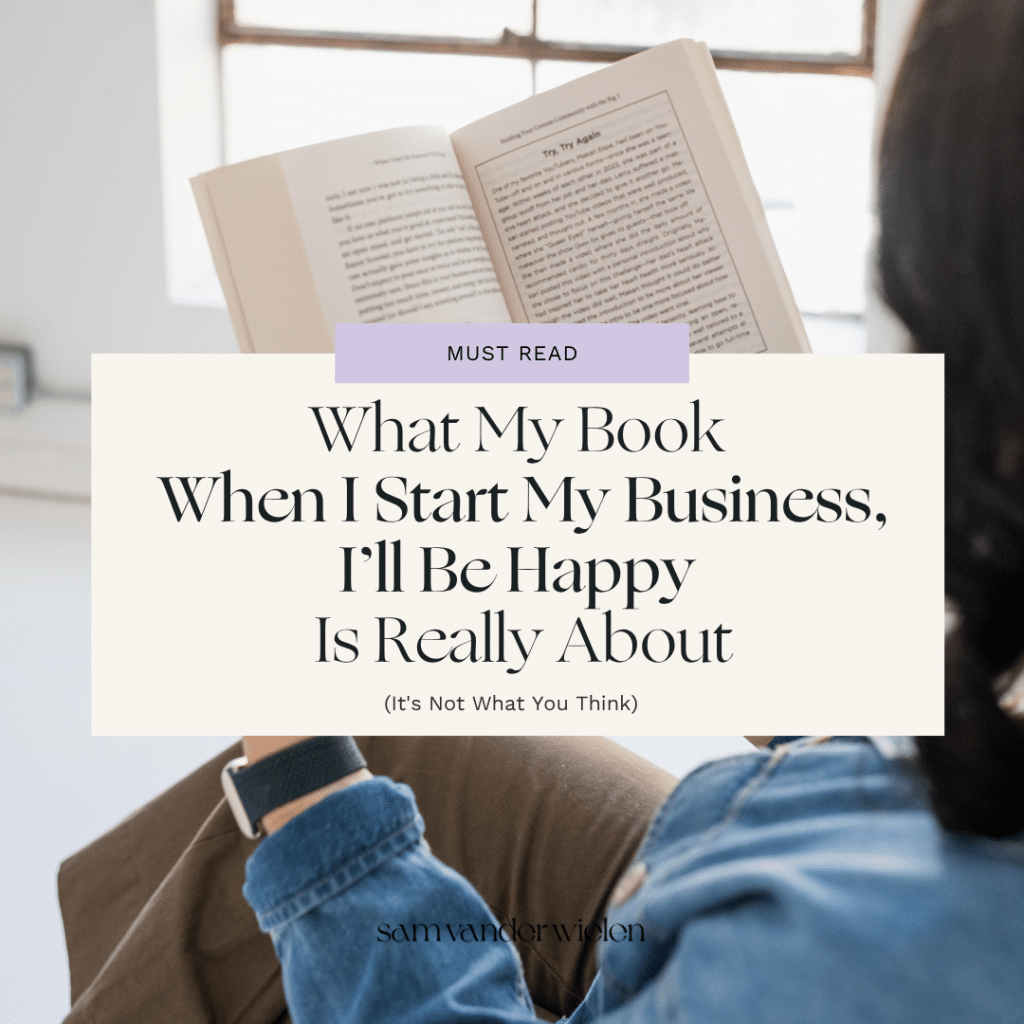
- Get Sam’s book, “When I Start My Business, I’ll Be Happy”
If you’re ready to legally protect and grow your online business today, save your seat in my free workshop so you can learn how to take the simple legal steps to protect the business you’ve worked so hard to build. Click here to watch the free workshop so you can get legally protected right now!
LEARN:
- Read Sam’s Blog for the latest legal tips, podcast episodes & behind the scenes of building her seven-figure business.
- Listen to our customer stories to see how getting legally protected has helped 1,000s of entrepreneurs grow their own businesses.
CONNECT:
- Join the Free Legal Workshop to learn how to get your business legally protected today!
- Follow Sam on Instagram for legal tips, business-building advice & daily food + Hudson pics
- Like us on Facebook
- Follow my podcast, On Your Terms®, on Instagram so you catch all our episodes
- Subscribe and follow on all podcast platforms and activate notifications for new episodes
FAV TOOLS:
- Kajabi // use Kajabi to sell your course, program, or even build your entire website. Get a 30-day free trial with my link.
- SamCart // what I use for my checkout pages and payment processing and LOVE. And no, not because it’s my name.
- ConvertKit // what I use to build my email list, send emails to my list, and create opt-in forms & pages
DISCLAIMER: Although Sam is an attorney she doesn’t practice law and can’t give you legal advice. All episodes of On Your Terms® are educational and informational only. The information discussed here isn’t legal advice and does not intend to be. The info you hear here isn’t a substitute for seeking legal advice from your own attorney.
© 2022 Sam Vander Wielen LLC | All Rights Reserved | Any use of this intellectual property owned by Sam Vander Wielen LLC may not be used in connection with the sale or distribution of any content (free or paid, written or verbal), product, and/or service by you without prior written consent from Sam Vander Wielen LLC.
AFFILIATE LINKS: Some of the links we share here may be affiliate links, which means we may make a small financial reward for referring you, without any cost difference to you. You’re not obligated to use these links, but it does help us to share resources. Thank you for supporting our business!
–
 0 Comments

So What Do you think?